https://doi.org/10.36253/bsgi-7537
Initiatives for Territorial Regeneration Under the Prism of Social Innovation: A Comparison Between Alpujarras (Spain) and Monti Dauni (Italy)
Iniziative per la rigenerazione territoriale sotto il prisma dell’innovazione sociale: una comparazione tra Alpujarras (Spagna) e i Monti Dauni (Italia)
1 Dipartimento di Economia, Università di Foggia, Foggia, Italia
2 Dipartimento di Geografia Umana, Università di Granada, Granada, Spagna
E-mail: marilena.labianca@unifg.it; favalver@ugr.es
Abstract. In the context of development policies favoring marginal areas, the LEADER approach represents one of the most innovative tools for regenerating rural areas throughout Europe. It considers the territory in its complexity and uniqueness. This emblematic change inevitably goes, hand in hand with the downward transfer of powers enabling the transition from a top-down to a participatory bottom-up approach to take place. Several European experiences document successful practices in neo-endogenous rural development and the promotion of social innovation under the LEADER lens and this thanks to the local capacity to combine internal resources, human and social capital with scientific knowledge and technical inputs, to coordinate internal and external actors, all this contributing to the development of regeneration projects in the rural areas. This study aims to analyze the effects of this local development approach in the regeneration of two marginal areas considered significant in Spain and Italy. The methodology is based on the in-depth and qualitative study of two selected projects. The research method is a preliminary attempt to evaluate the dynamics and processes of territorial regeneration in two areas at different stages of the process, more mature in Spain, and more recent still ongoing in Italy. Regenerative, relational and transformative dynamics are key elements for understanding the meanings and functions of these neo-endogenous initiatives and, therefore, for encouraging the concrete implementation of community indications on a local scale.
Keywords: marginal rural areas, neo-endogenous practices, social innovation, regeneration projects.
Riassunto. Nell’ambito delle politiche di sviluppo per le aree rurali marginali, l’approccio LEADER rappresenta uno degli strumenti più innovativi per la rigenerazione territoriale in Europa, in quanto considera il territorio nella sua complessità e unicità. Questo cambiamento emblematico, inevitabilmente, è andato di pari passo con il trasferimento di poteri verso il basso favorendo la transizione da un approccio top-down a un approccio partecipativo bottom-up. Numerose esperienze europee documentano pratiche di successo nello sviluppo rurale neo-endogeno e nella promozione dell’innovazione sociale nell’ottica LEADER e questo grazie alla capacità locale di combinare risorse interne, capitale umano e sociale con conoscenze scientifiche e input tecnici, per coordinare comunità e risorse (interne ed esterne), contribuendo allo sviluppo di progetti di rigenerazione delle aree rurali. Questo studio si propone di analizzare gli effetti di questo approccio di sviluppo locale nella rigenerazione di due aree marginali considerate significative in Spagna e Italia. La metodologia si basa sullo studio approfondito e qualitativo di due progetti selezionati. Il metodo di ricerca costituisce un tentativo preliminare di valutare le dinamiche e i processi di rigenerazione territoriale in diverse fasi del processo, più maturo in Spagna, e più recente ancora in corso in Italia. Dinamiche rigenerative, relazionali e trasformative sono elementi chiave per comprendere i significati e le funzioni di queste iniziative neo-endogene e, quindi, per favorire la concreta attuazione di indicazioni comunitarie a scala locale.
Parole chiave: aree rurali marginali, pratiche neo-endogene, innovazione sociale, progetti di rigenerazione territoriale.
Contents
2. Social Innovation and regeneration processes in marginal rural areas
2.1 Understanding territorial regeneration processes starting from the nature of social innovation
2.2 Dynamics of territorial regeneration processes
4.1 Monti Dauni Area (South of Italy, Apulia region)
4.1.1 The case of the project “Visit Monti Dauni”
4.2 Alpujarras Area and Soportújar Municipality (South of Spain, Andalusia region)
4.2.1 The case of Alpujarras: Witchcraft, Soportújar
4.2.2 Main results from the analysis
1. Introduction
In recent years, social innovation has progressively been recognized as a central role in development policies, in particular for disadvantaged rural areas, and in the context of the LEADER approach (in French “Liaison Entre Actions de Développement de l’Économie Rurale”)1, under the Common Agricultural Policy (Shucksmith 2000; Saraceno 2013; Bock 2016; Labianca 2016; 2021a; Cejudo, Labianca 2017; Pinilla, Sáez 2021; Navarro et al. 2022).
The focus of this approach is the involvement of local people and organizations as development actors rather than beneficiaries, providing them with the tools to contribute to the future development of their territories, through the establishment of mixed partnerships of public, private and civil sector actors called Local Action Groups (LAGs). Local Action Groups are the main tool for applying the LEADER approach for territorial development, directly involving local representatives in the development and elaboration of local strategies, in the different stages of decision-making and in the allocation of resources. Nowadays, there are 2.894 LAGs in Europe covering a rural population of 170 million (62%) (EC 2024), this explains the strategic role of the program, especially for marginal rural areas.
In Europe, the problematic of marginal rural areas derives from depopulation, lack of essential and organizational services, territorial/human capital, and innovation (Espon 2013; 2017; Copus, de Lima 2015; Cejudo, Navarro 2020; Dax, Copus 2022). Although processes of demographic decline are at the center of contemporary policies and research, they do not occur in isolation. There are associated processes of economic decline, particularly social disarticulation, which combine in a complex spiral of territorial weakening, well represented by the concept of shrinking. Thus, in many instances, rural contraction, ageing and depopulation are “dominant trends” in rural regions, leading to a worsening circle of marginalization (Esparcia 2024).
In addition to this, the phenomenon of “social and demographic decapitalization” increasingly distances these spaces from their recovery and significantly hinders the application and effectiveness of rural development policies (Leco et al. 2017, 97). A substantial decline in human and social capital is generating multiplier and negative territorial impacts, effectively compromising the capacity of communities to act and regenerate (Bock 2016; Labianca, Navarro 2019; Cejudo, Navarro 2024; European Parliament 2021a; 2021b).
In this context, the territories require major innovative efforts in terms of policy, governance, place-based initiatives and the development of new skills (OECD 2006; Labianca et al. 2016; 2021a; EC 2019; 2020c). Although there is still a flourishing scientific debate regarding the interpretation of social innovation, major difficulties lie in its concrete application, especially on a local scale, where specific conditions of each territorial context can greatly influence the success or failure of these initiatives. Additionally, it is often difficult to fully evaluate the impacts on these territories, as assessments typically focus solely on economic and tangible nature, neglecting the intangible ones that usually bring long-term outcomes (Labianca 2021a).
These problems have been addressed within the Common Agricultural Policy (CAP) through the LEADER approach, that is mainly based on social innovation as one of its main elements of transformation and development tools for rural areas in Europe. The original objective of this community initiative was to create innovative projects for rural development (EC 2006, 7). Since its introduction in 1991, LEADER has introduced innovative tools for rural areas, so much so that it was conceived as a laboratory of experimentation and social innovation, where Local Action Groups are the main actors promoting it. As confirmed by the most relevant literature on various experiences across Europe (among others Murdoch 2000; Dargan, Schucksmith 2008; Ward, Brown 2009; Dax et al. 2016; Cejudo et al. 2020) and key programming documents (EU Rural Observatory 1997; EC 2006; 2009; 2013), LEADER plays a strategic role for the future of rural areas. As stated by European Commission (2006) in the basic guide: “It can play an important role in encouraging innovative responses to old and new rural problems and becomes a sort of ‘laboratory’ for building local capabilities and for testing out new ways of meeting the needs of rural communities. It has generated valuable results in many rural areas in the EU Member States and could play a significant role in assisting rural areas in new and future EU Member States to adapt to today’s changing realities” (EC 2006, 4).
The LEADER approach, although between lights and shadows, can be considered one of the most innovative tools for rural development in marginal areas, as evidenced by various European experiences (Schucksmith 2000; Dax 2006; Dargan, Schucksmith 2008; Labianca 2016; 2021; Cejudo, Labianca 2017; Navarro et al. 2022; Cejudo et al. 2024). In fact, defined as a “laboratory for innovation” (Dargan, Schucksmith 2008, 279), fostering social innovation (Dax et al. 2016; Lacquement, Chevalier 2024), it can encourage the strengthening of partnerships and the development of local and extra-local networks, supporting community engagement and skills acquisition for the mobilization of local potential. It is considered a driving force in seeking new or improved solutions, and in implementing innovative approaches and strategies for the development mainly of marginal areas, encouraging collaboration among various actors and across different policy areas.
LEADER is recognized as having a crucial role in the development of marginal rural areas, for the ability to trigger new approaches, facilitating the exchange of ideas and objectives, stimulating innovation (new knowledge, products, services, governance), in particular by soliciting new methods and tools connecting agriculture, forestry and the local economy, thereby contributing to the diversification of economic activities and the strengthening of the socio-economic context (Labianca 2021a; 2023). Central to this process is the awareness and recognition of the value of territorial potential and diversity in Europe, representing an important novelty compared to traditional rural policy measures, placing particular attention to the intangible components of the territorial context thus influencing the methods, the approach and style of the strategy. Therefore, territories and actors are encouraged to take an active role rather than remaining passive participants.
Castaldi and Mendonça (2024) specifically discusses about “place-based intangibles” considered crucial for regional development, particularly traditions and knowledge that serve as “regional endowments”, however they are not static nor deterministic, they can be the result of a shared commitment and for the start of a new path. Therefore, the resources embedded in a place can be managed, used dynamically to project and repose the place in new directions and this is even more important in marginal, rural and peripheral regions. These processes often result from the involvement of multiple stakeholders and agencies which, thanks to the activated synergies, can achieve high-quality regional development with a long-term perspective.
But, in this sense, the major difficulty is to evaluate and monitor the intangibile impacts of the LEADER approach, where traditionally importance has been given mainly to verify the status of implementation with focus to quantitative indicators of predominantly economic performance. As stated in the latest periodic evaluation report of the impacts of LEADER in Europe (EC 2024), it is necessary to draw lessons from the results of the mid-term evaluation, although further improved in the CAP 2023-2027, still do not allow to detect, monitor and evaluate the “added value” of LEADER with regard to the intangible aspects and the impacts generated in the territories.
Starting from these assumptions, this study focuses on social innovation as a transformative process that, under certain conditions, could encourage territorial regeneration, and on the role that the specificities of territorial contexts have on the success/failure of the application of LEADER policies at local level in terms of territorial potentialities and diversity present in Europe. To achieve this, the study proposes a qualitative methodology of analysis applied to two projects implemented under the EU’s LEADER program, in two territorial contexts in marginal rural areas belonging respectively to Italy and Spain starting from the analysis of the combined role of factors that, together with depopulation, determine the decline and marginalization of these rural areas.
The study areas have been constantly observed by a network of researchers in different European countries who are involved in analyzing the LEADER experiences and the territorial impacts produced over time2. The approach adopted in the analysis is an evolutionary one to better understand how territorial regeneration can be achieved by focusing on the actors who guide these processes along their evolutionary trajectories. This perspective considers various constraints, the current context, and potential prospects (among others see Harris 2021; Bruun Ingstrup et al. 2024). The interviews conducted regard the projects identified by qualified actors as being capable of fostering processes of innovation and territorial regeneration, in these different experiences, one more mature in Spain, the other more recent, still in course, in Italy.
This contribution is organized into specific sections, reflecting the various phases of the research as indicated:
1) definition of the concepts of territorial regeneration and social innovation, emphasizing their main features. This is achieved by combining a literature review and the results of previous research that analyzed the best practices about social innovation in Europe (see Navarro et al. 2022);
2) conceptualization of the territorial dynamics triggered by innovation/social innovation practices through literature review;
3) development of a conceptual and methodological framework to analyze the projects of territorial regeneration to understand their nature, dynamics and where possible, the territorial impacts. The methodological framework (as detailed in Table 2) integrates results from the previous phases and was used for the elaboration of interviews with privileged local actors, having a key role of responsibility for local development strategies. These actors play significant roles for in-depth knowledge of the contexts in which they operate and of the path of place over time. Specifically, interviews were conducted with Directors, Presidents and technicians of the LAGs in the two study areas in Spain and Italy. Firstly, these actors were asked to identify the most significant territorial regeneration project and then to describe its main dynamics, following the framework structure and using the narrative form of the Interpretative Phenomenological Analysis (Smith, Osborn 2008; Pietkiewicz, Smith 2014);
| Main Dynamics | Social innovation as a process of territorial regeneration |
|---|---|
| Generative: nature of innovation (beneficiaries, time, operational characteristics, capabilities and main changes) | Ways to respond to new challenges and to those of territorial context Local transformation processes (type and nature) Models of activation, management and enhancement of local resources Ways of organizing/involving the local community in the decision-making process Forms and methods for benefits in favor of the territory and not individual actors Complexity, continuity and territorial extent of the initiative |
| Relational: actors and networks | Dynamics of forms of cooperation (actors, evolution, thickness) Type of collaboration and cooperation networks Network thickness (variety, diversity of actors, local community involvement) |
| Transformative: territorial added value and impacts (compared to the initial situation) | Awareness, re-appropriation of local resources and planning Changes in the behaviour of local actors Cultural, socio-economic, institutional changes Institutional and collective learning Increasing people´s ability to engage in cultural interaction and exchange Involvement of a plurality of actors, sectors in an integrated and strategic way |
4) analysis of the national significance, of the socio-economic characteristics of the study areas. This overview of the territories included searching, combining and analyzing the main significant data to explain the relevance of the case study on a national scale and to highlight the main local issues and dynamics;
5) analysis of the two projects in the implementation phase, through the answers to the interviews. Finally, an analysis of two projects currently in the implementation phase was carried out based on responses from the interviews.
2. Social Innovation and regeneration processes in marginal rural areas
2.1 Understanding territorial regeneration processes starting from the nature of social innovation
Analysis of regional innovation systems is an open and debated question in scientific and policy fields, driven by a growing interest in innovation as a competitive advantage and the need for new policies to address inequalities and regional disparities (Asheim et al. 2011). It has evolved in three main versions over time, from a Eurocentric, static production-driven approach, to a more flexible, dynamic and entrepreneurial one, up to the most recent, where it is recognized that regional innovation is an evolutionary process, typical of complex adaptive systems in which processes such as co-evolution, self-organization, path dependence and interdependence, relationships, variety and transversality are fundamental (Cooke 2021).
The concept of territorial regeneration is complex and somewhat ambiguous in the literature due to different spatial forms and practices (Pierson, Smith 2001; Atkinson 2002; Spagnoli 2022; Mykhnenko 2023). This complexity also affects its applications, along with the associated territorial dynamics and impacts. The processes of territorial regeneration aim to address the decline in marginal rural areas, by improving living conditions, and fostering sustainable development and community engagement (Bowers 2018). Definitively, territorial regeneration in rural areas refers to the processes and strategies aimed at enhancing the economic and social conditions of remote and deteriorated rural areas, encompassing rural revitalization and initiatives to reinvigorate local communities (Nosek 2017). According to Woods (2006), rural regeneration reflects a paradigm shift, with a focus on bottom-up approach, characterized by small community-led initiatives drawing on endogenous resources. Considering this context, what are the main characteristics of territorial regeneration projects, and how can we identify and analyze them on a local scale?
Territorial regeneration finds one of its triggering factors in social innovation, in fact the concept of social innovation can provide important elements for these issues. Social innovation encompasses multiple phases and complex dynamics that unfold at the local level, as widely explored by Neumeier (2012) who highlights its ability to reorganize resources and actors around a community shared goal. In fact, social innovation, according to Neumeier (2012, 65) “can be generally understood as a change in the attitudes, behaviours or perceptions of a group of people joined in a network of aligned interests that, in relation to the group’s horizon of experiences, leads to new and improved ways of collaborative action in the group and beyond”. Navarro et al. (2022), through the analysis of significant case studies in Europe, showed that social innovation is a process/engine of territorial regeneration, particularly highlighting the extraordinary transformative capacity that such innovations can play in marginal areas under the LEADER approach. The authors emphasize the role of the local scale and note that the most significant changes and innovations often arise from within communities, thus reaffirming the value of bottom-up approaches.
In this context, participation in social innovation is crucial, as it fosters networks of actors and extensive collaboration. In rural areas, processes of territorial regeneration have been started and tested through the participatory LEADER approach, making it important to understand the territorial impacts. In the case of Secco et al. (2017), LEADER includes elements that are generally considered to support social innovation. Classical characteristics of this approach, such as based development strategies, cooperation and networking are considered catalysts of social innovation too. According to Dargan and Schucksmith under the LEADER (2008, 288): “Innovation has been understood in terms of social innovation (to encourage local linkage and collective learning cultures) and cultural innovation (to improve the rural milieu), rather than, in the sense of science policy and technological innovation”. Esparcia (2014) established that innovative projects tend to rely on the support of an extensive network of actors and that public actors have a strong presence in innovative projects, at least during the early stages. Thuessen and Nielsen (2014) proved that democratization and bottom-up decision-making are the more relevant effects of these initiatives at local level. In the same sense, Vercher et al. (2022) noted that actors´ attitudes and aspirations about community needs influence the degree of the radicalism of social innovation; the way social innovations challenge the status quo of local communities is the key in distinguishing radical and incremental processes; and that radical social innovation usually requires longer adoption period and can bring about conflicts.
For Nordberg et al. (2020), an effective rural development model has to combine social innovation, community involvement and a quadruple helix approach. Social innovation networks have the potential to create new development opportunities for local communities and engage latent communities. Through the social innovation process, rural communities can collaborate with regional organizations and communities from outside and, in successful cases, introduce key tailored elements for innovation (Pylkkänen et al. 2015; Navarro et al. 2020; Labianca 2023). However, as noted by Dax et al. (2016), the bottom-up approach and support for social innovations are facing challenges and could be at risk.
The answer to questions related to the role and dynamics of social innovation in territorial regeneration processes requires an understanding of the connections between regeneration, LEADER and social innovation and, on the other hand, to study the dynamics underlying these processes, particularly, in rural and marginal areas. In this context, socio-economic innovation in the LEADER approach is oriented to transform marginal rural areas (Maccallum et al. 2009; Neumeier 2012; Labianca et al. 2018; 2020; Navarro et al. 2022) and not only concern processes, products but territories in their complexity and diversity (Schucksmith 2000; Cloutier 2003; Moulaert et al. 2005; 2008; Dargan, Schucksmith 2008; Mcallum et al. 2009; Howald, Schwarz 2010; Neumeier 2012; 2017). For Chatzichristos, Perimenis (2022, 1) “the evaluation results indicated that LEADER becomes a worthwhile investment when a wide range of its social outflows are considered. Additionally, to enhance its social value, a level of maturity and a solid economic basis must be first achieved. In this context, continuous monitoring and evaluation become crucial”.
Based on the literature review and the discussion above, this research considers two dimensions of social innovation. Firstly, social innovation is conceived as a co-evolutionary process of long-lasting learning, in which it is a process of construction of the territory, a daily practice intimately linked to the community, to the territorial context from which it arises. It relies on the reflective capacity of various actors, resources, and pathways, making it essential for understanding local strategies, dynamics, governance models, and processes. Secondly, the territorial effects generated by social innovation. These include organizational changes in terms of more effective procedures and long-term solutions (Cloutier 2003; Moulaert et al. 2005; Neumeier 2012; Lacquement, Quèva 2016; Labianca et al. 2020; 2021a). Additionally, social innovation fosters “increased territorial integration” through various forms of coordination and networking among the actors involved in economic development and management (Fontan et al. 2004). In fact, according to Neumeier (2012) social innovation can generate territorial reconfiguration, reorganization and the transformation or identity consolidation.
Table 1 synthesizes the main characteristics of social innovation, as identified in the literature review and adopted in this study, also highlighting the prerequisites for the effective implementation at the local scale. The following paragraph will address the complex dynamics of these processes and the effort to understand how to study and analyze them.
| What? | Nature | Innovative features | Process/requirements | Main goals | Main outcomes |
|---|---|---|---|---|---|
| A collective process of learning and creating knowledge for community wellbeing, new development model. Change in the attitudes, behaviour, perceptions of a group of people joined in a network of aligned interests that leads the group to new and improved ways of collaborative actions and beyond |
Not a specific form Organizational Procedural Practices Processes Services Tangible product Multisectoral/integrative approach |
Relative and extraordinary (user, context, application) Modification of the components on which the system is based (values, beliefs, representations, tools/know how, rules) Producing or enhancing social capital Deep territorial changes Focusing on local needs but especially on asset building |
Integral part of the process Learning and knowledge Empowerment and learning Diversity participation Cooperation of actors (multiactors, strategic multidisciplinary, flexible positions…) |
Community and individual wellbeing Better quality of life Resolution of current problems/ prevention of future problems / local aspirations |
Respond to needs more effectively than preexisting alternative Quality/ long term solution New and improved means of collaborative action New governance dynamics/ structures Empowerment and learning New asset building |
2.2 Dynamics of territorial regeneration processes
The clarification regarding the nature of the innovation connected to territorial regeneration processes requires an in-depth study of the dynamics that are triggered in these processes. In fact, it is essential to verify which contextual conditions allow these innovations to gain territorial significance in terms of their scope, duration, transformative capacity, and changes. In the review of literature, discussed in the previous paragraph, an interesting, targeted study, through the analysis of European best practices (Navarro et al. 2022) made it possible to identify the characteristics of social innovation precisely in terms of generative and regenerative capacity. These concrete experiences highlighted the role of specific clusters too.
About dynamics, a relevant contribution, in the field of evolutionary and institutional economic geographies can be found in the research by Harris (2021). The author focuses on a new approach to understanding institutional clusters, their configurations and evolution. The author outlines, through analysis of the literature on innovation, clusters, phases, processes, and key actors in territorial transformation.
The contribution investigates a question hardly addressed in the scientific debate. The author points out that in the evolutionary processes of innovative clusters, little attention has been given by literature to the role of actors, since they can mediate the evolutionary trajectories of clusters, prevent negative lock-in and facilitate updates within the cluster.
The need for a more “actor-centric approach” to understand cluster evolution is an open question. Recently, in the field of evolutionary economic geography, there have been ongoing debates regarding the role of actors in path creation and the development of new trajectories, trying to understand how actors, leveraging pre-existing conditions, can create new paths or bring radical changes through their actions (Hassink et al. 2019; Harris, 2021; Bruun Ingstrup et al. 2024).
According to Harris (2021, 444) “it is important to track the ongoing evolution of key actors, their relationships and behaviors, this provides an understanding of how actors can continue to drive the evolutionary trajectories. Thus, tracing the ongoing evolution of the key actors, their relationships and behaviours, will provide an understanding of how actors can continue to drive the evolutionary trajectories of clusters”. But “not all actors have the same ability to enact transformative changes in regional development, and so the actors (and their capabilities) present will affect not just the potential for change but the type of change that occurs” (Grillitsch, Sotarauta 2019; Harris 2021, 445). Therefore, from the analysis of Harris’s research (2021), it is possible to identify three main dynamics connected with processes of territorial regeneration:
1) generative dynamics, which pertain to the nature of innovation, especially social;
2) relational dynamics, concerning the actors, networks, processes and forms of collaboration;
3) transformative dynamics, which consider the territorial impacts produced and deriving from the projects and qualified in terms of added value.
The author explains the main factors necessary to understand the evolution of a cluster, by innovating both the methodological and conceptual framework, referring to dynamic and non-static clusters, moving beyond the traditional, sectoral aspects characterized by a deterministic approach. Instead, he expands the research scope to include cultural, relational, and institutional dimensions. He proposes a review of recent conceptual developments on clusters, from an evolutionary and institutional point of view in the context of economic geography, explaining the stages of their evolution, introducing the new concept of “institutional cluster configurations”. The latter are defined as the combination of shared goals, behaviors, and relationships between the actor involved. In fact, by tracing the evolution of these territorial configurations, it is possible to have information for a better understanding of how the actors guide the clusters in their evolutionary trajectories.
Therefore, “institutions are not a priori spatial constructions, but instead generated by actors in response to their socioeconomic challenges”. Furthermore, actors and their institutions are conditioned and constrained by the “institutional thickness” of the region in which they are located, “but do not necessarily embrace those formal rules and informal conventions”, then clusters of actors can influence the institutions formed through their goals and actions, in the process of forming an institutional configuration of the cluster that will influence the availability of externalities and provide (dis)advantages to local firms.
This means identifying the actors, but even more decisive, understanding their goals, the capacity to pursue them and the ways of sharing and realizing them (Harris 2021, 445). It is a very difficult task to understand, especially the composition of these actors, their ability to implement transformative changes in regional development and change processes. This approach of relational type applied to institutions is innovative because it provides significant keys for interpreting the processes of change, in which the actors are considered real engines of the evolution of cluster in a path-dependent trajectory. In this way, it is possible to trace configurations of the institutional cluster according to evolutionary trajectories. It is possible to conceive of the key actors as those who move from initial preconditions, the latter often being fundamental for starting new paths. Thus, these configurations serve as prerequisites for future path development cycles.
3. Method of research
Studies analyzing the impacts of projects financed or conducted under the LEADER approach have primarily relied on quantitative methods (see among others, Dax, Oedl-Wieser 2016; Nieto, Cárdenas 2017; Konečný 2019; Furmankiewicz et al. 2021). This research proposes a qualitative method aimed at capturing the intangible aspects of these initiatives. The method is grounded in a literature review and the research conducted by Harris (2021), from which analysis, three main types of dynamics emerge-generative, relational, and transformative—that characterize processes of territorial regeneration. To detect these complex dynamics, it was decided to use the Interpretative Phenomenological Analysis (IPA) methodology for interviews conducted with specific privileged actors to gain valuable insights.
This methodology was applied for the first time in the two cases study, moreover the innovative aspect of this research is not represented by the administration of the interviews to privileged actors, but rather by the conceptual framework reported in Table 2, led to the analysis of the selected projects. Table 2 combines both the results of the literature review about social innovation and regeneration processes, and the dynamic aspects of regeneration processes, discussed by Harris (2021).
The interviews were structured as open questions, following the framework outlined in Table 2, based on themes corresponding to the three main dynamics (generative, relational, transformative). Compatibly with the qualitative research methodology to understand how the events were experienced and the meaning attributed to them, we used the Interpretative Phenomenological Analysis (IPA) (Smith, Osborn 2008; Pietkiewicz, Smith 2014). By using the narrative form typical of the IPA, we explore and detail how participants make sense of their personal and social world connected to their experience, meanings, and events.
In particular, the interviewees, aimed to convey the personal experience and perception through an individual account of events, and this required a dynamic process of reconstruction trying to understand the “insider’s perspective” and process of the interpretative activity. In fact, the primary goal in using IPA is to investigate how individuals make sense of their experiences, trying to highlight how things appear to individuals, in this way the essential components of phenomena or experiences that make them unique or distinguishable from others. Therefore, the interviewees can talk about objects and events based on their own experience and language. This meant that the interviews were quite long in a dynamic process with an active role of the researcher who, through interpretative activity, aimed to give sense of the subject’s personal world. This usually requires a process of “dual interpretation” in which one tries to understand how an experience (object or event) is lived from the point of view of the participant (Smith, Osborn 2008). Furthermore, IPA was found to be consistent with bringing out history, the evolutionary processes, the paths of the territory and the role of the actors.
This type of interview, due to the time required and the depth analysis, was administered to the actors responsible for the project development and implementation (actors aware of different aspects and phases of the project’s realization), therefore at least the president, the director and the technician/s of the Local Action Group. In the Spanish case, the interviews were addressed to six key actors: the main facilitator (the manager) and the main decision-maker, the president, in the case of the LAG of Alpujarra Granadina; the major and the tourism councillor of the municipality of Soportújar; one of the technician of the consulting company elaborating the strategic touristic plan, and the tourist guide of the village.
The interview always started with the question of identifying, according to one’s own experience and point of view, the territorial regeneration project considered most significant, then following the structure of Table 2, representing the fundamental tool to conceptualize the study and the interviews to be administered, showing the main characters and dynamics of the regeneration processes.
Particular attention was paid to the initial conditions of the territorial context, the identification of the project deemed significant for the territory, telling the story of the project and the actors involved, the dynamics, the progress achieved, the continuity/coherence/functional and strategic connection with other projects carried out in the same territory. For relational dynamics, it was also asked a draft of a sociogram, highlighting the profiles of actors and their roles.
Special emphasis was placed on describing the dynamics of forms of cooperation (which actors involved, the evolution of the process, thickness), specifying the type of collaboration and cooperation networks. Finally, regarding transformative dynamics, the main changes produced by the project, both tangible and intangible, indicate whether they were adaptation projects (knowledge gained elsewhere and replicated in the territory), emergency solutions (response to urgent situation, challenges) or radical and complex changes (significant changes from previous practices, experiences, knowledge etc.).
4. Study areas
The selected areas, in Italy the Monti Dauni in Apulia region and in Spain the Soportújar in Andalusia region, are characterized by peripherality and rurality within the European context, similar geographical, socio-economic, structural characteristics, growing depopulation, ageing of the population, lack of basic services, low valorization of quality productions and local resources, subsistence agriculture and little valued strongly assisted by CAP subsidies, significant previous experience of LEADER programs, historical coincidence in different local intervention strategies and successive attempts at territorial cohesion over time.
The study areas are significant for many reasons: first for the spatial scales (municipal in the Spanish case, and sub-regional in the Italian one); second for the different level of maturity of the projects (more mature in Spain and at the beginning phase of the process in Italy) and third for common characteristics linked to marginality also according to national official classification.
The sections below provide a brief overview of the two areas considered, an essential phase for carrying out the interviews and understanding the dynamics and impacts deriving from territorial regeneration projects. As detailed below, some selected indicators take into consideration the main socio-economic aspects, trying to combine the most recent data, and drawing comparisons over time where possible. These descriptions and the related indicators are based on the effective availability of data and on the main characteristics emerging.
It is important to note the significant differences in territorial scope between the two analyzed territorial regeneration projects located in these territories. The Italian case, “Visit Monti Dauni” project involves 29 municipalities and a population of 54,403 inhabitants and belongs to the Inner Area of the Monti Dauni, one of the first 72 pilot areas of the National Strategy for Inner Area in Italy (Agenzia per la Coesione Territoriale 2014). In the Spanish case, “Witchcraft of Soportújar” project, involves one municipality but on which various projects and strategies of national importance converge.
4.1 Monti Dauni Area (South of Italy, Apulia region)
The Italian case study is placed in the South of Italy, specifically the Monti Dauni Area in the Apulia region (province of Foggia). It can be considered a national and regional representative case. In fact, during the current programming cycle 2014-2022, it assumes significant importance for various reasons on national and regional scale. Firstly, for the stability and continuity of the partnership that distinguishes various cooperation and programming experiences and tools developed over time (Labianca et al. 2014; Labianca 2014a; De Rubertis, Labianca 2017). Furthermore, this territory is classified as “rural area with overall development problems”, then it has been identified as one of the initial pilot areas of the National Strategy for Inner Areas in Italy (which encompasses over 1.060 municipalities). The Monti Dauni area is characterized by the coincidence of two multilevel strategies: the national strategy for inner areas and the local strategy under the rural development plan, as a LEADER area represented by a Local Action Group (Fig. 1), representing a pilot experience on a national scale. As shown in Figure 1, it is possible to highlight the strategic and planning coincidence, by observing the boundaries of the LEADER, non-LEADER, pilot inner area of Monti Dauni and their strategic overlapping.
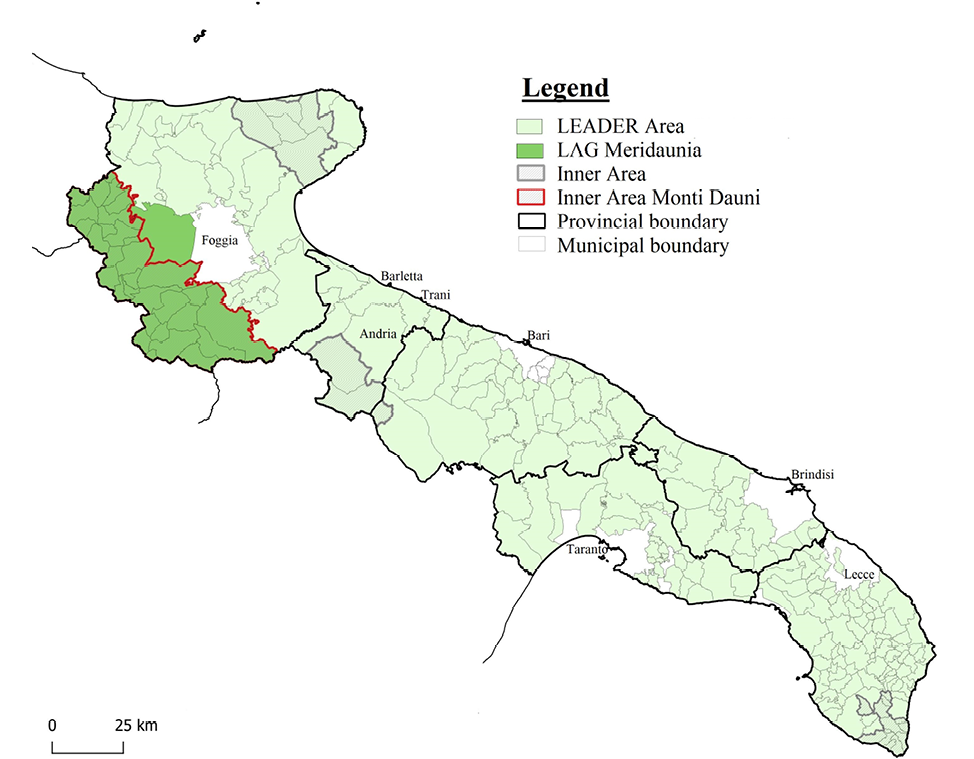
The Apulia region is defined as predominantly rural, except for some major municipalities coinciding with the provincial capitals (non-LEADER areas). It can be noted that for the area under study, the LAG of Meridaunia (identified as a LEADER area) coincides with the inner area outlined by the National Strategy. Notably, the only municipality not classified as peripheral in the national strategy is included in the local strategy as an indirect beneficiary3.
On an administrative level, the area consists of 29 municipalities, characterized by a low average population density, 28 of them fall within the Daunian Sub-Apennine which, compared to the rest of the region, has a specific physical and anthropic individuality, primarily due to its morphological and geological constitution, with variable morphological and altimetric profiles (compared to the flat and relatively uniform region) predominantly centralized, secondly due to the forms of human settlement, thirdly on the functional level, presenting an extreme weakness, since they are “elementary” centers with a very basic and reduced offer of services, owing the entire area gravitate towards the nearest major centers (Bissanti 1977).
Considering the geo-morphological structure, it is a very impervious area, suffering from the lack or difficulty of internal and external connections (Bissanti 1977; Mannella et al. 1990). Although the Daunia sub-region has historically held strategic importance in the region over the years, it has undergone a progressive isolation due to its morphology, socio-economic and functional peripherality, territorial imbalances also due to the lack of an efficient urban structure, reduced demographic weight aggravated by phenomena of increasing depopulation and ageing mainly due to massive rural exodus (Mannella et al. 1990; Fiori, Varraso 2000; Bozzi 2016; Ivona et al. 2021; Labianca 2021b). All the municipalities exhibit economic and productive marginality, small size and low population density, a dramatic and progressive trend towards depopulation and ageing, especially in the last years (with the population declining from approximately 143,000 inhabitants in 1951 to just 54.000 in 2021) (Tab. 4).
| Territory | Agriculture | Agribusiness | Quality productions | ||||||||||||||||
|---|---|---|---|---|---|---|---|---|---|---|---|---|---|---|---|---|---|---|---|
| Utilized agricultural area (UAA) (2010) (%) | Variation utilized agricultural area (UAA) (1982-2010) (%) | IIA (2002) | IIA (2011) | IIA (2004) | IIA (2013) | Incidence of enterprises with PDO and/or PGI products (2014) | |||||||||||||
| Monti Dauni Area | 71 | -9.6 | 2.1 | 2.9 | 1.7 | 2.2 | 1.1 | ||||||||||||
| Inner Areas in the Apulia region | 65 | -9.7 | 1.6 | 1.9 | 1.3 | 1.6 | 3.7 | ||||||||||||
| Inner Areas in Italy | 39 | -20.9 | 2.0 | 2.0 | 1.7 | 1.7 | 10.1 | ||||||||||||
| Apulia region | 66 | -15.7 | 1.4 | 1.7 | 1.2 | 1.4 | 5.2 | ||||||||||||
| Italy | 43 | -18.8 | 1 | 1 | 1 | 1 | 11.2 | ||||||||||||
| IIA – stands for Index of importance of the agricultural and agro-industrial sector. | |||||||||||||||||||
But in the last programming cycle, particularly within the 2014-2022 Rural Development Plan, a greater role has been recognized by the Region and, with a corresponding greater autonomy and responsibility to development for local agencies (LAGs under the LEADER approach). As confirmed by research (among others: Baldacci 1972; Bissanti 1977; Mannella et al. 1990) and the recent Regional Rural Development Plan (Regione Puglia 2021), the territory presents an historical limited supply of basic services (health, education and mobility) coupled with very negative demographic, economic and employment dynamics. These characters were highlighted by the analysis of the national and regional context which considered the persistence of depopulation phenomena, negative phenomena in the use of the soil (UAA, forest area, hydrogeological instability), the crisis of the productive sector, as well as the organization of education, health and mobility services. The territorial diagnosis carried out revealed a particular weakness emerged in the Monti Dauni Area, which more than other territories in the region fit into the classification of inner areas. To ensure effective planning and governance, LAG’s proposal for the Local Development Strategy must ensure consistency and complementarity with the National Inner Areas Strategy (Regione Puglia 2021).
To emphasize the national significance of this case, we examined some relevant indicators about social and structural conditions and the correlations among them in the municipalities involved (some of them reported in tables 3 and 4). They reveal the persistence of absence/inadequacy of basic services, often simplistically considered linked to the lower economic and entrepreneurial dynamism, generating pervasive and long-term impacts on a social and economic level. The levels of education are closely linked to the socio-economic conditions of families and the availability of basic services; their absence or scarcity represents a significant criticality in the territory in terms of human and social capital. These results confirm the need for strategic, targeted and long-term interventions in the territory in order to reverse the situation of inevitable marginality that would continue to afflict it, even in the presence of significant potential such as the extraordinary naturalistic, historical and landscape heritage which, if adequately exploited, could play a fundamental driver for development and a solution to the exodus, especially from smaller municipalities, of educated young people (Labianca 2023).
The national relevance of the Italian case is confirmed by additional socio-economic indicators (Tab. 3) also highlighted in the selection of inner areas in the National Strategy, revealing important aspects and dynamics. The comparison among the Monti Dauni area, the inner Italian areas, the whole region and Italy for selected indicators highlights the major socio-economic peculiarities of the territory.
| Main indicators | 2011 | 2021 | |||||||||||||||||
|---|---|---|---|---|---|---|---|---|---|---|---|---|---|---|---|---|---|---|---|
| Altitude (m) | 602 | ||||||||||||||||||
| Population (Inhab.) | 60.691 | 54.403 | |||||||||||||||||
| Density (Inhab/ km²) | 31 | 28 | |||||||||||||||||
| Population over 65 and + age (%) | 25.0 | 26.0 | |||||||||||||||||
| Tourism bed places | 1.016 | 1.261 | |||||||||||||||||
| Incomes per capita (average) | 2015 (17.650) | 2021 (18.365) | |||||||||||||||||
| Companies (Inhab. *100)1 | 5.4 | 6.4 | |||||||||||||||||
| 1 Due to the differences in statistical surveys in Italy and Spain, the company data are expressed as the number of local active units. | |||||||||||||||||||
In particular, the strong role of agriculture, in fact over 70% of the utilized agricultural land, the highest value than the other territories and whose variation (1982-2011) very contained (low reduction) confirm the persistence over time of a significant role of the primary sector. The data also supports the importance of the sector in agro-industrial and food with indicators showing growth over time and often above the regional values. Specific weaknesses of the territory emerge in terms of the ability to valorize local productions (through the incidence of enterprises with certified production of quality) compared to other territorial contexts (Tab. 4).
Considering the socio-productive connections with other sectors, particularly tourism, thanks to the extraordinary local resources and the regional investments in recent years, as part of the rural development plans, relations with agriculture and the ability to fully express one’s potential are rather modest. Contrary to expectations, in the face of increasing investments supported by regional government in accommodation facilities (especially non-hotel establishments), by combining data on main tourism indicators over time (in the last ten years) about the movement of tourist flows and the capacity of accommodation facilities, it is possible to highlight a reduction, albeit modest in arrivals (-2.5%), nights spent (-10%) and days of average stay (-0.2). The touristic flows are modest and are still limited to internal ones. The comparison between the two decades reveals an increase in both the total number of accommodation facilities and beds but with a low utilization rate, as evidenced by the low average stay overtime (2.7 nights). However, this increase concerns in most cases the non-hotel structures which include agritourism, bed and breakfasts strongly encouraged by the rural development plan of the region, external community resources, especially in the last years.
4.1.1 The case of the project “Visit Monti Dauni”
The project reported by the main actors as a good practice of innovation and potential territorial regeneration is “Visit Monti Dauni” implemented in the programming period 2007-2013, still in course. About the generative dynamics, this intervention has been the results of the project “Integrated tourism services of the Dauni Mountains” under the regional operational program for Axis 6 which focuses on “Protection of the environment and promotion of natural and cultural resources”, for the competitive repositioning of tourist destinations. The project aims to solve important critical issues concerning the abandonment of small municipalities by young people, the decline of important traditional activities like agriculture and the lack of services capable of enhancing the extraordinary local heritage, the difficulty of networking and exploiting local potential, in particular connected with agriculture. Demographic challenges, including the ageing of the population and the emigration of young people, especially educated people, are largely due to the absence or reduced availability of basic services and on-site care and work opportunities. The main criticalities emerged from interviews confirm the analysis by the Italian Strategy of Inner Area and the evidence of the territorial analysis. The main problems concern the progressive depopulation that this area has experienced since the 1950s and the lack of services, especially tourist ones, although the entire territory has extraordinary potential in terms of naturalistic, landscape, gastronomic and cultural heritage.
The project is made visible through a platform, a portal in which various local actors, in particular small entrepreneurs (about 60) from various sectors, including an organization of local producers, have been put online to make the entire area better known. The virtual platform is a real networking, facilitating tool, made up of actors that the LAG has painstakingly involved in the network project. In fact, in each phase of strategy development, associations, entrepreneurs and local actors have been encouraged and involved in thematic meetings by the Local Action Group with institutions and mayors to discuss the feasibility of the project. All participating operators sell their products and services linked by a basic network and area strategy. It is an idea that arises from the main problems of the territories in which one of the major criticalities was making the potential known, to increase networking among local operators, and to make themselves known and recognized from inside and outside (especially by tourists and by other economic operators).
The direct beneficiaries have increased the services offered, although they are still limited, and concern not only tourists but also the production of goods and related enhancement. It is a project that is the result of a long path over time, considering the initial situation of the territorial context, in which abandonment by young people and ageing prevail with low local opportunities. The project is trying to open the audience of beneficiaries, thanks above all to the additional resources supporting the area during the next programming cycle and to the funds of the National Strategy of Inner Areas, also trying to develop new local capacities to create new networks, innovative contents and ideas for territorial enhancement.
By focusing on relational dynamics, the project introduces a new way, relying on the use of a platform and the field experience of the LAG to connect tourists and local entrepreneurs in demand, and supply of services. However, it has created a new way to connect local operators (until then isolated, poorly informed and non-cooperating with each other and with the outside) with each other and make themselves known to initiate new forms of cooperation and local activation. In fact, if at the beginning of the project, the number of entrepreneurs involved was quite low, the growing climate of trust, sense of collaboration, the constant activity in the field of LAG, are increasing the number of adherents as enterprises, cooperatives and associations.
Clearly the high institutional and programmatic cooperation emerges over time, starting from a notable lack of cooperation/networking between entrepreneurs, associations, consortia, universities and study and research centers, which is lower than the rest of the region. This project is trying to resolve these problems which for years blocked broader initiatives and projects. As far as the local population is concerned, it is a process that has activated certain participation and interest in the part of the community for their territory. As emerged in the interviews, regarding the aspects of functional relations with other institutions and policy areas, the support from regional institutions has primarily been limited to more reporting aspects, largely due to overarching constraints. However, a renewed interest emerges from various actors and tourists who are the result of a long process of building networks and relationships in the area, especially starting from small entrepreneurs. In fact, the latter have gained greater confidence and now are launching innovative processes at the production level, focusing on quality and better connected agri-food supply chains. As argued by the interviewees of the LAG, the more relevant aspect to note is the role of leadership of the local actors, in particular the mayors who belong to the administrative inner area defined in the national strategy. Although the project is the result of a long path, it is recent in terms of development, and it is expected to produce growing results in the coming years.
Specifically, about transformative dynamics now, it is observed an increase in the accommodation facilities, institutional collaboration of the municipalities of the area, associations and local entrepreneurs, and less experts such as universities and research centers. As emerged in all the interviews, the main results concern the greater sense of belonging of the community and above all the entrepreneurs who are increasing the range of products and services offered strongly connected with the resources of the territory.
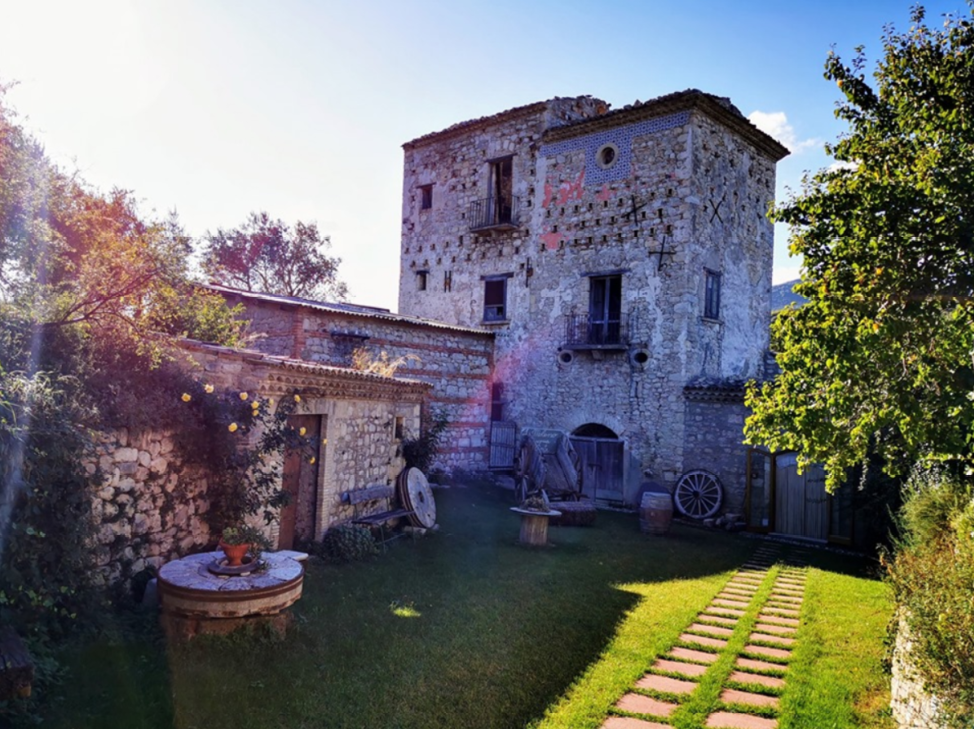
Among the most significant examples is the recovery and valorization of among the most beautiful villages recognized as authentic in Italy, located precisely in this territory such as Pietramontecorvino, Bovino (Fig. 2) or considering the valorization of local productions through single and associated agricultural enterprises, of which one of the most significant examples in the area is the “Terre di Biccari” Consortium. Through specific thematic experiences offered not only to tourists, of art and culture, adventure, wellness, taste, entertainment and nature, various local actors, entrepreneurs, consortia, associations have coalesced around a common objective which represented the main reason for joining the area project. An important aspect is that, as highlighted in our framework, in developing the interview the innovative processes must take into consideration the effective starting situation of the territories. In this case, as also emerged in the interviews, it is a fragile territory that presents various criticalities not only in terms of infrastructures, as declared in the national strategy, but above all socio-economic.
In this case, the main transformative dynamics and territorial impacts concern new forms of cooperation among different actors that are growing together with greater trust in an area destined for abandonment, especially by young people. Even if the flows of tourists are still modest, as emerged in the data and interviews, there is a renewed interest on the part of both the local community and foreigners who, by virtue of new needs for personal and family well-being, also following the Covid emergency, are rediscovering, sometimes even moving permanently, the small villages that characterize this territory. The increase in production activities and services, together with tourists although still modest, bode well, because important interventions are underway that aim at the greater presence of tourism, educational and health services in the area to better connect it also at an international level. The project, proposed as a sort of virtual showcase for the inside and for the outside of the area, opening the area, especially in terms of international cooperation and strengthening, progressively is involving new actors with different expertise. This effort is rebuilding confidence and increasing awareness of local resources.
4.2 Alpujarras Area and Soportújar Municipality (South of Spain, Andalusia region)
Alpujarras is a remote mountain area in the South of Spain, on the south side of the Sierra Nevada Mountain where the LEADER approach has been developed through a long-time trajectory, from 1992 until nowadays, and in which, tourism activity has been one of the main development pillars (Fig. 3). It is an area with a strong geographic and historical identity, placed in the south face of Sierra Nevada, and shaped by deep valleys. This deep rural area shares a traditional agrarian sector, in decadence, and consolidated rural and natural tourism in some municipalities, but others without any relevance to tourism activities. Most of these municipalities have serious problems of ageing, remoteness and depopulation (19 inhab. /Km², year 2021). The municipality of Órgiva has the largest population (3,589 inhabitants), and the total inhabitants of the area are 25,904 inhabitants (Cejudo 2021).
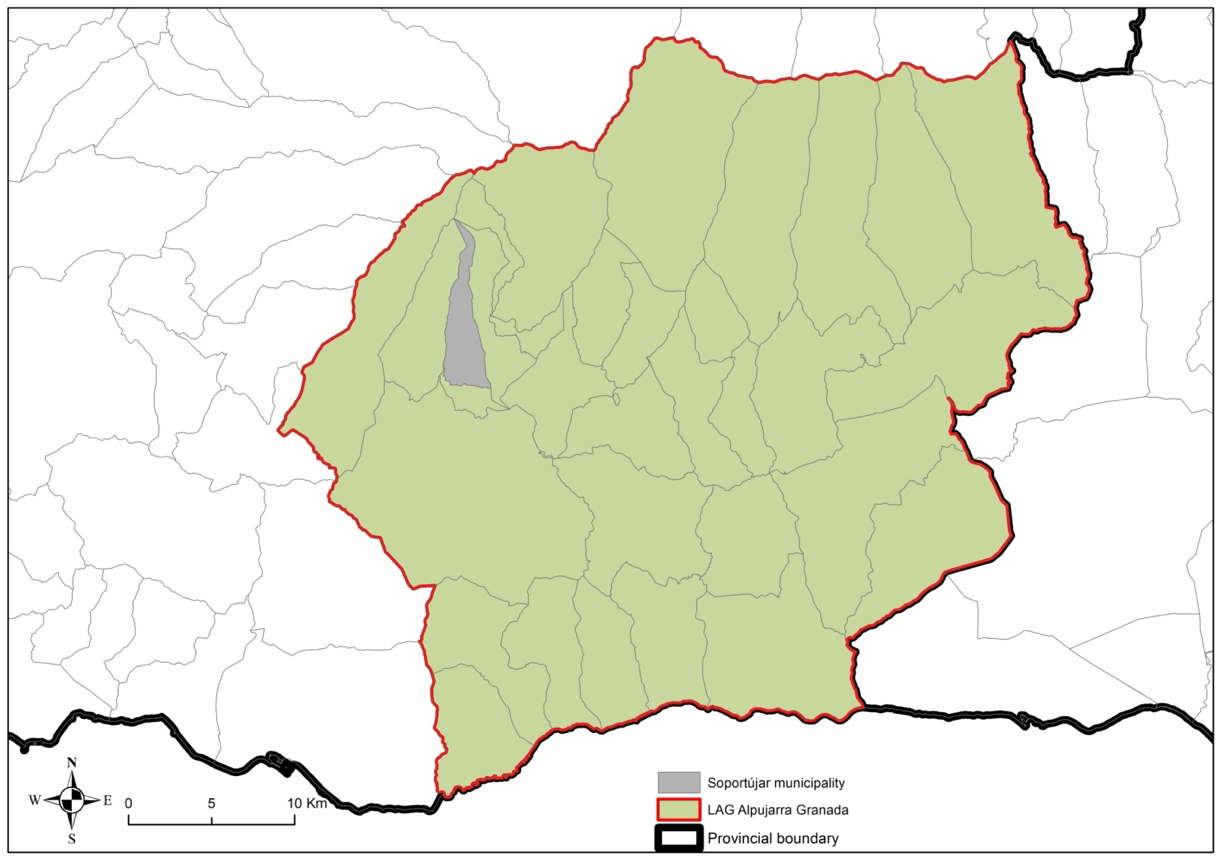
Soportújar is a small municipality (265 inhabitants, year 2022) in the western part of this area. Before the start of the initiative, the village’s ageing and remoteness were relevant weaknesses, as highlighted by the severe depopulation that the municipality has suffered since the middle of the 20th century (Maroto et al. 2024, 291), falling from 832 inhabitants in 1950 to 280 in 2011. In addition, this village was characterized by minifundismo, a highly fragmented land ownership and small farm, and a slope that prevented the mechanization of the arable land. It was therefore necessary to look for an alternative. The opportunity to valorize an intangible resource, the tradition of witchcraft, and the negative nickname of the inhabitants of “sorcerers/witches”, united to the differentiation necessity and the potential of tourists coming to this area of Alpujarras, eased the emergence of the Spanish initiative. This initiative’s implementation has contributed to maintaining and even slightly increasing this municipality’s inhabitants (the number of inhabitants of 2011 is over-numbered, being real the current data) (information extracted from the interview to local tourism councilor and Maroto et al. 2024), valorizing also its tangible heritage and urban landscape, and creating a tourism offer, raising the number of pubs, bed places, companies and incomes per capital from 2011 until now (Tab. 5).
| Main indicators | 2011 | 2022 |
|---|---|---|
| Altitude (m) | 927 | |
| Population (Inhab.) | 280 | 265 |
| Density (Inhab/km²) | 20 | 19 |
| Population over 65 and + age (%) | 29.3 | 30.6 |
| Tourism bed places | 0 | 41 |
| Incomes per capita (average) | (2015) 10.119 | (2021) 11.659 |
| Companies (Inhab. *100) | 3.2 | 7.2 |
4.2.1 The case of Alpujarras: Witchcraft, Soportújar
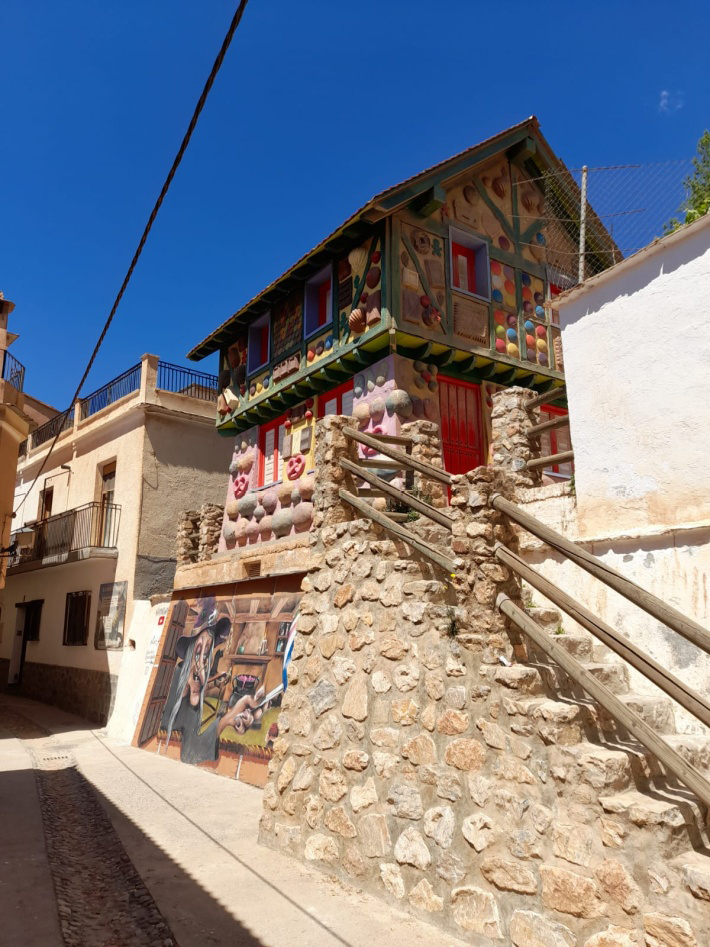
Considering the generative dynamics, the Spanish case “Witchcraft of Soportújar” project offers a precise vision of the role played by the different public administrations, entities and collectives that participate in the design, funding and implementation of development strategies (Maroto et al. 2024, 287). This initiative has been a huge success. It was first implemented in the programming period 2007-2015, specifically in 2009 and 2013, having an initial total investment of 200,000 euros, 150,000 euros in grants, and 45,000 euros from the municipality of Soportújar (according to the facilitator of the LAG of Alpujarra Granadina and the tourism counsellor of the municipality). The Embrujo project was based on a cultural resource of an anthropological nature, an old legend and tradition, the nickname of the inhabitants of this municipality, Soportújar, calling them “brujos y brujas” (wizards and witches) from neighbouring municipalities: definitively, witches and witchcraft. The intention was to differentiate and create a new offer in Alpujarras. Thanks to this initiative a museum and several sculpture figures were carried out along the streets of the village (Fig. 4). The initial effort came from the own municipality and the provincial government of Granada. The previous mayor and the director of the provincial tourism planning office played a crucial role in the initial steps of this initiative. This municipality previously lacked touristic infrastructure.
Therefore, it was the valorization of the cultural and intangible heritage of the area the main innovation input, emerging a new tourist product. At the same time, the urban landscape, of narrow and windy streets, with ditches and arcades recovered. The principal obstacle was the high investment and the low capacity of the municipality to deal with it. On the other hand, it is necessary to highlight the major’s leadership role, who used the local, cultural and traditional heritage to generate an innovative project and get the involvement of the inhabitants of the municipality of Soportújar in this initiative.
In the 2014-2020 period, the municipality of Soportújar received a second investment of LEADER Local Development Strategies of 45,776 euros, aimed at recovering the architectural heritage of the village, in the line of the creation of a singular touristic product (Manager of the LAG). The municipality has initiated contacts with other similar towns and cities, such as Salem (United States) or Zumagamurri (Vasque Country, Spain).
In the last four years, the approval of a Touristic Sustainable and Strategic Plan for the Municipality, “Proyecto Embrujo”, has taken to Soportújar to reach the consolidation of the tourism activity and the search for new and sustainable objectives: the improvement of the attention and reception of visitors, with quality infrastructures and tourist services; to obtain the declaration of Soportújar as a Tourist Municipality; to promote entrepreneurship among the population with new services for tourists; to structure the offer and the circuit of visits to the destination, generating a local tourist product; to improve and preserve anthropological and cultural values; to reinforce the digitalization of the destination; to better understand the demand in order to make quality decisions and to increase the stay and overnight stays at the destination, so that it stops being a destination of passage. This plan has recently been funded by the Next Generation Funds, and approved by the Secretariat of State for Tourism, with 1.7 million euro. It pursues solving the problems of over-arrival of visitors, building parking for public and private transport, recovering the urban and architectonic landscape and heritage, and supporting an increase in the number of bed places. This plan pursues also, the declaration of “Touristic Municipality” for Soportújar (Tourism Ministry 2022).
Some of the main tourist attractions created in the municipality by this initiative were: Witchcraft Interpretation Centre, With-Eye Cave, Haunted Bridge, Statue of the path to the Buddhist Centre, Fountain of the Witches, Snake Arcade, Fountain of the Dragon, Circle of the Convents and Hansel and Gretel´s house (according to the Touristic guide of the municipality). The locations of these attractions were designed to spread the visitors around all the village and highlight concrete spaces of the municipality. These new attractions are being integrated with preexisting ones, such as the landscape, traditional arcades, urban ditches, and urban morphology, promoted and recovered thanks to the last LEADER project.
Regarding relational dynamics, according to the interview of the manager of the LAG (Alpujarra Granadina), the collaboration among different public and local entities, such as the local government, the provincial, and the partnership of the LAG, was a key aspect. Also, the involvement of the local community was relevant, participating in the implementation of this initiative and all the events celebrated, playing the Adult Education School and the women of the village a key role (according to the Major of the municipality); and supporting and participating in all the events related to the valorization and dissemination (through social networks, press, radio and TV) of local witchcraft. The LAG supported the initiative from the beginning, and the grant was its main contribution. Finally, the Provincial Government, “Diputación de Granada”, financed this initiative, and encouraged the promotion and creation of this touristic product, totally different and innovative. Definitively, the idea and implementation had a top-down character, from the Provincial Government, the Municipality and the LAG, having the local community a secondary role.
Finally, transformative dynamics became important in this territory. The more relevant aspect was the creation of a new touristic product. As a result, the municipality suffered radical change, setting up new inhabitants and removing the depopulation problem. The number of inhabitants kept similar from 2006 until 2021, new settlers arriving, who created new entrepreneurial initiatives, taking advantage of the arrival of visitors. Also, it produced a mental change in the inhabitants, who felt proud to live and belong to this community.
However, the project’s success has been so relevant that visitors´ massification overpassed the reception capacity. It is the case of the necessity of parking, noise and congestion on the streets. The implicit conception of the type of visitor to receive in the municipality, those looking only to take pictures, is the main problem of the over-tourism in Soportújar. The manager of the LAG noted: “the project got out of hand, changing the behaviors and habits of the local inhabitants, moving some of them during the weekends to avoid the tourism mass problems”.
According to the Touristic Counsellor, the number of businesses has experienced a huge increase, taking consequently to the creation of new jobs. The village has gone from having just two bars to six today and from having just one shop to five today, apart from the souvenir shop, which newcomers have promoted. New ideas and innovations are brought thanks to these new inhabitants. There is also a demand for housing, which has led to an increase in the price of land. Most importantly, from being in a situation where the school was under threat of closure, they now have 15 children enrolled, and they expect two more to join next year.
However, this initiative is producing also negative effects. The project´s success has been so relevant that visitors´ massification over-passed the reception capacity. It is the case of the necessity of parking, noise and congestion on the streets. The implicit conception of the type of visitor to receive in the municipality, those looking only to take pictures, is the main problem of the over-tourism in Soportújar (according to touristic guide of the municipality). The manager of the LAG noted: “the project got out of hand, changing the behaviors and habits of the local inhabitants, moving some of them during the weekends to avoid the tourism mass problems”. According to the information given by the tourist guide, the arrival of visitors has been growing from 2013 until now, having its higher development after the COVID pandemic, reaching unsustainable levels. Thus, in 2023, at the Witchcraft fair, the village reached more than 20,000 visitors for only 260 inhabitants. Also, the arrival of tourists is minimal because of the reduced number of accommodations offered, limiting the economic revenues that the municipality could receive if the village had more tourist accommodation, infrastructures and services. The Embrujo Project has attracted a huge number of day-trippers and fewer tourists, and these visitors are not generating the economic revenues that potentially might be obtained if the village had more tourist accommodation on offer and better infrastructures and services. Definitively, there is sufficient evidence to argue that in Soportújar, the Witchcraft Project is establishing a solid basis to consolidate a transformative dynamic.
4.2.2 Main results from the analysis
The comparison of two similar areas on the socio-economic level has highlighted common problems despite being two experiences at different stages, one more mature in Spain, one more recent and still ongoing in Italy. Definitively, the principal results focused on the next points. In the context of generative dynamics and types of innovations, both two projects were based on significant contextual problems above all of a socio-economic nature and the difficulty of fully exploiting local resources and potential (historical, cultural heritage, quality production), facing ageing/population loss, lack of basic and complementary services, looking for the reactivation of the local economy, the establishment of new partnerships, and integrated internal and external networks. Both the projects pursued the activation, process management and enhancement of local resources, cultural and intangible heritage, and urban landscape recovery. The processes involved actors, particularly the local community, albeit with varying degrees of involvement, the most extensive in the Spanish project, involving an internal network (local politicians, small tourism entrepreneurs from the area, facilitators from the LAG, and the local community); and also, external (regional politicians, facilitators from the provincial and regional governments).
In both projects, the guiding action of specific local actors was important, promoting the start of processes of involvement, especially towards the local community. In Italy, the guide role of the LAG to create a network of institutional cooperation among the mayors and economic operators was crucial, especially based on contextual knowledge and historical experience. In Spain, the innovation came from the use of local culture and anthropological resources, being transformed in a positive challenge. Also, the conjunction of this popular knowledge and “formal” knowledge coming from different leaderships of specific key actors. Therefore, innovations “are institutionalized and linked with intra-regional governance networks in a temporally contingent process linking incremental and radical social innovations” (Stoustrup 2022, 1).
About networks and actors, in Italy a key role was played by the LAG, which tried to connect to the national and regional strategy, from which it has recently received particular attention, although more coordination work is needed between interventions and policy actions; while in Spain, the Local Governments of the Municipality and the Province, with leaders and facilitators working also as promoters and the initial reappropriation and participation of the community, implicating this a collective learning. Definitively, local empowerment derived from the LAG partnership and produced a proactive involvement and role of the community of Soportújar. The leadership carried out by several local politicians, joint with the facilitation role of the LAG, municipality and provincial government, were key elements. These local and public facilitators had a key role in both initiatives (Vercher 2022). These projects worked as cooperation processes between local actors/communities/institutions.
Regarding transformative dynamics, both projects were focused on the need to solve structural social, economic and infrastructural problems, such as population ageing, depopulation, employment, lack of services, accessibility. In both cases, this led to the search for a solution that could reconnect places to people through governance processes, inside and outside the area, especially tourists. These solutions required the deployment of many financial and human resources and efforts, involving the development of new tools both in Spanish and Italian experiences. In Spain’s more mature and articulated project, this has led to an effective increase in tourist arrivals, while in Italy, the results are still modest however, highlighting potential especially in the coming years thanks to the qualitative and quantitative increase in accommodation facilities.
These dynamics and products are trying to limit the spirals of depopulation and marginality, causing positive, structural and long-term impacts. Hence, continuous strategic planning and governance are required.
In Spain, in particular, the main changes have been focused on a new tourist product, the settlement of newcomers in the village, and the excessive arrival of visitors, which also leads to a need for continuous governance, external collaboration and urban and tourist planning, and definitively the appearance of a transformative dynamic. In both cases, an increase in awareness of the local community was declared a sort of “change of mentality” in the inhabitants and economic operators. Furthermore, for the first time, this local awareness has led to the need to have knowledge tools of the territory, through a process of census and networking of resources and actors (improving knowledge/ mapping of resources, operators, networks, the connection of operators, internal and external visibility, support for receptive and para-receptive structures, complementary services, and the synergy of tourist systems and operators). Some important critical issues concern the need to make the areas attractive for young people because, especially in the Italian case, educated people are needed to continue the process that has just begun. In the Italian case, a greater awareness of local resources, of the value of the cultural, environmental, and landscape heritage that characterize the area is increasing, but it must also be supported by educational actions thanks to the synergy that can be activated with universities and research centers. In the Spanish case, the need is to create a sustainable destination, conciliating touristic use and community life.
Increased cooperation networks highlight that such networks evolve and change (as it happens especially in the Italian case). The persistence of ties and the evolution of the network are linked to the path of the place not only in terms of time but also of intensity. Another aspect to highlight in the two cases is the development of virtuous interrelations between the actors who, having a deep contextual knowledge base, were motivated to cooperate and communicate. Through the action and interaction promoted by the LAGs between diversified agents, the improved circulation of knowledge was given impetus to innovative ideas that turned into business successes at a local scale, further strengthening previous interactions, contributing to a reorganization of the existing socio-economic structure and changing the local path of decline. Such reorganization can be translated into economic returns but as happened in the two case studies, into new interpretations of the territorial context in which the actors are located, creating greater awareness of their strengths and weaknesses. This reflexive capacity in relation to the territorial context was the result of a long path, as witnessed by the interviewees.
Furthermore, the coordination of actions thanks to the presence of LAGs has become an important component of the intangible resources on which networks of actors are being built and modified (for example the creation of new businesses often in cooperation with each other).
In these evolutionary processes, as we have found in the two case studies, the pre-existing behaviors of the actors (Italian case) and the structure of the actors of the institutional configuration (Spanish case) have been modified.
5. Conclusion
The involvement of the community influenced the territorial impacts of these initiatives. In the case of the “Witchcraft Project”, the identification of local inhabitants contributed to the initiative´s success, changing a negative identity for a positive one. In a certain way, the social cohesion of the local community has been improved, encouraging local linkages (Dargan, Schucksmith 2008), awaking the local community of Soportújar, and adding the fourth element of the quadruple helix (Nordberg et al. 2020), the civil society. However, this involvement and participation of the local community is not always adequately supported, especially on an operational level. As known, profound transformation processes extend adoption periods. Neo-endogenous initiatives do not conclude once implemented, nor do they include involvement of local inhabitants and the governance mechanisms, and this is common to the two cases analyzed.
However, additionally, the long-term planning and management of these projects determine the transformative dynamics and the implementation through time. In the two cases examined the long-term vision, the integration between different programming plans and projects is fundamental. In the case of the “Witchcraft project”, its excessive success and the low level of long-term planning from the local government have derived an over-arrival of visitors and the need for continuity of strategic touristic planning. In the case of the Monti Dauni the creation of new accommodation facilities, while filling the gap in the availability of accommodation services, must be supported by an adequate and integrated policy of the various connected services linked to accessibility, training, care services, promotion and territorial valorization to guarantee socio-economic sustainability. In both cases, the transformation processes are underway. The local government and LAG, since having contextual knowledge and operate on the territory, are in all respects agents of the transformation processes which, however, must operate according to an integrated and strategic vision.
As argued by Harris (2021), regardless of the organizational thickness present in the broader region, actors whose goals and capabilities are sufficient to support such networks and shared behaviors are needed. In fact, at local scale LAGs demonstrated a decisive role not only in the development of strategies but, above all, in their implementation. The extent and scope of the territorial impacts produced by the projects derive from the in depth-knowledge of local contexts and the strong involvement of local communities (citizens, businesses, experts etc.). In other words, contextual knowledge (the specific path of the place, the resources, critical issues, problems and the potential) has been crucial for the development of the project strategy. This knowledge significantly influences the nature of the results, which can range from mere innovation (mainly technical sense, for example a new product), to social innovation and, ultimately, to a higher, more complex level of territorial regeneration.
The necessity of long-term planning and the involvement of residents are crucial to support regeneration projects, this is because, as documented in this research, they become protagonists of territorial regeneration processes by investing directly in the territories. Additionally, the creation of public-private networks can help mitigate and reduce negative impacts or face new challenges, for example in the Spanish case: the lack of touristic infrastructure, the almost null presence of accommodation offers, excessive arrival of visitors on some specific dates, high dependence on visitors activity, the cooperation with similar destinations or the whole shire of Alpujarras; search of funding; or in the Italian case the low average stay with low occupancy rate of accommodation facilities. It is relevant to mention the strategic role of the LAGs in these marginal and rural areas, which know and manage the assets and problems of local communities and under the LEADER approach´s bureaucratic procedures obtain external funds to valorize local assets (Cejudo et al. 2022).
In these areas, strong bonds with local leaders and communities, as well as a deep knowledge of local assets and opportunities, are crucial to obtain and keep adapting successful initiatives over time. However, it is essential to recognize that the more critical transformative dynamics are caused by the sum and accumulation of the high number of valorization heritage and tourism projects in these areas over time. For instance, in the case of Las Alpujarras, the transformative dynamics have been driven by the sum of a high number of projects in rural tourism and the valorization of local assets and heritage, which generated an elevated demonstrative effect, and attracted a high number of newcomers, entrepreneurs and tourists.
In the Italian case, the process began a few years ago, involving different operators and actors who chose to engage in a collaborative network aiming at promoting the entire programming area, through the rediscovery of cultural, environmental and landscape heritage, products and how they can be offered to tourists. The creation of a public virtual platform, supported by the trust inspired by LAG and sharing with local actors, is evolving into a real connection project. However, as this research shows, it must be adequately supported and managed to succeed.
In both cases analyzed, the added value provided by the LEADER approach has been crucial, although with different levels of participation, more mature in the Spanish case, to be implemented in the Italian one. As emerged from this research the mere provision of policy measures to promote practice-based and networked innovation processes capable of combining different knowledge is not enough if not adequately supported at a local scale by actors who initiate and, above all, consolidate such self-construction processes in a place over the long term. In both cases, it was important for the local actors to become aware of the fundamental problems of their areas, so as to become effective promoters of change, often strongly supported by external funds.
Considering the initial situation, local decision-making has been improved, with efforts to valorize the local assets, foster cooperation especially between different and never previously reached actors (such as the entrepreneurs of the Monti Dauni area who are gaining trust), public-private partnerships, working these projects as inspirations of other ones. The change of mentality of the local community and actors and their involvement in rural development projects, albeit with different degrees of maturity in the two areas considered, are the principal value added.
In the cases examined, local assets have acquired the meaning of valuable resources, thanks to the processes of solicitation and formation of collective identity based on the place. This has stimulated processes of collective action that are still shaping the dynamics of development, where careful planning, organization and management are essential to avoid unforeseen problems (such as those experienced with over-tourism in Spain).
Two final considerations can be stated. Firstly, the strategic role of socio-economic innovation for marginal rural areas in terms of territorial cohesion, knowledge of needs/problems, partnership continuity, institutional support, and even maintenance of local inhabitants. This occurs when processes of social innovation produce new sustainable and inclusive initiatives, locally embedded and linked to the specific resources of the territory, as argued by Vercher and Herráiz (2022).
Secondly, the relevant negative aspects that can lead to a lock-in effect in the evolutionary process are related to the distrust of local operators, parochialism, contextual difficulties (cooperation, creation of entrepreneur networks, number/competition between different tools), planning/management tools, and resources (financial, knowledge etc.). Additionally, recommendations must be directed at long-term planning and management tools and strategies. In fact, it is crucial to monitor not only the economic and tangible changes of these fragile areas, but also the intangibles ones, such as organizational and social changes. These aspects are often overlooked over time, particularly due to negative demographic trends. As emerged in this study, it is important to have an in-depth knowledge of the initial territorial context to grasp its dynamics, changes, and problems. Therefore, it is essential to understand the specific evolutionary dynamics in order to intervene to solve the major problems.
The use of only quantitative data, often incomplete and not always comparable (especially at an international level when choosing a more detailed analysis scale), hides the complex territorial dynamics for which only constant monitoring of the evolution of the processes of change can facilitate the final evaluation.
Important dynamics emerged in the interviews concerned the difficulties of marginal areas, especially in the initial stages, of promoting processes of involvement of the local community, institutions and the main actors in the area, processes that must be followed directly and which, increasingly complex, require greater investments in human capital. Although, it often deals with underestimated processes, because the results are not immediately evident, it is a question of laying the foundations for increasingly complex dynamics that represent the added value of such experiences. However, an underestimated role is represented by education and training, human and social capital in these territories.
As shown in this study, the processes of regeneration and territorial development are quite complex and require a strategy that goes beyond the conception of marginality as an isolated issue. Instead it should be addressed according to a medium-long term perspective, as an opportunity, aiming precisely at radical and profound changes in the local community (but often ignored by official reporting systems at different levels), facilitating knowledge recombination, as Cooke (2021) states, identifying the “structural holes” or “white spaces” where opportunities for may reside and as emerged in this research, only those who are familiar with the territorial context and the long-term path can identify.
Definitively, the research method is a preliminary attempt to evaluate the dynamics and processes of territorial regeneration. Generative, relational and transformative dynamics are key elements to understanding the meanings and functions of neo-endogenous initiatives, and, therefore, improving the implementation of these practices.
The methodology has been effective in reflecting on processes, bringing out the critical viewpoints of key actors, and all the aspects often overlooked in official reports. In the process of reflection on territorial dynamics, the interviewees were forced to distinguish them (not without difficulty), to bring out above all problems and criticalities (which are usually omitted), to self-assess the path of the place by considering other aspects not merely quantitative and tangible. As discussed in Harris’ work (2021) and in both cases, the key actors must be able to use local preconditions such as pre-existing organizational “thickness” and institutional frameworks, furthermore, “the institutional configuration of the cluster” is fundamental. In fact, the relationships between key actors in the institutional configuration can condition and limit any opportunity for the actors to generate new forms of path development.
At last, this research conducted at a local level to study territorial regeneration processes demonstrates that Geography is fundamental in understanding and realization of processes place/path dependent because they are not a-spatial and homogeneous. The complexity of the processes of territorial regeneration requires specific knowledge, field work, interpretative reading, knowledge and skills of understanding the complexity of territorial contexts, of spatial processes and their dynamic evolutions, which are specific to geographical sciences, whose contribution to research is fundamental.
Finally, a systemic approach is necessary, considering the interconnections among a huge number of factors and roles involved; also, the understanding of the links between social innovation processes, more radical and effective in marginal rural areas, and neo-endogenous strategies, like the LEADER, and realized through territorial regeneration projects.
For future research, although the methodology has proven to be effective in highlighting significant aspects, however, for its improvement it is suggested to further focus attention on the internal dynamics of the actors and their roles in the process for over time. Another aspect concerns understanding the path of development phases to detect the evolutionary trajectories or, on the contrary, the potential alterations. This requires an in-depth study in which even the institutional configuration itself may condition and limit these processes. Furthermore, it is important that the objectives of the survey are clear to the interviewees, making them understand the importance of detecting all aspects (positive and especially negative, problems, critical issues, limits, weaknesses and gaps of inherited and entrenched path etc.) to offer a contribution to a better understanding and facilitate common reflection.
References
AEIDL (1999). Assessing the added value of the LEADER approach, Rural Innovation. Dossier no. 4, LEADER. Brussel, European Observatory.
Agenzia per la Coesione Territoriale (2014). Classificazione dei Comuni italiani secondo la metodologia per la definizione delle Aree Interne. https://www.agenziacoesione.gov.it
Agenzia per la Coesione Territoriale (2022). Strategia Nazionale Aree Interne, https://www.agenziacoesione.gov.it (programming documents and data).
Area Interna Monti Dauni (2017). Strategia Area Interna Monti Dauni, http://www.areainternamontidauni.it/jsps/Documenti.jsp
Asheim, B. T., Smith, H. L., Oughton, C. (2011). Regional Innovation Systems: Theory, Empirics and Policy. Regional Studies, 45(7), 875-891. https://doi.org/10.1080/00343404.2011.596701
Atkinson, R. (2002). Rebuilding community: Policy and practice in urban regeneration. Urban Studies, 39, 2555-2556.
Baldacci, O. (1972). Puglia. Le regioni d’Italia, 14. Torino, UTET.
Bissanti, A.A. (1977), La Puglia. In (a cura di). Capire l’Italia. I paesaggi umani. Milano, TCI.
Bock, B.B. (2016). Rural Marginalisation and the Role of Social Innovation; A Turn Towards Nexogenous Development and Rural Reconnection. Sociologia Ruralis, 56, 552-573. https://doi.org/10.1111/soru.12119
Bosworth, G., Annibal, I., Carroll, T., Price, L., Sellick, J., Shepherd, J. (2016). Empowering local action. Sociologia Ruralis, 56, 427-449. https://doi.org/10.1111/soru.12089
Bosworth, G., Rizzo, F., Marquardt, D., Strijker, D., Haartsen, T., Aagaard Thuesen, A. (2016). Identifying social innovations in European local rural development initiatives. Innovation: The European Journal of Social Science Research, 29(4), 442-461. https://doi.org/10.1080/13511610.2016.1176555
Bosworth, G., Price, L., Hakulinen, V., Marango, S. (2020). Rural Social Innovation and Neo-endogenous Rural Development. In Cejudo, E., Navarro, F. (eds.). Neoendogenous Development in Rural Areas. Results and Lessons. Cham, Springer, 21-32.
Bowers, S. (2018). Rural Revitalization: A Framework for Action. Journal of Rural Studies, 60, 26-33.
Bozzi, A. (2016). Agriculture and Rural Life for the Protection and the Promotion of Inland Areas: The Case of Subapennino Dauno (Apulia). Geotema, 52, 114-123.
Bruun Ingstrup, M., Morisson, A., Munk Damgaard, T., Lamberty, J. (2024). An actor-centric approach for defining policy action during cluster development. Regional Science Policy & Practice, 16(5), 100037. https://doi.org/10.1016/j.rspp.2024.100037
Castaldi, C., Mendonça, S. (2024). Places as brands: charting the value of place-based intangibles. Regional Studies, 58(10), 1781-1791. https://doi.org/10.1080/00343404.2024.2355280
Cejudo, E. (2021). Estrategia provincial ante el reto demográfico y la despoblación del medio rural de Granada 2020-2023. Aspectos poblacionales, demográficos, sociales y económicos. Fortaleciendo la resiliencia de los territorios rurales. Granada, Diputación de Granada.
Cejudo, E., Navarro, F. (a cura di, 2020). Neoendogenous Development in European Rural Areas. Results and Lessons. Cham, Springer Geography.
Cejudo-García, E., Navarro-Valverde, F., Cañete-Pérez, J.A. (2022). Who Decides and Who Invests? The Role of the Public, Private and Third Sectors in Rural Development according to Geographical Contexts: The LEADER Approach in Andalusia, 2007-2015. Sustainability, 14, 3853. https://doi.org/10.3390/su14073853
Cejudo-García, E., Navarro-Valverde, F., Cañete-Pérez, J.A. (eds., 2024). Win or Lose in Rural Development. Case studies from Europe. Cham, Springer.
Chatzichristos, G., Perimenis, A. (2022). Evaluating the social added value of LEADER: evidence from a marginalized rural region. Journal of Rural Studies, 94, 366-374. https://doi.org/10.1016/j.jrurstud.2022.07.016
Cooke, P. (2021). Systems of Innovation and the Learning Region. In Fisher, M.M., Nijkamp, P. (eds.). Handbook of Regional Science. Berlin, Springer, 835-852.
Dargan, L., Shucksmith, M. (2008). LEADER and Innovation. Sociologia Ruralis, 48, 274-291. https://doi.org/10.1111/j.1467-9523.2008.00463.x
Dax, T., Oedl-Wieser, T. (2016). Rural innovation activities as a means for changing development perspectives – An assessment of more than two decades of promoting LEADER initiatives across the European Union. Studies in Agricultural Economics, 118(1), 30-37. https://doi.org/10.7896/j.1535
Dax, T., Strahl, W., Kirwan, J., Maye, D. (2016). The LEADER programme 2007–2013: Enabling or disabling social innovation and neo-endogenous development? Insights from Austria and Ireland. European Urban and Regional Studies, 23(1), 56-68. https://doi.org/10.1177/0969776413490425
Dax, T. (2020). Neoendogenous Rural Development in Mountains Areas. In Cejudo, E., Navarro F. (eds.). Neoendogenous Development in Rural Areas. Results and Lessons. Cham, Springer, 3-19.
Dax, T., Copus, A. (2022). European rural demographic strategies: Foreshadowing Post-Lisbon rural development policy? World, 3(4), 938-956. https://doi.org/10.3390/world3040053
Dipartimento per le Politiche di Coesione e per il Sud, Strategia Nazionale Aree Interne – SNAI. Elenco Aree SNAI 2021-2027 (aggiornato al 12 ottobre 2023). https://politichecoesione.governo.it/, ultima visita 26/01/2025.
EC (European Commission; 2009). Creativity and Innovation in EU Rural Development. EU Rural Review (The Magazine from the European Network for Rural Development), 2. https://enrd.ec.europa.eu.
EC (European Commission; 2006). The Leader Approach: a basic guide. https://ec.europa.eu/enrd/sites/default/files/enrd-static/app_templates/enrd_assets/pdf/leader-tool-kit/leader_approach_en.pdf
EC (European Commission; 2013). Knowledge Transfer and Innovation in Rural Development Policy. EU Rural Review (A Publication from the European Network for Rural Development), 16.
EC (European Commission; 2016). Directorate-General for Research and Innovation. Open innovation, open science, open to the world : a vision for Europe. Publications Office. https://data.europa.eu/doi/10.2777/061652
EC (European Commission; 2019). Building stronger agricultural knowledge and innovation systems (AKIS) to foster advice, knowledge and innovation in agriculture and rural areas. https://enrd.ec.europa.eu.
EC (European Commission; 2020a). Strategic Plan 2020-2024. Directorate General for Agriculture and Rural Development. https://research-and-innovation.ec.europa.eu/strategy/strategy-2020-2024_en
EC (European Commission; 2020b). Commission staff working document. Analysis of links between CAP Reform and Green Deal. Brussels, 20.5.2020 SWD (2020) 93 final.
EC (European Commission; 2020c). Report on the impact of demographic change. June 2020.
EC (European Commission). Commission Staff Working document executive summary of the evaluation (2024). Evaluation of the impact of LEADER towards the general objective “Balanced Territorial Development”. Brussels, 1.7.2024, https://ec.europa.eu/transparency
Esparcia, J. (2014). Innovation and networks in rural areas. An analysis from European innovative projects. Journal of Rural Studies, 34, 1-14. https://doi.org/10.1016/j.jrurstud.2013.12.004
Esparcia, J. (2024). Rural Depopulation, Civil Society and Its Participation in the Political Arena in Spain: Rise and Fall of ‘Emptied Spain’ as a New Political Actor? In Cejudo, G. E., Navarro, V.F.A., Canete, P.J.A. (eds.). Win or Lose in Rural Development. Case studies from Europe. Cham, Springer, 39-64.
European Parliament (2021a). Demographic Outlook for European Union, https://www.europarl.europa.eu/RegData/etudes/STUD/2021/690528/EPRS_STU(2021)690528_EN.pdf.
European Parliament (2021b). REPORT on reversing demographic trends in EU regions using cohesion policy instruments. https://www.europarl.europa.eu/doceo/document/A-9-2021-0061_EN.html
Fiori, M., Varraso, I. (a cura di, 2000). Centri e flussi della Daunia. Una trama che avvolge ma non organizza il territorio. Bari, WIP.
Harris, J. L. (2021). Rethinking cluster evolution: Actors, institutional configurations, and new path development. Progress in Human Geography, 45(3), 436-45. https://doi.org/10.1177/0309132520926587
Hassink, R., Klaerding, C., Marques, P. (2014). Advancing evolutionary economic geography by engaged pluralism. Regional Studies, 48(7), 1295-1307. https://doi.org/10.1080/00343404.2014.889815
High, C., Nemes, G. (2007). Social Learning in LEADER: Exogenous, Endogenous and Hybrid Evaluation in Rural Development. Sociologia Ruralis, 47, 103-119. https://doi.org/10.1111/j.1467-9523.2007.00430.x.
Ivona, A., Rinella, A., Rinella, F., Epifani, F., Nocco, S. (2021). Resilient Rural Areas and Tourism Development Paths: A Comparison of Case Studies. Sustainability, 13, 3022. https://doi.org/10.3390/su13063022
Konečný, O. (2019). The Leader approach across the European Union: One method of rural development, many forms of implementation. European Countryside, 11(1), 1-16. https://doi.org/10.2478/euco-2019-0001
Labianca, M. (2016). From technological to social innovation: objectives, actors, and projects of the European rural development program (2007-2013) in the Puglia region. Norois, 241, 49-65. https://doi.org/10.4000/norois.5999
Labianca, M. (2021a). Towards a Visionary Approach for rural areas. From the key features to planning the future of LEADER. Perspectives on Rural Development, Vol. 5, SIBA Unisalento.
Labianca, M. (2021b). Can GIS Foster Conscious and Critical Learning in Geography? An Application from Students to a Real Case Included in the National Strategy for Inner Areas: Monti Dauni, Apulia (Italy). Sustainability, 13, 9246. https://doi.org/10.3390/su13169246
Labianca M. (2023). Proposal of a Method for Identifying Socio-Economic Spatial Concentrations for the Development of Rural Areas: An Application to the Apulia Region (Southern Italy). Sustainability, 15(4), 3180. https://doi.org/10.3390/su15043180
Lacquement, G., Chevalier, P. (2024). European LEADER Programme (2014–2022) and Local Action for Territorial Development: The Paradox of Innovation. In Cejudo-García, E., Navarro-Valverde, F., Cañete-Pérez, J.A. (eds.). Win or Lose in Rural Development. Case studies from Europe. Cham, Springer, 191-213.
Leco, F., Díaz, A. P., Rodríguez, A. B. M. (2017). Crisis demográfica en la Extremadura rural: valoración a través de los Grupos de Acción Local (2007-2014). Cuadernos geográficos de la Universidad de Granada, 56(1), 76-100. https://revistaseug.ugr.es/index.php/cuadgeo/article/view/4018
Mannella, S., Fiori, M., Carparelli, S., Mininno, A., Varraso, I. (1990). Scritti geografici sul Subappenino Dauno. Bari, Adriatica Editrice.
Maroto-Martos, J. C., Pinos-Navarrete, A., Ruiz-Moya, N. (2024). Can Successful Promotion of Tourism Prevent Rural Depopulation? A Case Study of Soportújar (Spain). In Cejudo, G.E., Navarro, V.F.A., Canete, P.J.A. (eds.). Win or Lose in Rural Development: Case Studies from Europe. Cham, Springer Nature, 285-309.
Moulaert, F., Martinelli, F., Swyngedouw, E., Gonzalez, S. (2005). Towards Alternative Model(s) of Local Innovation. Urban Studies, 42(11), 1969-1990. https://doi.org/10.1080/00420980500279893
Mykhnenko, V. (2023). Smart shrinkage solutions? The future of present-day urban regeneration on the inner peripheries of Europe. Applied Geography, 157. https://doi.org/10.1016/j.apgeog.2023.103018
Neumeier, S. (2012). Why do Social Innovations in Rural Development Matter and Should They be Considered More Seriously in Rural Development Research? – Proposal for a Stronger Focus on Social Innovations in Rural Development Research. Sociologia Ruralis, 52, 48-69. https://doi.org/10.1111/j.1467-9523.2011.00553.x
Neumeier, S. (2017). Social innovation in rural development: identifying the key factors of success. The Geographical Journal, 183(1), 34-46. https://doi.org/10.1111/geoj.12180
Nieto, A., Cárdenas, G. (2017). 25 years of the LEADER initiative as European rural development policy: The case of Extremadura (SW Spain). European Countryside, 9(2), 302-316. https://doi.org/10.1515/euco-2017-0019
Nordberg, K., Mariussen, A., Virkkala, S. (2020). Community-driven social innovation and quadruple helix coordination in rural development. Case study on LEADER group Aktion Österbotten. Journal of Rural Studies, 79, 157-168. https://doi.org/10.1016/j.jrurstud.2020.08.001
Nosek, Š. (2017). Territorial cohesion storylines in 2014–2020 Cohesion Policy. European Planning Studies, 25(12), 2157-2174. https://doi.org/10.1080/09654313.2017.1349079
Pierson, J., Smith, J. (eds., 2001). Rebuilding Community Policy and Practice in Urban Regeneration. London, Palgrave Macmillan.
Pietkiewicz, I., Jonathan, A., Smith (2014). A practical guide to using Interpretative Phenomenological Analysis in qualitative research psychology. Czasopismo Psychologiczne – Psychological Journal, 20(1), 7-14. https://doi.org/10.14691/CPPJ.20.1.7
Pinilla, V., Sáez, L. (2021). What Do Public Policies Teach us About Rural Depopulation: The Case Study of Spain. European Countryside, 13(2), 330-351. https://doi.org/10.2478/euco-2021-0021
Prezioso, M. (a cura di, 2018). Quale Territorial Impact Assessment della Coesione Territoriale nelle Regioni Italiane. La concettualizzazione del problema. Bologna, Pàtron.
Prezioso, M. (a cura di, 2020). Territorial Impact Assessment of national and regional territorial cohesion in Italy Place evidence and policy orientations towards European Green Deal. Bologna, Pàtron.
Regione Puglia – Dipartimento Agricoltura, sviluppo rurale e tutela dell’ambiente (2021). Italy - Rural Development Programme (Regional) - 2014-2022. https://psr.regione.puglia.it
Saraceno, E. (2013). Use of disparity and diversity in EU rural policies. Sociologia Ruralis, 53, 331-348. https://doi.org/10.1111/soru.12017
Shucksmith, M. (2000). Endogenous Development, Social Capital and Social Inclusion: perspectives from LEADER in the UK. Sociologia Ruralis, 40, 208-218. https://doi.org/10.1111/1467-9523.00143
Smith, J.A., Osborn, M. (2008). Interpretative phenomenological analysis. In Smith, J. (ed.), Qualitative psychology: A practical guide to research methods. London, Sage, 53-80.
Spagnoli, L., Ferrari, V. (2012). Nuove figure interpretative e progettuali per una rigenerazione ecosostenibile degli spazi urbani. Roma tra città e campagna. Documenti geografici, S.1., 61-89.
Secco, L., Pisani, E., Burlando, C., Christoforou, A. (2017). What Future for LEADER as a Catalyst of Social Innovation? In Pisani, E., Franceschetti, G., Secco, L., Christoforou, A. (eds.). Social capital and local development. Cham, Palgrave Macmillan, 417-438.
Spagnoli, L. (a cura di, 2022). Itinerari per la rigenerazione territoriale tra sviluppi reticolari e sostenibili. Milano, Franco Angeli.
Stoustrup, S.W. (2022). A rural laboratory in the Austria alm - Tracing the contingent processes fostering social innovation at the local level. Sociologia Ruralis, 62, 542-563. https://doi.org/10.1111/soru.12372
Thuessen, A. Nielsen, N. (2014). A territorial perspective on EU’s LEADER approach in Denmark: The added value of Community-Led Local Development of Rural and Coastal Areas in a Multi-Level Governance Settings. European Countryside, 6(4), 307-326. https://doi.org/10.2478/euco-2014-0017
Tourism Ministry (2022). Resolución de 22 de diciembre de 2022, de la Secretaría de Estado de Turismo, por la que se publica el Convenio con la Comunidad Autónoma de Andalucía y el Ayuntamiento de Soportújar (Granada), para la ejecución del Plan de Sostenibilidad Turística «Soportújar, por un turismo de calidad», https://www.boe.es/boe/dias/2023/01/13/pdfs/BOE-A-2023-926.pdf
Tourism Ministry (2022). Strategic Touristic Plan for the Municipality of Soportújar. https://www.boe.es/diario_boe/txt.php?id=BOE-A-2023-926
Vercher, N. (2022). The Role of Actors in Social Innovation in Rural Areas. Land, 11(5), 710. https://doi.org/10.3390/land11050710
Vercher, N., Bosworth, G., Esparcia, J. (2022). Developing a framework for radical and incremental social innovation in rural areas. Journal of Rural Studies, 1-10. https://doi.org/10.1016/j.jrurstud.2022.01.007
Vercher, N., Herráiz, C. (2022). Estrategias de innovación social en el desarrollo de las áreas rurales. Estudio de casos en cooperativas agrarias de Formentera (Islas Baleares) y el Solsonés (Cataluña). TERRA. Revista de Desarrollo Local, 10, 221-242. https://doi.org/10.7203/terra.10.24547
Woods, M. (2006). Rural Geography. Processes, Responses and Experiences in Rural Restructuring. London, Sage.
1 LEADER was originally established as a stand-alone Community Initiative program - Leader I (1991-1993), Leader II (1994-1999), and Leader+ (2000-2006). Following this period, it transitioned from being a separate program to being integrated into the Rural Development Programs (2007- 2013). From 2014 to 2020, LEADER was merged into the broader framework of the Community-Led Local Development (CLLD) approach.
2 The European Research Group is composed of researchers from different universities in Europe (Finland, United Kingdom, Italy, France, Germany and Spain) who since 2014 have been continuously engaged in observing and analyzing the territorial impacts of the LEADER program in significant regional cases. Among the projects financed, in particular: “Programas de desarrollo y cambio rural en la Unión Europea: Gobernanza, resultados y lecciones a compartir (2007-2013)”. Study areas: European Union NUTS II regions. Finland, United Kingdom, Italy, France, Germany and Spain” and the last one “Resilience of rural areas to tackle depopulation in the COVID time. Comparative analysis at the European level. (RuralRebirth)”.
3 The Municipality of Lucera, although not included in the national classification for inner areas (see Dipartimento per le Politiche di Coesione e per il Sud 2023) is regarded by the responsible actors of the Monti Dauni Area as a part of the strategic area, not only for its territorial proximity, but for the complexity of socio-economic, productive and institutional relations that connect it to the territory (see Area Interna Monti Dauni 2017). It should be noted that the municipality of Lucera was excluded in the calculation of the Inner Area indicators.