https://doi.org/10.36253/bsgi-7584
Mobility, Tourism and Sustainability: The Case of the “Slow” Motorcycling
Mobilità, turismo e sostenibilità: il caso del motociclismo “lento”
Dipartimento di Scienze Psicologiche, Pedagogiche, dell’Esercizio Fisico e della Formazione, Università degli Studi di Palermo, Italia
E-mail: gaetano.sabato@unipa.it
Abstract. In the context of slow mobility, among the forms of tourism overlooked is motorcycle tourism, often described as a form of short excursions. On the contrary, some motorcyclists who use less powerful and less polluting vehicles organize themselves into small communities (clubs) to enjoy specific landscapes and visit small villages. The routes they favor are “slow”: e.g., they avoid motorways, using country roads; their destinations are often natural places. This article aims to study from the perspective of cultural geography some forms of this “slow” motorcycling, as these bikers define themselves. The research focuses on a group of motorcyclists in Sicily, Italy, and it is part of a larger fieldwork. Through ethnographic interviews, the article investigates the perception and the narratives that these motorcyclists have about their way of travelling. Objective of the research is to understand the ways in which bikers conceive and use the landscape and the environment from a tourist perspective. Finally, the article proposes a reflection on the possibility of considering motorcycle tourism as a form of slow tourism and a potential vehicle for territorial development.
Keywords: slow tourism, motorcycle tourism, cultural geography, landscape, mobilities.
Riassunto. Nell’ambito della mobilità “lenta” il motociclismo turistico è spesso trascurato e descritto come una forma di escursionismo. Al contrario, alcuni motociclisti amano utilizzare mezzi poco potenti e poco inquinanti, organizzandosi in piccoli club per fruire di particolari paesaggi e percorsi “lenti”. Evitano le autostrade, preferendo strade statali o di campagna; raggiungono luoghi naturali o piccoli borghi. Questo articolo – parte di una ricerca più ampia – studia, da una prospettiva geografico-culturale, alcune forme di mototurismo “lento”, come lo definiscono coloro che lo praticano. Il focus è un gruppo di motociclisti in Sicilia: utilizzando alcune interviste etnografiche, l’articolo ricostruisce le percezioni e le narrazioni che essi producono sul loro modo di viaggiare. Obiettivo della riflessione è comprendere le modalità attraverso cui i motociclisti concepiscono e utilizzano il paesaggio e l’ambiente visitati. Il motociclismo turistico viene considerato come una forma di turismo lento e un potenziale elemento per lo sviluppo territoriale.
Parole chiave: turismo lento, turismo motociclistico, geografia culturale, paesaggio, mobilità.
Contents
2. Motorcycling as Form of Slow Tourism
3.2. The First Results Emerged During the Fieldwork
3.2.2. Sociability and Solidarity
3.2.3. Slow Riding and Enjoying the Landscape
1. Introduction
The increasingly strong connection that has emerged in recent decades between slow tourism understood as a travel style and heritage landscapes understood as places to visit, but also to pass through (Massey 2005, 2006) to reach various destinations, has multi-layered and cultural roots and cannot be dismissed merely as a fashion or economic trend. This connection subtends a complex interweaving of contemporaneity that implies (also symbolically) modes of production, semantisation and appropriation of space (Lefebvre 1991; Foucault 2003; de Certeau 1990), modes of travelling, i.e. forms of mobility and consumption (Urry 1995, 2007; Sheller, Urry 2006), modes of observation and fruition (Urry, Larsen 2011) of the landscape itself. As Kaaristo and Rhoden observe (2020, 302): “Tourism landscapes are localizable but not necessarily fixed either in time or in space, as they can be mobile and dispersed simultaneously in many locations, times and physical configurations”. Heritage landscapes become attractive for tourism if they can be reached, even symbolically: they are constructed (Cusimano 1999) and/or (re)defined precisely by mobility practices and forms. For instance, certain places, “objects of movements”, can be dynamic in their own right, “within networks of human and non-human agents” (Sheller, Urry 2004, 6). Slow tourism does not of course only imply forms of mobility (see Sheller, Urry 2016), but presupposes some that perhaps best enable the fruition (and redefinition) of heritage landscapes. Indeed, the awareness that it somehow requires of tourists determines modes of exploration and travel that express systems of agency. The way tourists travel can also become agentic with regard to the landscape, ‘producing it’ (Massey 2005).
The origins of slow tourism can be traced back to the Slow Food movement, born in Italy in the late 1980s, and subsequently to the international Cittàslow network, also founded in the peninsula in the late 1990s (Andrews 2010; De Salvo 2011; Rur 2012). From the earliest formulations of ‘slow tourism’ and from the first studies that contributed to a debate around this type of tourism (Matos 2004; Babou, Callot 2009; Gardner 2009; Dickinson, Lumsdon 2010; Lumsdon, McGrath 2011, Fullagar et al. 2012), it is clear that it embraces a counter-trend philosophy to the ways, times and consumption of the standard mass tourism industry, based on ‘quality’ rather than ‘quantity’ (Nocifora, De Salvo, Calzati 2011). In particular, some authors (Dickinson, Lumsdon 2010; Lumsdon, McGrath 2011; Dickinson et al. 2011) have above all insisted on four constitutive elements of slow tourism: slowness (i.e. the way of conceiving time), locality (the interaction with destinations), modes of transport and travel experience (the relationship between means of transport and the journey itself), and environmental consciousness (i.e. a certain ethical awareness of the environment). Using another fundamental formulation in Rosa’s terms, these forms of ‘slowness’ constitute a response to “social acceleration” (Rosa 2013): slow tourism, therefore, takes the form of resistance and (more or less) conscious deceleration.
From the four-part model considered foundational, other instances have developed in the scholarly debate over twenty years later, which critically take into account the way in which transformations in the tourism industry have contributed to reshaping slow tourism itself (Guiver, McGrath 2016; Oh et al. 2016; Caffyn 2018; Clancy 2018). In these twenty years, with a scientific production that has analysed various facets of it, and with the rapid changes we are witnessing in the tourism market, elements of discontinuity emerge with respect to the possibility of univocally identifying slow tourism. The contemporary debate has not only revolved around definitional issues: talking about “slow tourism” also implies a review of the concepts of “mass tourism” and “sustainability” (Polixeny et al. 2017). Recently, Cisani and Rabbiosi (2023) on the basis of Germann Molz’s (2009) formulations of ‘velocity’ and ‘pace’, Lefebvre’s (1992) notion of ‘rhythm’ and Cresswell’s (2010) idea of ‘politics and mobility’, have pointed out how the very idea of ‘slowness’ in slow tourism is often questioned, bringing it back to the issue of mobilities: “acceleration and deceleration are always relational, mingling the pace of tourism – historically and situated – with different velocities experienced and given meaning to. […] Slow tourism is contextualised mobility, the product of a consumer society which it is […] impossible to escape” (Cisani, Rabbiosi 2023, 166).
Among the forms of tourism related to the heritage landscape and forms of sustainability, motorcycling tourism is often overlooked. This is probably because both motorcycling and related tourism are often associated with forms of fast mobility that seem to have little to do with slow tourism. However, it should considered that talking about sustainability about motorbike tourism which is very close to some fundamental ideas of slow tourism, implies a broader reflection to avoid the risk of fruitless labelling. On one hand, on a straightforward approach it is inevitable to classify motorbikes as oil-based mechanical means of transport and, therefore, as “polluting” and even “inappropriate” for slow tourism (Zago 2011; Callot 2013). For example, as in the case of car travels (Dickinson, Robbins 2007; Dickinson, Lumsdon 2010), motorbikes may also tend to facilitate some detours from the main journey, lengthening routes and having a higher carbon footprint compared to completely ecological means1. In this regard, it should also be noted that slow tourism is more inclined to detours to lesser-known places or places far from the classic tourist circuits. On the other hand, it is also true that it is not only relevant “the means of locomotion itself, or how much it pollutes, but rather the intentionality and attitude towards time and economic, environmental and social sustainability issues of the traveller” (Med Pearls 2020, 12). As some scholars shown (van Goeverden 2007; Dickinson et al. 2010; Dickinson, Lumsdon 2010), the choice of means of transport implies a different planning (and agentivity) and thus a different way of conceiving tourism: in an inverse movement to travellers using aeroplanes, slow tourists put the choice of “how to get there” before the destination.
Although this is not yet a real reversal of the major sales trend for large motorbikes2, sales of small- and medium-capacity motorbikes have taken a slice of the European market, driven by the recent arrival of models that are very popular especially in the Asian market.
The liveliness of the market, addressed by an increasing number of motorbike manufacturers, confirms the choice of many motorcyclists who like to return to vehicles that are easier to handle and maintain. In fact, these are often models that echo the lines and design of motorbikes that came out in the 70s and 80s, aimed at enthusiasts between 35 and 70 years of age, who find themselves in means of transport reminiscent of motorbikes they have already owned in the past, or at young people on their first experience. These “riding motorbikes”, as they are called among enthusiasts, are not only used to facilitate urban travel, or by commuters. Even if they are not designed for long motorway journeys, they are still capable of handling excursions and new forms of “slow motorcycling” which also recall more obsolete ways of travelling. They are used for the pleasure of riding and sharing small trips often outside the larger urban centres, aimed at savouring a way of travelling that is attentive to rural landscapes and small towns, reached via main roads rather than motorways. This deceleration (Rosa 2013) is physical as it depends on the choice of vehicles and routes, both of which are slower. But it is, of course, also a symbolic deceleration: the consumption habits of these motorcyclists may imply the concept of “consumer spirituality” (Husemann, Eckhardt 2019), especially when one considers the value of their way of touring as an “escape” from the accelerations of everyday life. In this perspective, deceleration could be seen “as a new post-secular form of spirituality” (Husemann, Eckhardt 2019).
Building on what has been said so far, this contribution aims to propose a reflection from the perspective of cultural geography on the connection between slow tourism and the heritage landscape, through the illustration of a case study, “slow motorcycling” as a form of tourism and exploration of territories. This study is part of an ongoing research, conducted using qualitative methods including ethnography above all, on a group (formed spontaneously) of Sicilian motorcyclists who, in their free time, use vehicles and travel modes comparable to forms of slow tourism. The activity of the group, by definition, would fall more under hiking than tourism, since its members usually visit their destinations and return during the day. However, for our purpose, the difference between the two typologies appears less meaningful, as the activities carried out by the group have modalities that can easily fit into one label or the other, making a taxonomy less useful.
2. Motorcycling as Form of Slow Tourism
Before getting to the heart of the issues surrounding the research on the group studied into the next section, it seems appropriate to focus here on two aspects: i) despite many studies on various aspects of motorcycling, the connection between the latter and slow tourism remains little studied. Thus, is given here a brief overview of some of the issues surrounding motorbike tourism as an object of study. ii) There is a significant correlation between the type of vehicle used and the type of tourism practiced by the studied group. Therefore, some European data that refer to the type of motorcycle and motorcycle-consumer the group may fall into are analysed here.
Next, this section offers a brief theoretical reflection on the possible link between motorcycle use and the concept of speed and freedom by resorting to Rosa’s and Berger’s formulations. They are useful in theoretically framing the relationship between motorcycling and slow tourism.
Still in 2011 Walker wrote: “Motorcycles are rarely mentioned in tourism literature; but this is hardly surprising given the limited literature on motorbiking in general. Research into motorcycling tends to focus on aspects of safety […], some academic literature […] examines the environmental aspects of motorcycles and several ethnographic studies […], but they mainly focus on very specific biker sub-groups such as […] Hell’s Angels and are not very representative of the general motorcyclist population” (Walker 2011, 169). Indeed, in recent years, the international literature on leisure motorcycling and, in particular, motorbike tourism, although still scarce (Gronau, Große Hokamp 2022), has been enriched by a number of contributions analysing various aspects of it, such as: the motivations and preferences of motorcyclists (in Wales; Cater 2017); a geography of the most popular destinations (Scol 2016); the economic impact on certain areas (the Blue Ridge Mountains, North Carolina; Weddell 2014); the application of the “moto-mobility” concept and the economic potential of motorcycling (Pinch, Reimer 2012); the connection with ecotourism and adventure tourism (Almeida et al. 2021; Scherhag et al. 2022); the attractiveness of rural tourism for motorcyclists and the possibilities of local development (in the USA; Sykes, Kelly 2016); the environmental impact of motorbike tourism (off-road and illegal) in forests and protected areas (on the Polish-Czech borderland; Chylińska, Kołodziejczyk 2023); the potential impacts of motorcycle travel demand management (in Vietnam; Lihn et al. 2023); gender issues (with reference to India; Romy, Dewan 2021).
However, despite the variety of topics covered over time, the relationship between motorcycling and slow tourism remains little studied. This is not strange considering that several scholars have long pointed out the lack of a scientific literature on motorbike tourism (Walker 2011; Weddell 2014) so that it is more difficult to analyse individual case studies (e.g. its demand generators, Sykes, Kelly 2016) and to interpret them in the light of a more general and organic framework theory. For these reasons, motorbike tourism tends to be considered part of other better-known types of tourism: for example, adventure or eco-tourism (Almeida Ramoa et al. 2021).
The (combustion engine) motorbike market in Europe is quite dynamic, with more than 1 million registrations in 2023 alone and 10.5% growth over the previous year (2022). The 5 countries with the highest number of sales were: Italy, Spain, Germany, France and the UK (ACEM 2024). In the markets of these countries, recent years have seen a certain spread of small- to medium-sized motorbikes (126cc-500cc). While the bulk of sales in 2022 and 2023 in the same markets is dominated by the larger displacements (500cc and above)3, an increasingly interesting slice has been conquered by less powerful vehicles.
In the ranking of the top 5 countries with the highest number of motorbikes registered in 2023, Italy retains first place as the market for small to medium engine capacities (see Tab. 1).
| Country | Small-medium size motorbikes registered | Total registered motorbikes | |||||||||||||||||
|---|---|---|---|---|---|---|---|---|---|---|---|---|---|---|---|---|---|---|---|
| Italy | 113,646 (126-500 cc) | 311,800 | |||||||||||||||||
| France | 58,605 (126-600 cc) | 197,668 | |||||||||||||||||
| Spain | 36,613 (126-500 cc) | 213,821 | |||||||||||||||||
| Germany | 19,867 (126-499 cc) | 212,383 | |||||||||||||||||
| UK | 16,594 (126-500 cc) | 109,527 | |||||||||||||||||
| * Data (including motorbikes and scooters) are taken from sources diversified by country, since ACEM does not report the registrations by cylinder capacity: ANCMA 2024 (Italy); Dumain et al. 2024, 27 (France); ANESDOR 2024 (Spain); IVM 2024, 37 (Germany); MCIA, 2024 (UK). In the French case the source reports a slightly wider range: 126-600 cc. | |||||||||||||||||||
This orientation of consumption towards the purchase of more accessible, cheaper, less performing, vehicles may open up some reflections on the way in which a proportion of motorcyclists in Europe conceive of travelling. Indeed, this motorcycling is mainly populated by those who have had previous experience and who have decided to switch to a more manageable and user-friendly motorbike, or those who are new to motorcycling and therefore want a more accessible vehicle.
Some of the largest manufacturers of 126-500 cc today are Asian motorbike manufacturers, mainly Japanese, Chinese and Indian, while others, based in Europe or the USA, often have their production plants in China or India (Butzbach 2024; Dumain 2024), where the demand for less powerful, but sturdy and durable motorcycles is quite widespread.
A subset of this motorbike commercial segment that has been quite successful in recent years is represented by motorbike models that reproduce designs from the past, but with better technology and new safety standards. Various models fall into this broad category vintage motorbikes that are linked to an imagery of motorcycling rooted in the post-WW II era and made famous by films and novels. This certainly has reasons related to marketing logics, however the age of the motorcycle tourists who participated in some of the studies mentioned is between 35 and 55 years old (Weddell 2014; Cater 2017) or 30 and 59 years old (Almeida Ramoa et al. 2021). The finding also seems to be confirmed by a wider bibliographic review (Gronau, Große Hokamp 2022). In this regard Cater writes: “The lack of interest in the motorcycle tourism sector may be due to a perceived image of rebellious youthful bikers which is actually at odds with their current demographic as this study found that motorcycle tourists [in the UK] were typically older and male. […] The largest age group was 45-54 years of age, illustrating that the motorcycle tourism market is older and likely has more time and more money to spend on this pursuit” (Cater 2017, 183). Moreover, some motorcyclists who return to two-wheeled vehicles at an older age, or others who decide to become motorcyclists, choose small and medium-sized motorbikes because they are easier to ride and handle or because they are reminded of iconic motorbikes.
Their use gives an idea of the philosophy that drives those who choose them. Apart from the primary use as a daily means of transport, between the suburbs and the city centre or within large cities that are congested with traffic, there is also a “pleasure” use that consists mainly of “riding” in leisure time. This certainly includes the use of motorbikes for tourism or hiking and not as a secondary reason. The choice to use a two-wheeler, which is more uncomfortable, less versatile and more dangerous than a car, responds to a specific desire for alternative mobility from which to derive a certain enjoyment.
It is not possible to explain the choice to use a motorbike (even for tourism purposes) solely by focusing on pragmatic reasons (Schouten, McAlexander 1995; Murphy, Patterson 2011). Cultural, symbolic and psycho-physical issues must also be considered. Theoretical paradigms in the social sciences do not propose an unambiguous direction. First, the uncomfortableness of a motorcycle compared to other road vehicles lays bare the question of how the body turns out to be involved in riding, implying different forms of vulnerability. Berger (who was also an expert motorcyclist) using a phenomenological approach described this condition: arriving “by motor bike […] is also a special way of travelling. Except for the protective gear you’re wearing, there’s nothing between you and the rest of the world. […] You are in the space through which you are travelling” (Berger 1991, 189-190).
Not secondarily, it is important to remember the connection between speed and freedom that underlies Rosa’s and Berger’s reflections on riding motorbikes. In Rosa’s (2010, 1) culturalist approach, the issue is certainly to be linked to the modernity: “Speed and freedom in modernity are intrinsically linked, and the motorcycle […] is the most striking symbol of this fusion. The power and attraction of the motorbike is in the sensual experience of mastering life at high speed”. However, while this link between speed and freedom is well represented by the imagery within which modern motorcycles are positioned (they are often chosen for their power), those who use motorcycles for slow touring appear to be bucking the trend. These bikers assign a different value to speed: they choose less powerful motorcycles for riding and enjoying the route considering maximum versatility (modulating long journeys, breaks, and keeping costs affordable). Such versatility is considered a form of freedom that implies the possibility of approaching a trip in a more sustainable way, both in terms of “stretched” time and in economic terms.
Motorbike riding can certainly respond to an aestheticising sense that has to do above all with sensory experience (Scuttari 2019), but also with a concept of “freedom” often emphasised in the imagery associated with motorcycling. In this regard, Berger again highlighted this intertwining of corporeality, sensoriality and freedom:
There’s an ongoing stability, […] the result of continuous minor adaptations, following from what you’ve just perceived a fraction of a second earlier. […] And speed is of the essence. […] Bikes do go fast […]. But their relation to the phenomenon and sensation of speed is […] complex […]. / The fastness that counts most is that between decision and consequence, between […] a reflex action, and its effect. […] [No other vehicle] leave your body so exposed. From this comes the sensation that the bike is responding as immediately as one of your own limbs […]. This immediacy bestows a sense of freedom […] between oneself and space. It touches the notion of aim, both spatially and subjectively. And it is with your eyes that you first take aim. […] You must look there […] and you and the bike will follow. […] Your “gaze” directs you, but it is also as though what you are looking at pulls you, draws you on. (Berger 1991, 190-191)
The experience of speed on a motorbike is only one part of moving and travelling. Several variables (usually considered advantageous by motorcyclists) come into play when using a two-wheeler for touring. The versatility of the vehicle makes it possible to avoid queues in traffic; the possibility of stopping virtually anywhere during the trip; the need to carry only one passenger in addition to the driver, as well as minimal luggage; and the economy of fuel consumption and maintenance of the bike. The connection between the use of small - to medium - sized motorbikes and the slow touring experience seems to have significant potential. Often, these motorcyclists put in second place the need to get from point A to point B in the shortest possible time, giving greater value to the enjoyment they derive from immersing themselves in an exhilarating landscape, from tackling a series of bends and from involving their body in the ride. In short, the motorbike journey is already part of the destination.
This is even more pronounced in the case of riders of less powerful motorcycles designed to enhance the riding pleasure associated with lower speeds in favour of greater vehicle control, but without expensive electronic technology.
The roads willingly frequented by motorcyclists for tourism are not motorways, but extra-urban or country roads, which are often longer and more winding, but which allow close contact with natural, rural and urban landscapes.
Several of the reflections proposed so far find confirmation in the field experience carried out during the ethnography on the group of motorcyclists called the “BikerS N’FooD Club”.
3. The “BikerS N’FooD Club”
As mentioned, this study is based on research that is still in progress, conducted using qualitative methods, including above all ethnography, on a group of motorcyclists that formed spontaneously in 2023 in Western Sicily, Italy and who chose to call themselves “BikerS N’FooD Club”.
3.1. Methodology Employed
It would be useful to dedicate an entire study to the methodology used in this work, as several theoretical and epistemological issues are involved, but this would be beyond the aim of this paper. In short, the process that guided this fieldwork originates from an attempt to understand how a group of motorcyclists who choose low-performance motorbikes and routes that emphasise how the journey is made rather than the destinations themselves can be approached as a form of slow tourism. As a first step, various studies on motorcycling and slow tourism were taken into consideration (Section 2). Then, the author of this study, as a motorcyclist and member of the group, has been able to follow from the inside the dynamics surrounding the formation and development of the small community from its foundation to today. Studying a newly formed group of motorcyclists from the inside through ethnographic fieldwork seemed the most suitable method to highlight the symbolic processes that inform the narratives and perceptions of the bikers. The author has personally taken part in several trips with his motorbike, and he is a member of the online groups created by the “club”. Given that this is a work in progress, this paper will give an initial account of some of the evidence that emerged during the fieldwork. It was conducted through the methodology of participant observation, which allowed some ethnographic interviews with 5 informants (here named A, B, C, D, E), all men and aged between 49 and 62 (1 is 49 old; 2 are 55; 1 is 56; 1 is 62). The informants were chosen according to these criteria: the frequency with which they were present at group outings and in online interactions; the willingness to be interviewed. All informants show some similarity in socio-economic conditions, and all have full-time jobs; 3/5 have a university degree. A and B, the founders, are also considered by the author to be privileged informants, as it was possible to dialogue with them on several occasions and their collaboration enabled a better understanding of the group. The interviews were conducted during free conversations with the informants, asking guiding questions (the same for all) in no fixed order, so as to leave the interviewees freer to answer. Furthermore, it was possible to converse with the informants on several occasions. The interviews were recorded with the consent of the informants. Once transcribed, the texts were then analysed using qualitative methods to identify some symbolic evidences. Similarly, field notes and short audio recordings taken during participant observation were transcribed and analysed. Other useful sources that were integrated into the data collection came from some texts taken from the public chat of the Whatsapp and the Facebook groups (devoid of any reference to sensitive and personal data).
3.2. The First Results Emerged During the Fieldwork
The “BikerS N’FooD Club” group was formed in October 2023 and had 49 members in March 2024. The informants A and B managed the aggregation with a simple proposal to the participants. The original nucleus of the group (half of them) came from other aggregation experiences: the members had already known each other from being part of a larger group dedicated to a single motorbike brand4. At the same time as the foundation, a group was created on the WhatsApp network, to facilitate communication. Here a short public presentation text states: “[The group is] born with the aim to promote care for nature and good friendship. All always united by a passion for two wheels and good cuisine”. The name and purpose of the group are intended to bring together motorcyclists with a passion for nature (and, for urban and extra-urban excursions) and good food. In addition to the WhatsApp group, a Facebook equivalent was created to exchange contents (photos, videos).
The make, model and cylinder capacity of the motorbike are not distinguishing features for being part of the group (although at least half are small and medium-sized motorbikes).
Almost all of the members live in Western Sicily: in Palermo and its surroundings, as well as in the territories of Trapani and Agrigento. The age of members is between 17 and 65, although the average is just over 50. In the WhatsApp group the female presence is around 1/5 of the total. However, it should be considered that these figures may vary, since on excursions some group members may bring their partners, friends or relatives along as passengers or on other bikes. The number of participants, therefore, may vary depending on the activity, destination and route.
The group currently has no legal status but takes the form of a free and spontaneous aggregation of people, more like a group of friends than a club.
The planning of group activities (almost entirely) goes through the WhatsApp network. Here, interactions are quite frequent. The founders often take on the role of “moderators”, as well as animators, proposing possible itineraries and weekend excursions to the other members. All members are encouraged to propose routes and to carry them out. The destinations reached so far are all in Sicily: the group mainly carries out day trips, usually in a range of 200-500 km (Fig. 1). Rural and naturalistic destinations are preferred, as well as small villages. Usually, the choice of destination is combined with that of a typical restaurant, according to the two specific “missions” the group has set itself. Alongside the more “important” and popular excursions, group members organize impromptu motorbike riding that is less demanding in terms of both distance and time.
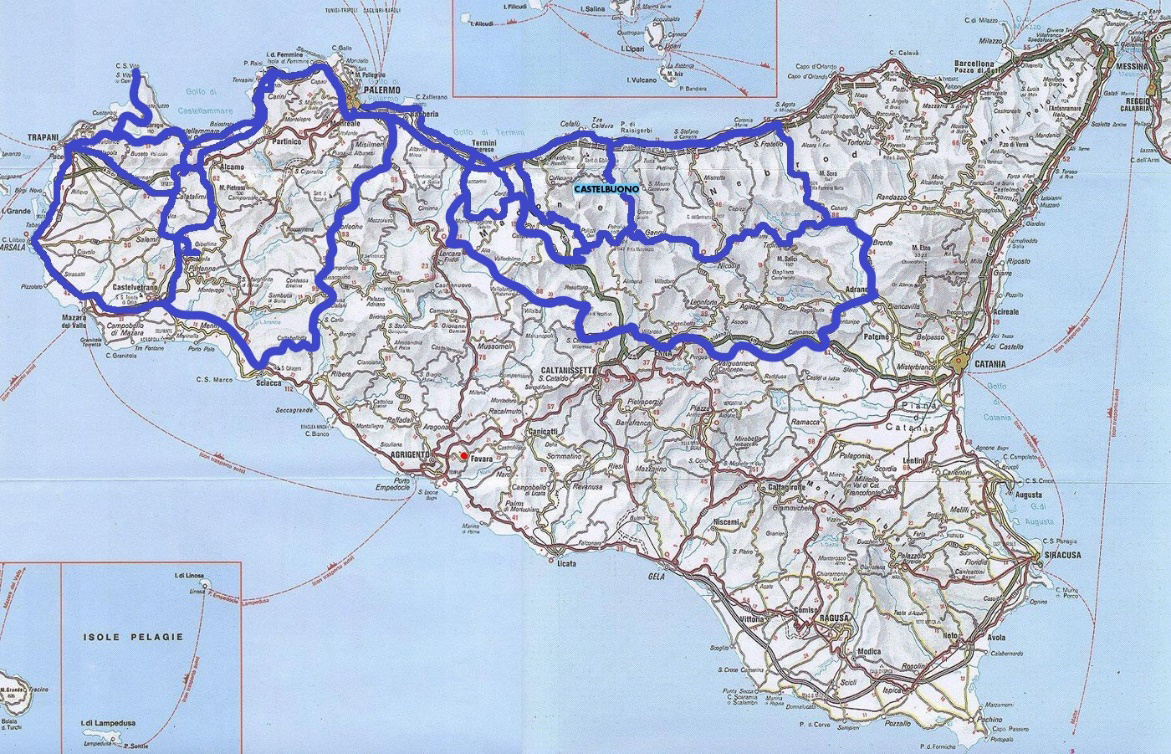
It is useful at this point to delve into certain issues with the help of some excerpts (Atkinson et al. 2003) from the interviews conducted with the five informants. Three themes emerge as fundamental: 1) the motivations behind the founding of the group, linked to the enjoyment of shared experiences; 2) the values associated with motorbike travel – the vehicle is conceived both as a means of sociability and as an opportunity for solidarity; 3) the “slow” enjoyment of the landscapes.
3.2.1. The Foundation
The foundation of the group is based on a sense of mutual recognition. The origin is a response to the desire of some of its members to come together through the broad inclusion of motorcyclists who share certain values, regardless of the model of vehicle used. For the founders, experiencing group travel is a fundamental idea. As Informant A stated, sharing landscapes and experiences becomes one of the main aims:
We [the founders] want to share our passion for discovering little-known territories and landscapes with others. I had a previous experience in a single-brand group [See footnote 5], but after changing motorbikes I got out of it. However, I wanted to continue to share the experience of travelling and exploring as a group. (Informant A)
Founders stated that they had created the group without any official position within it. On WhatsApp group they referred: “It is mainly us who propose destinations and itineraries, but anyone can do it” (Inf. B). Both emphasised that the group is quite open and welcoming, with the only caveat being that motorcyclist members should share certain values: “mutual respect for each other’s tastes and needs and a desire to share experiences”.
3.2.2. Sociability and Solidarity
Sociability and solidarity are considered important values by all informants: they are “exercised” especially during travels. The motorbike becomes a “condition” for the realization of these values. Informants A, C and E often quoted the sociability that comes from riding together: “The motorbike is a means, not the end: it serves to create sociality and conviviality before reaching a destination on the map” (Informant A); “The motorbike allows me to be with friends” (Inf. C). Moreover, Informant E referred feeling very relaxed with other members, giving the journey a double status: “I travel with my body but also with my mind, I enjoy the moment”.
Solidarity with group members refers above all to vehicle characteristics and travel modes. Moving together is considered another value and implies smoothing out differences between motorbikes, adapting speeds and routes: “The group travels at the speed of the slowest” (Informant A); “No one is left behind: this is travelling together” (Inf. B).
3.2.3. Slow Riding and Enjoying the Landscape
The way in which the landscape is enjoyed is an issue of great importance to the group. During the interviews, references were often made to an aesthetic sense of walking while enjoying or interacting with a landscape. Food is seen as a possible synthesis of this interaction: “During our rides out of town I feel like I’m inside one of the paintings I like best. I try to propose routes to the group that pass through different landscapes. I also include good food: it is part of the culture of an area” (Informant B). The enjoyment of the landscape is linked to the “slow” speed of the ride: “Slow tourism is probably what we do on our group trips. On a motorbike you create a certain harmony between body, vehicle and surroundings” (Inf. A). “The desire to experience landscapes, to stop and look at them, photograph them or film them, comes to the fore. The group is always attentive to nature. We do ‘slow riding’” (Inf. D). The way in which informants conceive motorbike touring is reminiscent of Porteous’ (1990) concept of “allscape”.
4. Conclusions
This article has proposed a reflection from the perspective of cultural geography on the connection between motorbike tourism and slow tourism, seeking to highlight how the cultural landscape can constitute a privileged destination for motorcyclists. In this regard, the case study of a group of Sicilian motorcyclists was presented, which horizontally organizes frequent excursions aimed at (re)discovering landscapes with their territorial and cultural specificities, such as natural and rural contexts and typical cuisine (Corvo, Matacena 2018). Within the group, there is an important presence of small- to medium-sized motorbikes, a circumstance that is in line with what is happening in Europe and Italy. They are perceived by motorcyclists as more sustainable vehicles (economically and socially) and suited to a way of travelling that is more focused on the experience to be had. Indeed, for many motorcyclists espousing this philosophy, the destination seems to be not so much the motorbike itself, but the motorbike trip itself. For these reasons and those discussed in this paper, it could be argued that this motorbike tourism is a form of slow tourism. Indeed, field experience shows how informants attribute a certain symbolic value to the exploration and (re)discovery of territories, through a tourist fruition (even for now it remains closer to hiking) that puts the experience to be lived and sociality first. Aspects that are further visible on the social media used by the group members: the narratives of trips made through the sharing of photos and videos, which reproduce well-known dynamics in tourism (Bruner 2005).
Furthermore, the way of experiencing motorbike travel that contemplates the value of slowness as a form of resilience and enjoyment of time and space around translates into practice a complex value system that binds together cultural dynamics, modes of consumption (of “spiritual utility”; Husemann, Eckhardt 2019) and forms of awareness.
In conclusion, motorbike tourism – a field that is still little studied but that potentially, in Italy alone, represents an induced activity worth about 3 billion euros (Solinghi 2022) – could come closer and closer to the forms of slow tourism and constitute in the future a sector for territorial development through the landscape (Meini 2007). It remains essential to also position this type of tourism within the current debate on the sustainability of tourism, which moreover warns on the need to redefine the concept of development processes themselves (Sharpley 2020) and integrate that of degrowth (Higgins-Desbiolles et al. 2019).
Another relevant issue concerns local policies to promote motorbike tourism. As with other vehicles, the road network (safe roads, signposting) is fundamental. In the case of visits to small towns or natural places, it is important to provide dedicated parking spaces, perhaps with spaces where technical clothing (helmets, jackets) can be left safely. In addition, some accommodation facilities in the area could activate dedicated services for motorcyclists (e.g. safe parking, guided tours, etc).
On the other hand, the limitations of this study suffer from the fact that the research and fieldwork are still in progress and that, therefore, it is still a partial work that needs to be refined later on. For instance, the informants interviewed are all men, whereas in future research it would be important to also include women in order to understand certain gender dynamics (Martin et al. 2006). Finally, it would be useful to further explore how specific landscapes and territories are affected by motorbike tourism also from the point of view of environmental sustainability.
Acknowledgements
The author thanks the founders and the members of the Bikers N’Food Club as well as Filippo Cappellano, Francesco Di Bona, Boris La Corte, Francesco Lombardo and Alessandro Rubino, who with their helpfulness and collaboration made the realisation of this study possible. To them goes a certificate of sincere gratitude for the privilege of sharing and travelling hundreds of kilometres on two wheels together.
References
ACEM (2019). CCT TRUE report: true or not? ACEM comments on the ICCT report on pollutant emissions in Paris. https://bit.ly/43khsEy
ACEM (2024). Statistical Release (January 2024). https://bit.ly/acemreg
Almeida Ramoa C.E., Santos Pires, P., Silva Añaña, E. (2021). Motorcycle Tourism and Nature: An Analysis of Motorcyclists’ Motivations to Travel. Leisure Studies, 40(3), 407-423. DOI: https://doi.org/10.1080/02614367.2020.1858327
Andrews, G. (2010). Slow Food. Politics and Pleasure. London, Pluto Press.
ANCMA (2024). 2023/2022 New Registrations. https://www.ancma.it/statistiche/
ANESDOR (2024). Asociación Nacional de Empresas del Sector de Dos Ruedas. https://bit.ly/anesdor
Atkinson, P., Coffey, A. and Delamont, S. (2003). Key Themes in Qualitative Research: Continuities and Changes. Walnut Creek, Rowman Altamira.
Babou, I.E., Callot, P. (2009). Slow Tourism, Slow (r)evolution? Nouvelles mobilités touristiques, Cahier Espaces 100(56), 48-54.
Berger, J. (1991). Keeping a RendezVous. New York, Vintage International.
Bruner, E. (2005). Culture on Tour: Ethnographies of Travel. Chicago, University of Chicago Press.
Butzbach, T. (2024). Constructeurs indiens. Géants méconnus. L’Officiel du cycle, de la moto, du quad de la mini-voiture, 3943, 20-25.
Caffyn, A. (2018). Slow Tourism. In Agarwal, S., Busby, G., Huang, R. (Eds.). Special Interest Tourism: Concepts, Contexts and Cases. Wallingford, CABI, 183-195.
Callot, P. (2013). Slow Tourism. In Idowu, S.O., Capaldi, N., Zu, L., Gupta, A.D. (Eds.). Encyclopedia of Corporate Social Responsibility. Berlin, Springer, 2156-2160. DOI: https://doi.org/10.1007/978-3-642-28036-8_149
Cater, C. (2017). Tourism on Two Wheels: Patterns of Motorcycle Leisure in Wales. Tourism Management, 61, 180-189. DOI: https://doi.org/10.1016/j.tourman.2017.02.007
Chylińska, D., Kołodziejczyk, K. (2023). Wounded Landscape: Environmental and Social Consequences of (Illegal) Motor Tourism in Forests on the Example of Worek Okrzeszyna (The Central Sudetes on The Polish-Czech Borderland). Quaestiones Geographicae, 42(4), 121-142. DOI: https://doi.org/10.14746/quageo-2023-0039
Cisani, M., Rabbiosi, C. (2023). Exploring Tourism Slow Mobilities. In Biasori, L., Mazzini, F., Rabbiosi, C. (Eds.). Reimagining Mobilities across the Humanities. Abingdon-New York, Routledge.
Clancy, M. (Ed.) (2018). Slow Tourism, Food and Cities Pace and the Search for the “Good Life”. London-New York, Routledge.
Corvo, P., Matacena, R. (2018). Slow Food in Slow Tourism. In Clancy, M. (Ed.). Slow Tourism, Food and Cities. Pace and the Search for the “Good life”. London-New York, Routledge.
Cresswell, T. (2010). Towards a Politics of Mobility. Environment and Planning D: Society and Space 28(1), 17-31. DOI: https://doi.org/10.1068/d1140
Cusimano, G. (1999), Luoghi percorsi discorsi. In Cusimano, G. (Ed.). La costruzione del paesaggio siciliano: geografi e scrittori a confronto. Palermo, La Memoria - Annali della Facoltà di Lettere e Filosofia dell’Università di Palermo, Palermo, 197-202.
de Certeau, M. (1990). L’invention du quotidien. I Arts de faire. Paris, Gallimard.
De Salvo, P. (2011). Cittáslow: modello alternativo di sviluppo lento e sostenibile. In Nocifora, E., de Salvo, P., Calzati, V. (Eds.). Territori lenti e turismo di qualità, prospettive innovative per lo sviluppo di un turismo sostenibile. Milano, FrancoAngeli, 49-61.
Dickinson, J.E., Lumsdon, L.M. (2010). Slow Travel and Tourism. London, Earthscan.
Dickinson, J.E., Lumsdon, L.M., Robbins, D. (2011). Slow Travel: Issues for Tourism and Climate Change. Journal of Sustainable Tourism, 19(3), 281-300. DOI: https://doi.org/10.1080/09669582.2010.524704
Dickinson, J.E., Robbins, D. (2007). Using the Car in a Fragile Rural Tourist Destination: A Social Representations Perspective. Journal of Transport Geography 15(2), 116-126. DOI: https://doi.org/10.1016/j.jtrangeo.2006.11.002
Dickinson, J.E., Robbins, D., Lumsdon, L. (2010). Holiday Travel Discourses and Climate Change. Journal of Transport Geography, 18(3), 482-489. DOI: https://doi.org/10.1016/j.jtrangeo.2010.01.006
Dumain, D., Le Gouic, S., Lopes, A. (2024). Bilans 2023. Démonstration de force. L’Officiel du cycle, de la moto, du quad de la mini-voiture, 3943, 26-39.
Foucault, M. (2003). Surveiller et punir: Naissance de la prison. Paris, Gallimard.
Fullagar, S., Markwell, K., Wilson, E. (Eds.) (2012). Slow Tourism: Experiences and Mobilities. Bristol-Buffalo-Toronto, Channel View Publications.
Gardner, N. (2009). A manifesto for slow travel. Hidden Europe Magazine, 25, 10-14.
Germann Molz, J. (2009). Representing Pace in Tourism Mobilities: Staycations, Slow Travel and The Amazing Race. Journal of Tourism and Cultural Change, 7(4), 270-286. DOI: https://doi.org/10.1080/14766820903464242
Gronau, W., Große Hokamp, J. (2022). Motorcycle Tourism: The Long Ride Towards an Academic Field of Research – a Literature Review. Zeitschrift für Tourismuswissenschaft, 14(3), 248-262. DOI: 10.1515/tw-2022-0013
Guiver, J., McGrath, P. (2016). Slow tourism: Exploring the discourses. Dos Algarves: A Multidisciplinary e-Journal, 27, 11-34. DOI: https://doi.org/10.18089/DAMeJ.2016.27.1
Higgins-Desbiolles, F., Carnicelli, S., Krolikowski, C., Wijesinghe, G., Boluk, K. (2019). Degrowing Tourism: Rethinking Tourism. Journal of Sustainable Tourism, 27(12), 1926-1944. DOI: https://doi.org/10.1080/09669582.2019.1601732
Husemann, K.C. and Eckhardt, G.M. (2019). Consumer Spirituality. Journal of Marketing Management, 35(5-6), 391-406. DOI: https://doi.org/10.1080/0267257X.2019.1588558
Kaaristo, M. and Rhoden, S. (2020). Travelling and Travelled Landscapes: Imaginations, Politics and Mobilities of Tourism: Introduction to the Special Issue. International J. of Culture, Tourism and Hospitality Research, 14(3), 301-305. DOI: https://doi.org/10.1108/ijcthr-08-2020-234
IVM (2024). Jahresbericht 2023. https://www.ivm-ev.de/en
Lefebvre, H. (1992). Eléments de rythmanalyse: introduction à la connaissance des rythmes. Paris, Syllepse.
Lefebvre, H. (1991). The Production of Space. Oxford, Blackwell.
Linh, H.T., Tuan, V.A., Adnan, M., Bellemans, T. (2023). Analyzing Potential Impacts of Motorcycle Travel Demand Management Using an Activity-Based Travel Demand Model for Ho Chi Minh City, Vietnam. Procedia Computer Science, 220, 567-574. DOI: https://doi.org/10.1016/j.procs.2023.03.072
Lumsdon, L.M., McGrath, P. (2011). Developing a Conceptual Framework for Slow Travel: a Grounded Theory Approach. Journal of Sustainable Tourism, 19(3), 265-279. DOI: https://doi.org/10.1080/09669582.2010.519438
Martin, D.M., Schouten, J.W., McAlexander, J. H. (2006). Claiming the Throttle: Multiple Femininities in a Hyper‐Masculine Subculture. Consumption, Markets and Culture, 9(3), 171-205. DOI: https://doi.org/10.1080/10253860600772206
Massey, D. (2005). For Space. London, Sage.
Massey, D. (2006). Landscape as a Provocation: Reflections on Moving Mountains, Journal of Material Culture, 11(1/2), 33-48. DOI: https://doi.org/10.1177/1359183506062991
Matos, W. (2004). Can Slow Travel Bring New Life to the Alpine Regions? In Weiermair, K., Mathies, C. (Eds.). The Tourism and Leisure Industry. New York, Haworth, 93-103.
MCIA (2024). Press Statistics December 2023. https://www.bit.ly/mciastat
Med Pearls (2020). Research Study on Slow Tourism International Trends and Innovations.
Meini, M. (2007). Turismo locale e identità locale. Riconsiderando il ruolo del paesaggio. In Zilli, I. (Ed.). Il turismo tra teoria e prassi. Napoli, NIS, 167-184.
Murphy, S. and Patterson, M. (2011). Motorcycling Edgework: A Practice Theory Perspective. Journal of Marketing Management, 27(13-14), 1322-1340. DOI: https://doi.org/10.1080/0267257X.2011.627366
Nocifora, E., De Salvo, P., Calzati, V. (Eds., 2011). Territori lenti e turismo di qualità, prospettive innovative per lo sviluppo di un turismo sostenibile. Milano, Franco Angeli.
Oh, H., Assaf, A.G., Baloglu, (2016). Motivations and Goals of Slow Tourism. Journal of Travel Research, 55(2), 205-219. DOI: https://doi.org/10.1177/0047287514546228
Pinch, P., Reimer, S. (2012), Moto-Mobilities: Geographies of the Motorcycle and Motorcyclists. Mobilties, 7(3), 439-457. DOI: https://doi.org/10.1080/17450101.2012.659466
Polyxeni, M., Mylonopoulos, D., Kondoudaki, A. (2017). The Application of Slow Movement to Tourism: Is Slow Tourism a New Paradigm? Journal of Tourism and Leisure Studies 2(2), 1-10. DOI: https://doi.org/10.18848/2470-9336/CGP/v02i02/1-10
Porteous, J.D. (1990). Landscapes of the Mind: Worlds of Sense and Metaphor. Toronto, Toronto University Press.
Romy, A., Dewan, M. (2021). The Bikerni: An Ethnographic Study on Women Motorcyclists in Modern India. Journal of Tourism and Cultural Change, 19(6), 868-883. DOI: https://doi.org/10.1080/14766825.2020.1849242
RUR (2012). Città slow: dall’Italia al mondo. Milano, FrancoAngeli.
Rosa, H. (2010). Full Speed Burnout? International Journal of Motorcycle Studies, 6(1).
Rosa, H. (2013). Social Acceleration: A New Theory of Modernity. New York, Columbia University Press.
Scherhag, K., Gross, S., Sand, M. (2022). Adventures on Two Sheels – Comparative study of Motorcycle adventure tourists in Germany, Austria and Switzerland. Zeitschrift für Tourismuswissenschaft, 14(3), 303-332. DOI: https://doi.org/10.1515/tw-2022-0017?urlappend=%3Futm_source%3Dresearchgate
Schouten, J.W. and McAlexander, J.H. (1995). Subcultures of Consumption: An Ethnography of the New Bikers. Journal of consumer research, 22(1), 43-61. DOI: https://doi.org/10.1086/209434
Scol, J. (2016). Motorcycle Tourism: Renewed Geographies of a Marginal Tourism Practice. Via Tourism, 9. DOI: https://doi.org/10.4000/viatourism.356
Scuttari, A. (2019). Cycling and Motorcycling Tourism. An Analysis of Physical, Sensory, Social, and Emotional Features of Journey Experiences. Cham, Springer Nature.
Sharpley, R. (2020). Tourism, Sustainable Development and the Theoretical Divide: 20 Years on. Journal of Sustainable Tourism, 28(11), 1932-1946. DOI: https://doi.org/10.1080/09669582.2020.1779732
Sheller, M., Urry, J. (2004). Tourism Mobilities: Places to Play, Places in Play. London, Routledge.
Sheller, M., Urry, J. (2006). The New Mobilities Paradigm. Environment and Planning A: Economy and Space, 38(2), 207-226. DOI: https://doi.org/10.1068/a37268
Sheller, M., Urry, J. (2016): Mobilizing the New Mobilities Paradigm. Applied Mobilities, 1(1), 10-25. DOI: https://doi.org/10.1080/23800127.2016.1151216
Solinghi, M., (2022, 2 October). Mototurismo, chi fa le vacanze in moto e quanto vale il settore. Gazzetta dello Sport. https://bit.ly/3VteeN4
Sykes, D., Kelly, G.K. (2016). Motorcycle Drive Tourism Leading to Rural Tourism Opportunities. Tourism Economics, 22(3), 543-557. DOI: https://doi.org/10.5367/te.2014.0454
TRUE (2019). Remote sensing of motor vehicle emissions in Paris.
Urry, J. (1995). Consuming Places. London, Routledge.
Urry, J. (2007). Mobilities. Cambridge, Polity Press.
Urry, J., Larsen, J. (2011). The Tourist Gaze 3.0. London, Sage.
Van Goeverden, C.D. (2007) Long Distance Travel in Europe: The Potential of the Train. In Peeters, P. (Ed.). Tourism and Climate Change Mitigation: Methods, Greenhouse Gas Reductions and Policies. Breda, Stichting NHTV Breda, 105-117.
Walker, L. (2011). Tourism and Leisure Motorcycle Riding. In Prideaux, B., Carson, D. (Eds.). Drive Tourism. Trends and Emerging Markets. London, Routledge, 169-182.
Weddell, M. (2014). Travel Preferences of Recreational Motorcyclists. Journal of Tourism Insights, 5(49), 1-11. DOI: https://doi.org/10.9707/2328-0824.1045
Yperman, I. (2011). Commuting by Motorcycle: Impact Analysis. TML 10.69. https://bit.ly/prmotsc
Zago, M. et al. (Ed. 2011). Guidelines for the Slow Tourism, Research Report of the Cross-Border Cooperation Italy-Slovenia 2007-13 Slow Tourism. https://www.slow-tourism.net. Trieste, s.n.
1 The issue of whether (heat-engined) cars or motorbikes are more or less polluting has been debated in various fora for several decades, but remains controversial. Quantitative studies on the environmental impact of motorbikes have to consider many variables (such as local traffic conditions; vehicles used; anti-pollution regulations, etc.) that make it difficult to generalise the results. E.g. a study (Yperman 2011) conducted on a section of Leuven-Brussels highway in 2011 concluded that 10% more motorbikes meant 40% less congestion and total emissions 6% lower: 1% from the different traffic composition and 5% from smoother traffic. If the data are encouraging, the same report admits that the effects of a modal shift depend on the local traffic situation. See also the recent controversy stirred up by a study on the case of Paris (TRUE 2019; ACEM 2019). Fascinating as the topic is, it is beyond the scope and reflections of this study.
2 Motorbikes rather than scooters are considered in this study. These are different vehicles both technically and in terms of use, although both may have large areas of overlap.
3 Only the number of registrations of motorbikes is considered here (and not scooters, tricycles, etc.).
4 The single-brand group (much larger) consists of owners of Royal Enfield motorbikes. Several members of the “BikerS N’FooD Club” are also members of the first group.