https://doi.org/10.36253/bsgi-7585
The “Slow Mobility” of Nature, between Conservation and adaptation: The Moving Sand Dune Råbjerg Mile in the Jutland Peninsula
La “slow mobility” della natura, tra conservazione e adattamento: la duna in movimento Råbjerg Mile nella penisola dello Jutland
Department of Historical and Geographic Sciences and the Ancient World, University of Padua, Italy
Email: alicetorrero23@gmail.com; etta.castiglioni@unipd.it
Abstract. The paper presents the particular “slow mobility” of the moving sand dune Råbjerg Mile situated in the Jutland peninsula. The dune nowadays is moving towards the northeast due to natural wind processes at a rate of 15 metres per year and it is supposed to submerge part of the territory that has in front, including a road and a railroad, in the next 100 years. Surprisingly, the Danish government has decided not to stop the course of the dune with the use of vegetation, but to let it continue its slow path, eventually relocating the infrastructures in danger. The will to show the “true nature” of the landscape to the next generation has brought the government to protect the area. Addressing the question of the heritage-mobility nexus of this “moving heritage landscape” in the framework of social-nature theories, we discuss this case study considering, on the one side, the interaction between “natural” mobility and human mobility on and in front of the dunes and, on the other side, the relationship between conservation and adaptation approaches.
Keywords: slow mobility, sand dune, Jutland Peninsula, conservation, adaptation
Riassunto. L’articolo presenta la particolare “slow mobility” della duna mobile Råbjerg Mile, situata nella penisola dello Jutland. Questa duna si sta spostando verso nord-est a causa dei naturali processi eolici ad una velocità di 15 metri all’anno e si prevede che nei prossimi 100 anni sommergerà parte del territorio antistante, compresa una strada e una ferrovia. Sorprendentemente, il governo danese ha deciso di non ostacolare il corso della duna tramite interventi di rimboschimento, ma di permettere il suo lento viaggiare, spostando se necessario le infrastrutture che potrebbero venire danneggiate. La volontà di mostrare la “vera natura” del paesaggio dello Jutland alle prossime generazioni ha inoltre spinto il governo a istituire un’area protetta. Affrontando la questione del nesso tra patrimonio e mobilità di questo “paesaggio patrimoniale in movimento” nel quadro delle teorie della social-nature, l’articolo discute il caso di studio con particolare attenzione all’interazione tra la mobilità “naturale” e umana sulle dune e di fronte ad esse e riflette sul rapporto tra conservazione e adattamento nella gestione del patrimonio.
Parole chiave: slow mobility, dune mobili, penisola dello Jutland, conservazione, adattamento.
Contents
3.2. The General Law for Protected Areas: Contrasting Dune Mobility
3.3. The Exception: The Wandering Dune, Råbjerg Mile
1. Introduction
Nature is movement: from the gradual shifts of tectonic plates to the swift dive of a peregrine falcon, from the ocean currents to nutrient flows within a tree, and from molten lava erupting from volcanoes to the wind rustling through leaves. The vitality of our planet relies on the continuous motion of living organisms, materials inside and outside them, and non-human entities. How we understand these intrinsic mobilities is closely tied to how we perceive and interact with nature itself.
Among these mobilities, this paper focuses on Råbjerg Mile, a moving sand dune located in the northern part of the Jutland peninsula in Denmark. Driven by wind, it is moving at a rate of 15 metres per year towards the northeast. If current meteorological conditions persist, the dune is expected to reach the east coast in 400 years, burying everything in its path, including the only road and railway connecting Denmark’s northernmost city, Skagen, to the rest of the country (Anthonsen 2018).
Remarkably, the Danish government has chosen not to halt the dune’s movement. Instead, it plans to let it continue its slow march towards the sea, eventually relocating threatened infrastructure. This decision is surprising, given that other moving dunes in the same area have been stabilised with the use of vegetation to prevent sand drift (Jensen 1994). In this case, however, the government has prioritised showcasing the “true nature” of the landscape for future generations, designating the dune as a heritage site (Bursk 2008).
This paper explores the nexus between heritage and mobility by analysing this “moving heritage landscape” through the lens of social-nature theories (Castree 2001; Blaikie 2001; Zanolin 2021; Rifkin 2022). It examines the interaction between ‘natural’ and human mobilities on and in front of the dune and investigates the relationship between conservation and adaptation, particularly in a case where “conservation” means the opposite of “steadiness”.
2. Theoretical Framework
Recent debates in heritage studies (Waterton, Thompson 2015; Pettenati 2023; Harvey, Wilkinson 2019) highlight two interrelated themes relevant to this case study. The first concerns the idea of heritage as “continual becoming” (Bartolini, De Silvey 2020), as a heritagisation process rather than a stable and unmodifiable fact (Silverman et al. 2017), which exists in continuity between the past and present and can only occur through change. The very concept of heritage “preservation” is thus called into question (Harrison et al. 2020). This underscores the need to consider heritage as a projection into the future, not merely in moralistic terms of the “debt” we owe to future generations. The process of heritagisation proposes a “second life” to what has lost its original meaning in the present, thereby creating something new (Harrison et al. 2020).
Second, our case study calls into question the very definition of natural heritage, which, according to Harrison (2009, 11), appears to presuppose a cultural dimension: “While this seems like a clear-cut distinction, it immediately throws up a series of problems in distinguishing the ‘social’ values of the natural world”. The different ideas of nature (e.g. sublime, pristine, resource) on which the different forms of heritagisation are based do not represent objective realities. On the contrary, they are social constructs: “The rhetoric of nature infuses our discourse and practices and mediates how heritage is understood” (Baird 2015, 210).
In the context of the Anthropocene, the central question of why the protection of nature as heritage is necessary has been addressed through the recognition of what is termed “Nature’s Contribution to People” (Chan et al. 2016). This approach overcomes the traditional division between “intrinsic” and “instrumental values” by introducing the so-called “relational values”, which are fundamental. These values are connected, on the one hand, to the relations established between humans and non-human entities, as well as within human societies, and on the other hand, to the responsibility that this implies. In these terms, nature conservation must be seen “as something we all negotiate collectively as good stewardship” (Chan et al. 2016, 1464). This perspective emphasises the deep social essence of nature. A focus on relationships highlights “that humans and a diversity of non-human entities are mutually implicated: they co-constituted the world” (Head 2012, 75) and “constantly co-produce the physical environment” (Stenseke 2018, 86).
In the broader approach of Social Nature, the “Nature Contribution to People” refers to overcoming the dichotomy of nature and society, as “nature is inescapably social” (Castree 2001, 3). To do so, Castree (2001) presents three approaches describing the relationship between society and nature. The technocratic approach equates nature solely with environmental issues to be resolved, recognising its instrumental value. Ecocentrism, in contrast, argues that nature has an intrinsic value as a whole, which goes beyond its usefulness to humankind. Even though these two approaches are opposites, both look at human interaction with nature as “impacting”, “making contact with” or “destroying” the environment. The third approach, social nature, demonstrates that society is inextricably linked to nature. For example, the same fraction of nature may have different physical attributes and implications for different societies, depending on how they use it (Castree 2001). As Blaikie succinctly puts it, “different people, different nature” (Blaikie 2001, 133).
This last theoretical approach challenges commonly used concepts such as the “balance of nature” or the “harmony between humans and nature”, questioning the existence of an alleged “pristine nature” untouched by societal transformation. Instead, it advocates observing phenomena through the lens of “non-equilibrium landscapes” (Zimmerer 2000). As Lorimer argues, “this world is hybrid – neither social nor natural. It is nonlinear rather than in balance” (Lorimer 2015, 2). Consequently, traditional perspectives on nature conservation are also questioned. According to economist Rifkin (2022), society is entering a new era based on resilience. After exploiting natural resources for so long, humanity must learn to limit itself and adapt to nature rather than attempt to control it. This requires rethinking our worldviews, economic systems, forms of governance, concepts of space and time, and our most basic drives and relationship with the planet. As the researchers Brian Walker and David Salt state,
Resilience thinking is about understanding and engaging with a changing world. By understanding how and why a system as a whole is changing, we are better placed to build a capacity to work with change, as opposed to being a victim of it (Walker and Salt 2006, 9).
In recent years, the concepts of resilience, adaptability, and adaptation have often been linked to climate change. Rifkin describes adaptability as “learning to live with change and developing the capacity to deal with it instead of trying to block it” (Rifkin 2022, 219), while adaptation has been defined as “any adjustment that reduces the risks associated with climate change, or vulnerability to climate change impacts, to a predetermined level, without compromising economic, social, and environmental sustainability” (de França Doria et al. 2009). Exploring these concepts enriches reflections on societal responses to natural dynamics, as they hold a broader relevance than just climate change. In this context, discussions around protected areas as a primary tool for nature conservation also arise. First, applying adaptation to protected areas is necessary to “make those conservation strategies more effective, and less vulnerable, to change over time” (Rissman 2011). Second, it is contradictory to view protected areas as “besieged islands in increasingly hostile contexts” (Gambino 2015, 4), created to allow nature to reclaim its rights amid widespread ecosystem destruction. However, a further step is needed: protected area management must combine the conservation of existing values with the awareness that heritage conservation “is linked to change and innovation” (2015, 5). Protected areas “should not be considered as custodians of a universal value, but rather as useful tools to disseminate practices inspired by precise social, political, economic, territorial and ecological goals” (Zanolin 2021, 86). Thus, it is appropriate “to pose the problem of responsive regulation of natural dynamics […] that must originate from the lessons of the past, but which cannot in any way leave aside the choices for the future, the strategies and the policies that we intend to develop” (Gambino 2015, 9). The phrase “let nature be nature”, used as a slogan in German national parks, with a “strong focus on the absence of human influence and control” (Aschenbrandt, Mitchler 2021, 6), offers a provocative lens for reflecting on conservation practices. It also highlights the contradictions inherent in interpreting this slogan through a social-nature perspective.
3. Case Study and Results
3.1. Description of the Area
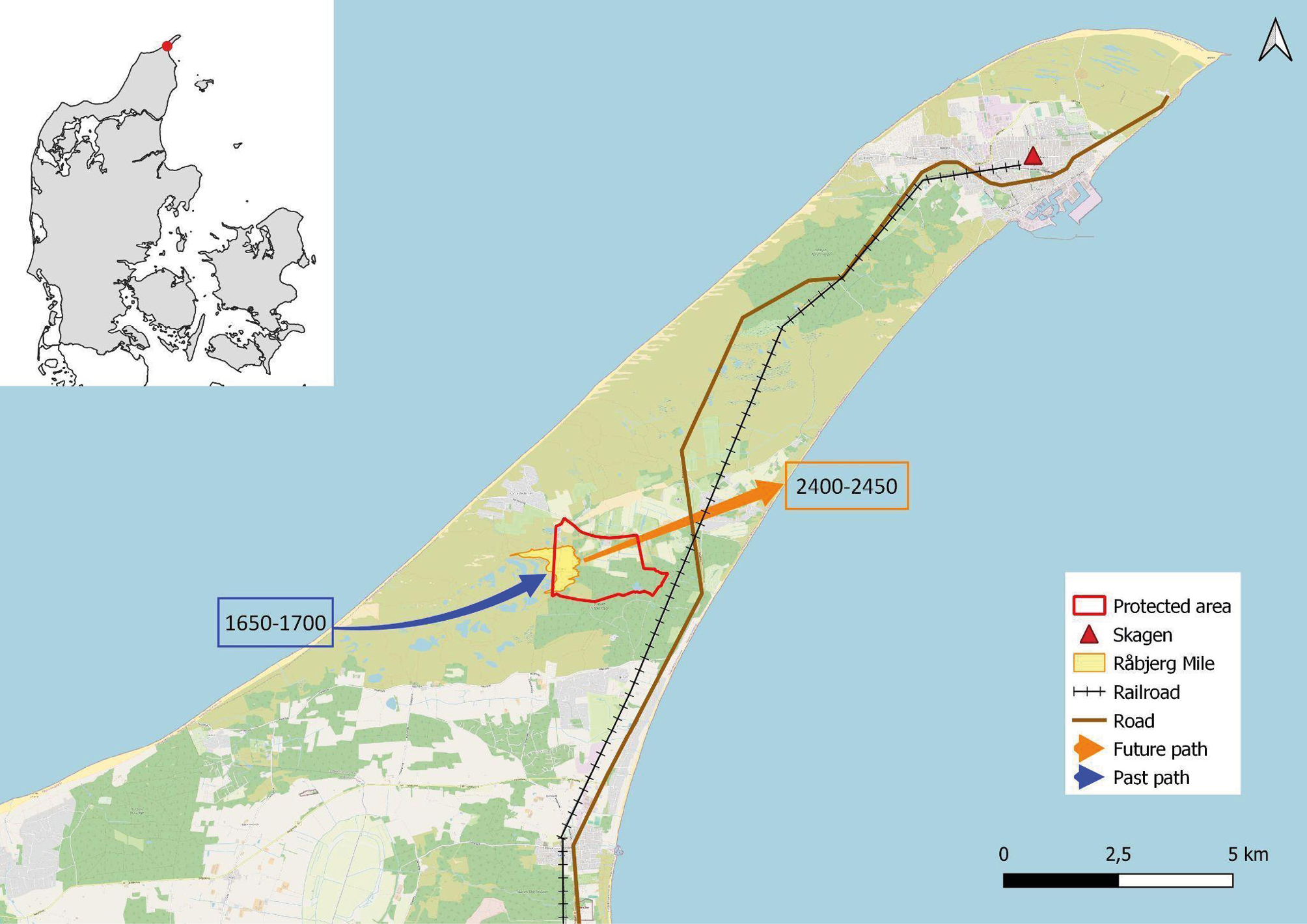
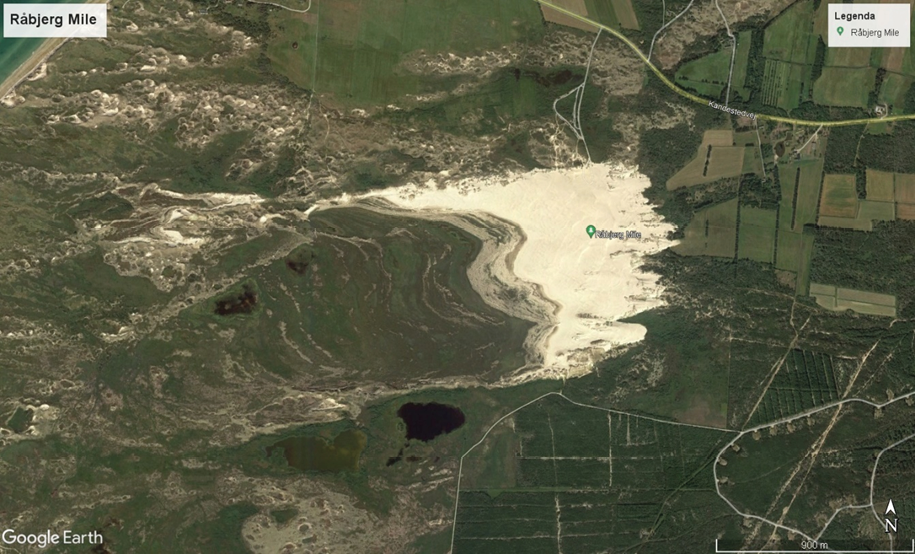
Råbjerg Mile is Denmark’s last moving dune, situated in the northern part of the Jutland peninsula in a region called North Jutland, specifically on the narrow Skagen Peninsula (Fig. 1, Fig. 2, Fig. 3). The area is part of the Frederikshavn municipality, which has a population of 58,053. The majority reside in the cities of Frederikshavn (24,938), Sæby (8,845), and Skagen (7,476)1. Skagen, located at the furthest end of the Skagen Odde peninsula (Fig. 1), from which it takes its name, is the largest settlement in the area. Apart from other small villages scattered across the peninsula, most of the land consists of sand dunes formed by debris carried by sea currents from the Skagerrak and Kattegat straits (Johannessen and Nielsen 2004).
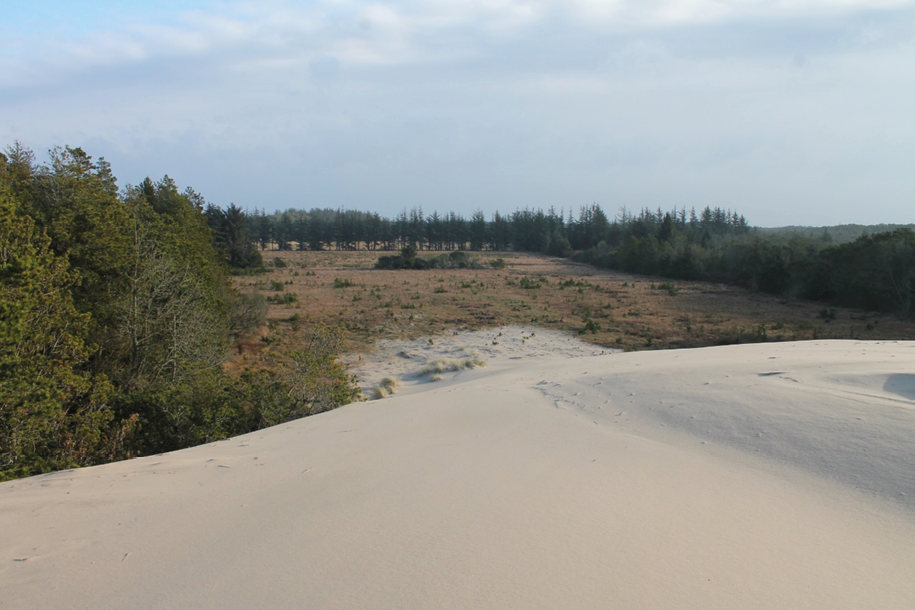
Between 1539 and 1900, efforts were made to halt the movement of dunes in the region by planting bushes capable of withstanding the strong winds and arid soil, as sand drift was causing damage throughout the territory. Today, most dunes are covered by bushes and pine trees, with strict laws protecting this cover (Jensen 2008). However, Råbjerg Mile is an exception: it is not covered by vegetation, and its wandering nature is both preserved and encouraged.
Before explaining the legal framework and objectives surrounding Råbjerg Mile, as well as its potential future, we will explore its characteristics, historical movement and how it ended up where it is now.
With approximately 4 million m3 of sand, Råbjerg Mile is among the largest dunes in Northern Europe. Its peak is approximately 40 metres above the ground, spans nearly 1 km in width and extends approximately 2 km long when including its parabolic horns. It has been migrating from WSW to ENE at an average rate of 15 metres per year between 1887 and 2014, making it one of the fastest-migrating parabolic dunes. However, the rate of its migration has not been constant. The direction of migration has not always been ENE, and the shape of the dune has changed significantly since 1887 (Anthonsen 2018).
According to the 2018 Geoviden – Geologi og Geografi report2, the exact origin of Råbjerg Mile is unknown, but it is believed to have formed on the west coast near the Skagerrak Strait. Its sand likely originates from Råbjerg Stene, located west coast of the dune. Assuming an average migration speed of 12.3 metres per year3, the dune would have formed around 1650–1700. The first detailed topographic map of the area from 1887 records its development and displacement, referring to it as “Studeli Mile” rather than Råbjerg Mile.
Since dune movement is closely tied to wind direction, historical wind data for the region from 1887 to the present have been analysed.4
Table 1 reveals a significant shift in migration direction between 1887 and 1966, moving from ESE to ENE. This change coincided with a reduction in north-west wind influence and an increase in south-western winds. After 1966, the dune’s direction stabilised, although its speed continued to fluctuate. From the report, it seems that the average speed of the dune is around 15 m/y, a speed that diminished only during the period between 1966 and 2008. From 1966 to 1977, the migration rate dropped to 10.2 m/year despite stronger winds, likely due to older dunes obstructing its path. Between 1977 and 2008, the rate slowed further to 6.7 m/year. However, after 2008, the dune accelerated to 14.9 m/year, likely due to having bypassed older dune formations.
| Time span | Moving direction | Prevalent winds | North horn speed | South horn speed | Average speed |
|---|---|---|---|---|---|
| 1887-1924 | ESE (105° - 93°) | North West - West | 13,3 m/y | 16,5 m/y | 14,9 m/y |
| 1924-1966 | ENE (77°) | West - North West | 13,3 m/y | 16,5 m/y | 14,9 m/y |
| 1966-1977 | ENE (73°) | West | 9,1 m/y | 11,2 m/y | 10,2 m/y |
| 1977-2008 | ENE (72°) | West - South West | 6,9 m/y | 6,4 m/y | 6,7 m/y |
| 2008-2014 | ENE (72°) | West - South West | 16,3 m/y | 13,5 m/y | 14,9 m/y |
Råbjerg Mile exemplifies the slow but persistent mobility of non-living natural elements. The next section explores how this mobility is influenced by human decisions, focusing on the contrast between laws protecting other dunes from drifting and, on the contrary, the unique legislation that prevents vegetation from stabilising Råbjerg Mile, allowing its movement to continue. This research draws on administration documents from the Ministry of the Environment, relevant laws, tourism promotion materials, and fieldwork-based photographic documentation5.
3.2. The General Law for Protected Areas: Contrasting Dune Mobility
Most of the dunes in the Skagen peninsula originated during the first part of the Little Ice Age, a period spanning from 1300 to 1850. During this time, local inhabitants primarily subsisted on fishing, agriculture, and livestock grazing. Grazing, often carried out directly on the dunes, destroyed much of the vegetation vital for preventing the sand from drifting (Jensen 2008). Moreover, the vegetation was also exploited for fodder, roofing, and as fuel for heating homes. The lack or discontinuity of vegetation cover over the dune area along with strong winds led to sandstorms that caused significant damage, including the displacement of entire villages and the abandonment of buildings buried under sand (Jensen 1994).
In 1539, King Christian II enacted the first law addressing sand drift. Its primary goal was to prevent the destruction of existing vegetation on the dunes by prohibiting grazing. The penalties for violating the law were so severe (including flogging and even hanging) that local residents refrained from denouncing their neighbours. Consequently, the law was systematically broken, and the situation did not change. Sand drift remained an unsolved problem for many centuries, with remnants of the destruction still visible today6.
In 1792, the first national Sand Drift Act was enacted. Unlike earlier efforts, this law mandated active measures to stabilise dunes by planting hardy vegetation capable of withstanding harsh winds and poor soil conditions. The law remained in force until 1857, when the state enacted Sand Drift Act II, which allowed the state to purchase or expropriate privately owned dune areas to facilitate stabilisation. An amendment in 1867 extended this provision to also adjacent private lands, recognising that stabilising the base and surrounding areas of dunes was critical to effectively halting drift. This gave plants a better chance of taking root in the soil, thus making it more stable. This initiative marked the beginning of systematic dune stabilisation, a practice that continues to this day (Jensen 1994).
The current legal framework governing the dunes of the Skagen peninsula – as well as Denmark’s coastal dunes7 – is outlined in LBK nr. 1392 of 2022/10/04. It is a revision of the Natural Protection Act, which was first passed in 1992 with the purpose of ‘protecting the country’s nature and environment so that social development can take place on a sustainable basis in respect for human living conditions and the preservation of animal and plant life’8. Key provisions relevant to dunes are found in §8, §8a, and §11, addressing dune protection, and §53, part of the chapter ‘Nature conservation and sand drift control’.
As noted in the previous section, bushes and trees were planted on and in the area around the dunes in the Skagen peninsula to prevent sand drift. Since 1539, the primary goal of dune management has been to protect vegetation that prevents sand drift. Under LBK nr. 1392/2022, no changes are permitted within dunes under state protection, including construction, cultivation, terrain modifications such as fencing or installing caravans9. However, §8a outlines exceptions, including measures to attenuate sand drift, as specified in §53. This article grants the Minister of Environment the authority to implement or mandate such measures on private land, including restrictions on land use to prevent sand drift.10
The Minister for the Environment’s decision on whether to implement mitigation measures is based on a balance between considerations of nature, including international nature conservation interests, the landscape and the cost of mitigation against other affected societal values. If, on this basis, the Minister decides that mitigation measures will not be carried out on a property that is significantly threatened by sand drift, the Minister may allow the owner to carry out the necessary measures at his own expense, where this can be done by the aforementioned considerations.11
This interplay of environmental, aesthetic, and societal values has driven Denmark’s approach to stabilising dunes. However, as the following section demonstrates, these same values underpin the government’s decision to allow Råbjerg Mile to remain a free-moving dune.
3.3. The Exception: The Wandering Dune, Råbjerg Mile
In Norway and Sweden, in Austria and France, in Britain as in North America – everywhere minds are moving in the same direction: to protect unspoilt nature against the efforts of culture to level everything out. Few countries in the world are in more need of such protection than Denmark. Our land is made of so soft a material that its delicate beauty can easily sustain a fatal scratch. A single workforce and an excavator can, in the space of a few weeks, transform the physiognomy of a region. Denmark only has its green slopes to offer protection against the storm and scouring rain. No defiant crags of rock, no protective mountain chains stand guarding the plains. (Aakjær 1919)
These words by Danish poet Jeppe Aakjær encapsulate the sentiment behind the opposition to dune stabilisation in the early 20th century. Aakjær feared that modern agriculture and afforestation, which in his opinion was driven not by a desire to protect the dunes but by a desire for enrichment through the sale of timber, would undermine community and respect for the greatness of nature. In his poetry, he celebrated the untamed landscapes of North Jutland, portraying nature as something that only represents itself, with mankind appearing only peripherally, as if not wanting to interfere (Nørregaard Frandsen 2016).
The document provided by the Danish Ministry of Environment (Bursk 2008) does not explain how Aakjær’s poems came to influence public opinion to such a degree that in 1901, the state decided to buy the land on which Denmark’s last and largest moving dune, Råbjerg Mile, was forming. Perhaps his poems and writings began to influence an educated, middle-class section of the population, sparking a discussion about the ‘traditional’ landscape of the peninsula.
In 1901, the Danish Government, abiding by the Sand Drift Act II, decided to purchase the land where Råbjerg Mile was moving. Unlike its efforts to halt sand drift in other areas, the government acquired this land to allow the dune’s movement to continue. This decision ensured that future generations could witness the ‘true face’ of the Skagen Peninsula. Råbjerg Mile was likely chosen because it was the largest dune in the area and its path lay across undeveloped land, free from infrastructure, buildings, and cultivated fields. This made it possible for the dune to move without engulfing major structures, affecting only vegetation. In the wake of the dune’s passage, small lakes, marshes, and the skeletal remains of trees long buried under sand have gradually emerged.12
Throughout the 20th century, Råbjerg Mile was left undisturbed, wandering approximately 1.5 km and beginning to encroach on privately owned land. Between 1901 and 2004, little information was recorded about this area, but during this time, the dune’s shape transitioned from crescentic to parabolic. This transformation is attributed to decreased wind energy and a slight rise in annual temperature and precipitation, conditions that promoted plant growth (Anthonsen et al. 1996).
A new significant conservation effort was initiated only in 2004 when the Danish Forest and Nature Agency, the Region of North Jutland, the Municipality of Frederikshavn, and the Danish Society for Nature Conservation jointly drafted a protection document. The decision was required due to the dune starting to invade the private lands in front of it. In 2008, the Nature Appeals Board officially designated the Råbjerg Mile a conservation site under Article 42 of the Nature Protection Law13. The conservation area spans 243.8 hectares, of which 115 hectares are state-owned. The remainder is divided among nine private landowners (Bursk 2008).
Importantly, Article §53 of the Nature Conservation Act, which permits landowners to undertake measures to prevent sand drift at their own expense, does not apply to Råbjerg Mile14. The Nature Appeals Board has specifically prohibited any action that would stop or alter the dune’s eastward migration. This includes preventing alterations – such as planting, building, or land modification – in the area ahead of the dune. The Board emphasised that its goal is to preserve the dune’s movement without encouraging or obstructing its natural progression (Bursk 2008).
The conservation document contains ten articles that outline permissible and prohibited activities within Råbjerg Mile’s protected area. Notably, Article 5 grants public access to the protected area. Walking is permitted on Forest and Nature Agency lands and on privately owned lands, including fenced pastures, up to 100 metres from Råbjerg Mile. This ensures that public mobility in and around the dune is allowed.
The Geoviden report (see par. 3.1) concludes with a projection of Råbjerg Mile’s future movement based on current wind patterns. If the dune continues to move ENE at a rate of approximately 15 metres per year, it is expected to pass Ålbækvej (the road linking Frederikshavn and Skagen, the only one connecting the latter to the rest of Denmark) in 230–280 years. In 350–400 years, it will reach the Kattegat, where its sands will eventually disperse into the sea, marking the end of its journey. The report reflects on the shifting perception of Råbjerg Mile and similar dune landscapes:
Our view of Råbjerg Mile and other dune areas has changed considerably over time. In N. V. Ussing’s 1899 book on the geology of Denmark, he talks about the destruction caused by the sand drift of community assets such as houses, churches and fields. Today we speak of ‘recreational value’ and value those areas where it is possible to experience the contrast with the cultural landscape and the free play of natural forces. Råbjerg Mile is an excellent example of this and was therefore already protected in 1901 […], and the day Råbjerg Mile reaches Ålbækvej, it is hoped that a bypass road will have been built so far west that the dune can continue its migration unhindered. (Anthonsen 2018, 10)
4. Discussion
The story of the Skagen Peninsula’s dunes prompts reflection on the very idea of nature conservation, revealing two different ways of preserving it. In most dune areas, conservation involves preventing sand drift, which means opposing the natural dynamics, even if it results in the preservation of the local ecosystems of today and in maintaining a stable environment – arguably a human-modified “natural” state (e.g. the vegetation on the dunes, a consequence of human actions). In this case, conservation counteracts other natural dynamics, and its object is not exactly “nature”.
Conversely, the preservation of Råbjerg Mile represents an entirely different philosophy: preserving the pristine landscape of the area, so future generations can experience living in close contact with wild nature. The dune’s mobility is protected at the expense of local land use and landscape features to offer future generations an unmediated encounter with the forces of nature to the point that infrastructures are going to be submerged, even mobility ones that connect the peninsula and its inhabitants with the rest of the country. Instead of controlling or mitigating its effects, authorities choose to embrace and adapt to the phenomenon. This strategy is feasible due to the relatively slow movement of the dune and the absence of major structures and cities in its path, allowing time for adaptation without severe, immediate consequences. Råbjerg Mile exemplifies a broader principle of learning to coexist with environmental change rather than resisting it – a paradigm increasingly relevant in addressing global changes like rising sea levels. As Rifkin (2022, 219) suggests, such strategies involve “learning to live with change and developing the capacity to deal with it instead of trying to block it”.
As in German national parks, the principle of “let nature be nature” applies at Råbjerg Mile. Conservation here does not focus on preserving specific natural elements in a fixed location but on maintaining the dynamic migration of the dune, even when it impacts other sites. The essence of the natural heritage lies in this movement, and preservation does not involve fencing the heritage site within the borders of a “nature sanctuary”. Unlike the concept of “untouchable wilderness” (Aschenbrand and Michler 2021), the protected area at Råbjerg Mile encourages public exploration. Visitors are invited to hike the dune, noting that “you can’t avoid sand in your shoes after a trip in the ‘mile’”15. Interestingly, walking on the dune contributes to its mobility, as the movement of feet causes the sand to “jump”, enhancing the dune’s dynamism. Thus, this “moving heritage” permits and even benefits from human presence.
An intriguing aspect of this case study is its future-oriented approach to conservation. The protected area encompasses the dune’s current location and the territory it is predicted to cover over the next 40 years. The primary goal is to manage the private fields currently being overtaken by sand and regulate land use in preparation for the dune’s arrival. Interestingly, the decision was made to protect only the area the dune is expected to cover in the coming decades – a predominantly agricultural area with minimal infrastructure. In contrast, larger infrastructure, including a campsite, a small village, and the road and railway connecting Skagen to the rest of the country, lies just outside this designated area.
When asked about the future of the dune, the Danish Environment Ministry office answered, “No one here can tell you what will happen regarding Råbjerg Mile in the future”16. However, discussions around this issue generally favour relocating mobility infrastructure to accommodate the dune’s movement. The decision to limit the protected area to the dune’s immediate future path has both advantages and disadvantages. On the one hand, since the dune’s movement depends on wind strength and direction, future changes in these variables could alter its course, leaving unprotected areas vulnerable. On the other hand, the existing protected zone ensures the dune’s freedom of movement for less than 40 years, especially given that over a decade has passed since the area’s designation.
Looking ahead, it would be valuable for the protected area of Råbjerg Mile to include clearer provisions regarding zones likely to be overtaken by sand in the near future as well as general guidelines for areas on the dune’s projected route. Such measures would not only clarify the government’s plans – particularly concerning the road and railway to Skagen – but also provide local residents with vital information. This could help them decide whether to build houses, invest in businesses, or purchase land in areas at risk of being engulfed by the dune and how they might navigate mobility challenges on the peninsula.
In essence, by focusing on the dune’s mobility, the heritagisation and protection efforts prioritise not what has been but what will be. This future-oriented perspective underscores the dynamic and evolving nature of Råbjerg Mile, highlighting the responsibility and planning required to ensure its preservation over the coming decade. Heritage studies often emphasise continual becoming and future orientation, and this site exemplifies both concepts.
Regarding the social nature approaches discussed earlier, elements of a technocratic mindset can be seen in how the dunes are stabilised, where nature is viewed as a threat (i.e. sand drift) to be controlled (e.g. stabilisation through the use of vegetation). In this context, vegetation is protected not to preserve the dune’s aesthetic but to maintain control over the sand drift, reflecting an “instrumental value” perspective. Conversely, the management and protection of Råbjerg Mile embody ecocentrism. Allowing a dune to roam freely despite potential damage reflects ecocentrist thinking, prioritising the dune’s “intrinsic value” and underscoring a fundamental shift in how we perceive and interact with nature.
However, this occurs not only because nature is viewed as an entity in its own right, which humans should not hinder, but also due to a desire to showcase its strength and power to future generations. From this perspective, while it may appear that nature and humans are seen as separate entities, a closer examination reveals a more interconnected relationship. Provisions encouraging the dune’s movement and protecting it from obstacles, alongside the promotion of nature tourism and public access to the area, reflect the relational value of the dune. The interplay between human mobility and nature’s mobility is evident: on one hand, tourists are encouraged to walk on and around Råbjerg Mile, fostering an intimate connection with the landscape. On the other hand, the dune’s wandering could eventually disrupt key infrastructure, potentially isolating the peninsula from the rest of the country. This inextricable connection between nature and human dynamics is best understood through the lens of social nature. The dynamic balance that is created is no longer about control but adaptability. Nature’s mobility is no longer viewed as an adversary to conquer but as a force with which to coexist.
5. Conclusion
In discussing this case study, we highlighted the contradictions between conserving wild nature, protecting a social nature, and adapting to a changing nature, all within the same small territory (if not within the same dune). It must be emphasised that the Danish government’s decision is facilitated by the unique conditions of this location. Here, the dune’s movement – so slow that its behaviour can be predicted – and the sparse population allow for a conservation approach that prioritises adaptation over control. However, this example demonstrates that adaptation is possible even when more immediate and traditional options, such as controlling nature, are available. While humans may struggle to see themselves as an integral part of nature, this case study suggests alternative ways to coexist without forcing nature to submit to human will. Adaptation enables preparation for nature’s changes without the need to restore the landscape to its “original” form, shifting the focus from preserving a static object to ensuring the continuity of its movement. In doing so, it challenges the very concept of conservation.
The case study also reveals a unique vision of a protected area – not only designed to preserve the dune’s future movement but also to facilitate human interaction with it. While the intent to let the dune wander aligns with the American concept of “wilderness” (Zanolin 2021), there is no effort to exclude humans. On the contrary, the dune has become a popular tourist attraction, attracting visitors from across Denmark to experience walking in a desert-like landscape. Thus, the landscape is not preserved as a memory of the pristine past but as a dynamic space with cultural and social value of the area. The dune’s movement enables a connection between human and natural mobility, yet it simultaneously threatens to limit the mobility of the people living in the area, requiring them to adapt to avoid isolation.
Despite these insights, several intriguing questions remain unaddressed. For example, how do the residents of Skagen, which could be cut off from the rest of the country if the dune submerges the road, perceive these changes? What about the inhabitants of the small village in dune’s path, or the private landowners whose properties are being overtaken by sand, or the tourists visiting the area? Moreover, how are the conservation measures communicated to the public? What rhetoric is used, and how is it received?
At first glance, the protection plan appears to avoid significant conflicts or opposition from stakeholders. This is likely due to the low intensity of land use in the affected areas, the relatively small size of protected zone, and the significant distance that still separates the slow-moving dune from key infrastructure. Although this process may be described as top-down, it does not seem to infringe upon the “rights to landscape” of local communities, as often occurs in other cases.
Nevertheless, the questions surrounding potential debates, differing perspectives, and the narratives employed in the communication regarding Råbjerg Miles could form the basis for future research. Analysing the case through the interpretative key of landscape studies (Castiglioni 2022) could deepen understanding of its relational and processual nature, while value-oriented approaches (Stenseke 2018) could be used to explore its exemplarity and contradictions, thanks to what Dematteis calls “fertile ambiguity of the landscape” (2010). Our case study provides a rich opportunity to test the criteria underlying conservation and adaptation decisions and to interrogate the theoretical assumptions driving debates on the social construction of nature and natural heritage conservation.
References
Aakjær, J. (1919). Naturfredning. Politiken, December 11, 1909; Samlede Værker: Artikler og Taler, 4.
Anthonsen, K. L. (2018). Where Does a Walking Dune go? Råbjerg Mile’s hike through 130 years. Geoscience – Geology and Geography, 3, 2-11. Retrieved from https://www.geoviden.dk/wp-content/uploads/2020/11/GEOVIDEN_3_2018_Online.pdf
Anthonsen, K. L., Clemmensen, L. B., Jensen, J. H. (1996). Evolution of a Dune from Crescentic to Parabolic Form in Responce to Short Term Climatic Changes. In Råbjerg Mile, Skagen Odde, Denmark. Geomorphology, 17(1-3), 63-77.
Aschenbrand, E., Michler, T. (2021). Why do UNESCO Biosphere Reserves get less Recognition than National Parks? A Landscape Research Perspective on Protected Area Narratives in Germany. Sustainability, 13(24), 13647. DOI: https://doi.org/10.3390/su132413647
Baird, M. F. (2015). Natural Heritage. Heritage Ecologies and the Rhetoric of Nature. In Heritage Keywords: Rhetoric and Redescription in Cultural Heritage. Denver, University Press of Colorado, 207-220. DOI: https://doi.org/10.5876/9781607323846.c013
Bartolini, N., DeSilvey, C. (2020). Making Space for Hybridity: Industrial Heritage Naturecultures at West Carclaze Garden Village, Cornwall. Geoforum, 113, 39-49. DOI: https://doi.org/10.1016/j.geoforum.2020.04.010
Blaikie, P. (2001). Social Nature and Environmental Policy in the South: Views from Verandah and Veld. In Castree, N., Braun, B. (Eds.). Social Nature: Theory, Practice and Politics. Oxford, Blackwell Publishers Ltd, 133-150. https://selforganizedseminar.wordpress.com/wp-content/uploads/2011/08/castree_braun_social_nature.pdf#page=147
Bursk, L. (2008). Naturklagenævnets afgørelse af 17 januar 2008 om fredning am Råbjerg Mile (NKN-111-0004, forrige j.nr. 03-111/800-0007). Naturklagenævnets, 1-22.
Castiglioni, B. (2022). Paesaggio e società. Una prospettiva geografica. Roma, Carocci Editore.
Castree, N. (2001). Socializing Nature: Theory, Practice, and Politics. In Castree, N., & Braun, B. (Eds.), Social Nature: Theory, Practice and Politics. Oxford, Blackwell Publishers Ltd, 1-21.
Chan, K. M. A., Balvanera, P., Benessaiah, K. (2016). Why Protect Nature? Rethinking Values and the Environment. Proceedings of the National Academy of Sciences, 113(6), 1462-1465. DOI: https://doi.org/10.1073/pnas.1525002113
Clemmensen, L. B., Murray, A. (2006). The Termination of the Last Major Phase of Aeolian Sand Movement, Coastal Dunefields, Denmark. Earth Surface Processes and Landforms, 31(7), 795-808. DOI: https://doi.org/10.1002/esp.1283
De Franca Doria, M., Boyd, E., Tompkins, E. L., Adger, W. N. (2009). Using Expert Elicitation to Define Successful Adaptation to Climate Change. Environmental Science & Policy, 12(7), 810-819. DOI: https://doi.org/10.1016/j.envsci.2009.04.001
Dematteis, G. (2010). Geografia dell’economia mondiale. Torino, UTET Università.
Gambino, R. (2015). Introduction: Reasoning on Parks and Landscapes. In Gambino, R., Peano, A. (Eds.). Nature Policies and Landscape Policies: Towards an Alliance. Turin, Springer, 1-21. DOI: https://doi.org/10.1007/978-3-319-05410-0
Harrison, R. (2009). Understanding the Politics of Heritage. Manchester, Manchester University Press.
Harrison, R., DeSilvey, C., Holtorf, C., Macdonald, S., Bartolini, N., Breithoff, E., Fredheim, H., Lyons, A., May, S., Morgan, J., Penrose, S. (2020). Heritage Futures: Comparative Approaches to Natural and Cultural Heritage Practices. London, UCL Press. DOI: https://doi.org/10.2307/j.ctv13xps9m
Harvey, D., Wilkinson, T. J. (2018). Landscape and Heritage: Emerging Landscapes of Heritage. In Howard, P., Thompson, I., Waterton, E., Atha, M. (Eds.). The Routledge Companion to Landscape Studies. Abingdon, Routledge, 176-191. DOI: https://doi.org/10.4324/9781315195063
Head, L. (2012). Conceptualising the Human in Cultural Landscapes and Resilience Thinking. In Plieninger, T., Bieling, C. (Eds.). Resilience and the Cultural Landscape: Understanding and Managing Change in Human-Shaped Environments. Cambridge, Cambridge University Press, 65-79. DOI: https://doi.org/10.1017/CBO9781139107778.006
Jensen, F. (1994). Dune Management in Denmark: Application of the Nature Protection Act of 1992. Journal of Coastal Research, 10(2), 263-269. http://www.jstor.org/stable/4298214
Jensen, F. (2008). Sandflugt og klitfredning – erfaringer og status. Copenhagen, Miljøministeriet.
Johannessen, P. N., Nielsen, L. H. (2004). Skagen Odde – et fuldskala, naturligt laboratorium. Geologi Nyt fra GEUS.
Lorimer, J. (2015). Wildlife in the Anthropocene: Conservation after Nature. Minneapolis, University of Minnesota Press.
Nørregaard Frandsen, J. (2016). The Jutland Heath as a Literary Place of Inheritance: Hans Christian Andersen, St. St. Blicher, Jeppe Aakjær. Scandinavica, Syddansk Universitet, 55(1), 29-33.
Pettenati, G. (2022). Landscape as Heritage: International Critical Perspectives. London, Routledge. DOI: https://doi.org/10.4324/9781003195238
Rissman, A. R. (2011). Evaluating Conservation Effectiveness and Adaptation in Dynamic Landscapes. Law and Contemporary Problems, 74(4), 145-173. http://www.jstor.org/stable/23063178
Rifkin, J. (2022). The Age of Resilience. Milan, Mondadori Libri.
Silverman, H., Waterton, E., Watson, S. (Eds., 2017). Heritage in Action: Making the Past in the Present. Cham, Springer. DOI: https://doi.org/10.1007/978-3-319-42870-3
Stenseke, M. (2018). Connecting “Relational Values” and Relational Landscape Approaches. Current Opinion in Environmental Sustainability, 35, 82-88. DOI: https://doi.org/10.1016/j.cosust.2018.10.025
Torrero, A. (2023). Teorie socio-naturali: come comportarsi nei confronti di una natura che cambia. Il caso studio delle dune mobili Råbjerg Mile. Master’s thesis, Università di Padova, Padova.
Walker, B., Salt, D. (2006). Resilience Thinking: Sustaining Ecosystems and People in a Changing World. Washington, Island Press.
Waterton, E., Watson, S. (Eds., 2015). The Palgrave Handbook of Contemporary Heritage Research. Basingstoke, Palgrave Macmillan.
Zanolin, G. (2021). La natura e l’immaginario: le aree protette come costruzioni sociali. Rivista Geografica Italiana, 128(2), 85-101. DOI: https://doi.org/10.3280/rgioa2-2021oa12034
Zimmerer, K. S. (2000). The Reworking of Conservation Geographies: Nonequilibrium Landscapes and Nature-Society Hybrids. Annals of the Association of American Geographers, 90(2), 356-369.
1 City population, Denmark: Major Urban Settlements, https://www.citypopulation.de/en/denmark/cities/
2 Produced by the National Geological Survey for Denmark and Greenland (GEUS) in cooperation with the Institute of Earth Sciences and Nature Management (IGN), the Museum of Geology (SNM), and the Institute For Geoscience (IG) (Anthonsen, 2018).
3 Average speed from 1887 to 2014; see the table below.
4 The Geoviden report shows us five stages of wind direction in five different years: 1887, 1909, 1924, 1966 and 1977. These dates were chosen because there are five different maps in the corresponding years that show the direction of the dune. Since then, the wind direction has not changed much, and so the direction of the dune has remained consistent.
5 The research was conducted within the scope of the MoHu – Centre for Advanced Studies in Mobility & Humanities (University of Padova, Italy); an earlier version of the research can be found in Torrero (2023).
6 Saint Lawrence Church (Sanct Laurentii Kirke) was almost entirely covered by sand between 1775 and 1795. For years, inhabitants of Skagen were forced to move large amounts of sand to gain access to the church. The decision was finally made in 1795 to abandon the church itself, as the dune had already covered part of the cemetery and the road leading to it. Over the years, the church was almost completely submerged, and today only the bell tower emerges from the sea of sand, a symbol of the intensity of the 18th century sand drift (Clemmensen, Murray 2006).
7 As said in the article 8 of LBK nr. 1392/2022, the following areas are dune protected: The shoreline of the Skagerrak and the North Sea, the area between the dune conservation line and the shores of the Skagerrak and the North Sea; areas protected by dunes under the previous legislation on combating sand drift; and areas that are dune protected by decision of the Minister.
8 LAW nr. 9/1992, §1 https://www.retsinformation.dk/eli/lta/1992/9
9 LBK nr. 1392/2022, §8 https://www.retsinformation.dk/eli/lta/2022/1392
10 LBK nr. 1392/2022, §53, 2 https://www.retsinformation.dk/eli/lta/2022/1392
11 LBK nr. 1392/2022, §53, 4 https://www.retsinformation.dk/eli/lta/2022/1392
12 Naturstyrelsen, Råbjerg Mile, https://naturstyrelsen.dk/find-et-naturomraade/naturguider/thy-og-vendsyssel/raabjerg-mile-og-bunken-klitplantage
13 LBK nr 85 af 04/02/2002, §42 https://www.retsinformation.dk/eli/lta/2002/85
14 LBK nr. 1392/2022, §53, 2 https://www.retsinformation.dk/eli/lta/2022/1392
15 Enjoy Nordjylland, Råbjerg Mile, https://www.enjoynordjylland.com/north-jutland/plan-your-trip/rabjerg-mile-gdk640523
16 The statement was given during a short correspondence via email between the authors and the secretary of the Danish Ministry of Environment (Miljøministeriet) in November 2022.