https://doi.org/10.36253/bsgi-7607
Mapping Differentiated European Integration: A Dynamic Proximity Approach
Mappare l’integrazione differenziata europea: un approccio basato sulla prossimità dinamica
Faculty of Social and Behavioural Sciences, University of Amsterdam, Netherlands
E-mail: e.sessa@uva.nl
Abstract. This article aims to challenge normative representations of European integration that foreground EU membership as a structuring principle. In scholarly literature, differentiation is increasingly recognized as a structural feature of the EU rooted in heterogeneous preferences and capacities between countries. Despite that, conventional maps continue to represent European integration as monolithic blocs defined by de jure ratification of treaties rather than variegated geographies driven by de facto heterogeneity of preferences and capacities. To map these variegated geographies, this article conceptualizes heterogeneity in terms of dynamic proximity and proposes an original mapping methodology based on cluster analysis. The results of the analysis show that different geographies of proximity between countries appear on the map depending on the dimension (institutional or organizational proximity) and the year (2000, 2010 or 2019) considered and that these geometries can only partially be traced back to bordering processes associated with EU membership.
Keywords: differentiated integration, heterogeneity, proximity, cluster analysis.
Riassunto. Nella letteratura accademica, la differenziazione è ormai riconosciuta come una caratteristica strutturale dell’integrazione europea, radicata nell’eterogeneità di preferenze e capacità tra i Paesi. Nonostante ciò, l’integrazione europea continua ad essere convenzionalmente rappresentata come blocchi di Paesi monolitici definiti dalla ratifica di trattati. Questo articolo propone una rappresentazione dell’integrazione europea alternativa a quella convenzionale basata sull’eterogeneità di preferenze e capacità tra Paesi, esse stesse radicate in differenze strutturali tra i loro sistemi politici ed economici. Per mappare questa eterogeneità, l’articolo concettualizza l’eterogeneità in termini di prossimità dinamica e propone una metodologia di mappatura originale basata sull’analisi dei cluster. I risultati dell’analisi mostrano che diverse geometrie di prossimità tra i Paesi emergono sulla mappa a seconda della dimensione (prossimità istituzionale o organizzativa) e dell’anno (2000, 2010 o 2019) considerato, e che queste geometrie possono essere ricondotte solo parzialmente ai processi di integrazione scaturiti dall’adesione formale all’UE.
Parole chiave: integrazione differenziata, eterogeneità, prossimità, cluster analysis.
Contents
2. Reconceptualizing Heterogeneity as Variegated Geographies of Proximity
2.1. Heterogeneity in Political Science: An Unexplored Driver of Differentiation
2.2. Reconceptualizing Heterogeneity: A Dynamic Proximity Approach
3. Mapping Dynamic Proximity: A Cluster Methodology
3.1. Identifying Proximity Dimensions
3.2. Operationalizing Proximity Dimensions
3.3. Cluster Analysis Methodology
4. The Variegated Geographies of European Integration
4.1. Institutional Proximity: Convergence in Fiscal Stability and Democratization
4.2. Organizational Proximity: Multispeed Adoption of Sustainability Standards
1. Introduction
The narrative of an “ever closer union” enshrined in the preamble of the Treaty of Rome has come under severe pressure recently. Euroscepticism gained traction and became gradually embedded in the agendas of opposition parties (Usherwood, Startin 2013), a process that culminated in the withdrawal of the United Kingdom (UK) from the European Union (EU) in 2020. The chronic instability that has afflicted the UK in the aftermath of Brexit weakened the case of exit campaigners elsewhere in the EU, but as of 2023 four member states known together as the Visegrád Group remain on a collision route with Brussels over their “illiberal turn” (Scott 2021).1 Enlargement fatigue settled in after the so-called Big Bang enlargement of 2004 (and the smaller ones in 2007 and 2013), resulting in stalled accession procedures and growing frustration among candidate member states such as Albania, Serbia and North Macedonia (O’Brennan 2014; Marusic 2022). All these events point to an on-going shift from an “ever closer union” to an “ever looser union” where countries follow variegated and open-ended integration trajectories (Schimmelfennig, Winzen 2020).
This shift is reflected in scholarly literature. Political scientists are increasingly interested in differentiated integration, i.e. the notion that countries integrate to different degrees and at different speeds (Holzinger, Schimmelfennig 2012; Leruth et al. 2019). This literature focuses on inclusion and exclusion from treaties (e.g. opt-outs of member states such as Denmark from the Eurozone or opt-ins of non-members such as EFTA countries into the EU Single Market) and transitional agreements delaying the implementation of given clauses (e.g. Romania and Bulgaria’s entry into the Schengen Area), as well as the heterogeneity of state preferences and capacities that is supposed to drive demand for such differentiation (Schimmelfennig 2014). The heterogeneity argument is appealing: different States are likely to demand different integration pathways depending on their own preferences and capacities. The main thrust of this article is to develop this argument further from a geographer’s perspective, which we incorporate in two ways. First, by complementing the absolute concept of heterogeneity (i.e. differences between countries) with the relative concept of proximity (i.e. distance between countries). Second, by broadening the focus from State preferences and capacities to country characteristics. We then illustrate the usefulness of reconceptualizing heterogeneity (of preferences and capacities) as variegated geographies of (institutional and organizational) proximity by mapping the latter using cluster analysis. Our claim is that the resulting maps provide an interesting vantage point to analyse differentiated integration complementary to conventional maps of European integration reifying EU membership as a structuring principle (see Fig. 1).
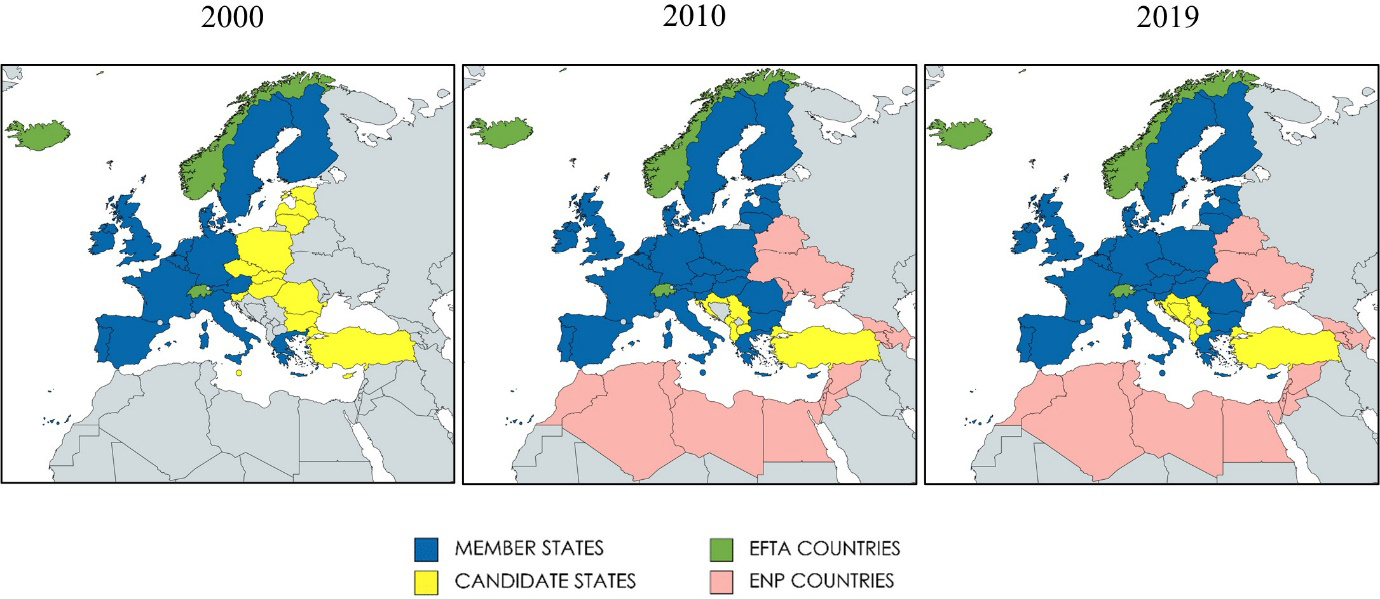
The article is organized as follows. Section 2 reviews the differentiated integration literature in political science to problematize how heterogeneity is currently conceptualized and then draws from the proximity literature in geography to reconceptualize it. Section 3 describes the methodology of the cluster analysis used for mapping Europe’s heterogeneity or, to use our jargon, Europe’s variegated geographies of proximity between countries. Section 4 presents the results of the cluster analysis, which show that depending on the dimension (organizational or institutional proximity) and the year (2000, 2010 or 2019) considered variegated geographies of proximity between countries appear on the map. Section 5 concludes with a discussion on what these variegated geographies tell us about past and future demand for differentiation in the EU.
2. Reconceptualizing Heterogeneity as Variegated Geographies of Proximity
In this section, we make the case for reconceptualizing heterogeneity. First, we review the differentiated integration literature to argue that the concept gains in importance in a structurally differentiated EU and to problematize how it is currently conceptualized (Section 2.1). Second, we develop a novel theoretical framework for heterogeneity drawing from the work of proximity scholars in geography (Section 2.2.).
2.1. Heterogeneity in Political Science: An Unexplored Driver of Differentiation
Political scientists define differentiated integration as the “institutional response to the increasing heterogeneity of member state preferences and capacities resulting from both the widening and the deepening of the EU” (Schimmelfennig 2014, 683). Two aspects are foregrounded in this definition – heterogeneity (of preferences and capacities) and differentiation (of integration pathways) – but the first aspect has been largely neglected in the literature, perhaps because until recently the ever-closer union narrative has not been seriously challenged (see reviews by Holzinger, Schimmelfennig 2012; Leruth, Lord 2015). Indeed, if all countries are bound to eventually converge into an ever-expanding homogeneous core, scrutinizing the heterogeneity of preferences and capacities that explains why countries converge at different speeds can be (and has been) considered a secondary question. But what if they are in fact not bound to converge?
The argument that all countries are bound to converge is supported by the observation that so far differentiated integration has been mainly multi-speed and inclusive, that is mostly based on transitory opt-outs from treaties finalized at facilitating the inclusion of new members in the union (Schimmelfennig, Winzen 2020). A different story emerges, however, if we shift the focus from formulation to implementation of treaties: differentiation might be more permanent than the treaties suggest (Leruth et al. 2019). Denmark negotiated quasi-permanent opt-outs from the Economic and Monetary Union (EMU) and the Common Security and Defence Policy (Dosenrode 2022), although the latter was subjected to referendum and removed after Russia’s full-scale invasion of Ukraine in 2022 (Euronews 2022). Sweden committed to adopt the euro, but remained in fact out of the EMU by means of strategic non-compliance (Hofelich 2022). Romania and Bulgaria’s accession to the Schengen Area, which was discussed again and vetoed by Austria and the Netherlands in 2022 despite all formal requirements had been arguably fulfilled (Całus, Kobeszko 2022), showed that even opt-outs formulated in unambiguously transitory terms might result into deadlocks. Based on this evidence, one can argue that we are shifting from an ever-closer union where differentiated integration is “little more than an ephemeral process of convergence on similar outcomes at different speeds” to an ever-more differentiated one where opt-outs, opt-ins and all kinds of other exemption and exclusion clauses become “a permanent, organizational principle of the Union” (Leruth et al. 2019, 5).
If countries are not bound to converge, but to follow permanently differentiated integration pathways aligned with their own preferences and capacities, then understanding heterogeneity becomes crucial. This argument is not new. Holzinger and Schimmelfennig (2014, 299) argued that “what kind of heterogeneity matters (most)” is important to substantiate a basic story about differentiated integration that “has strong initial plausibility but is indeterminate”. Surprisingly, their call was left largely unanswered since. Two issues might help explain this gap. First, the definition of heterogeneity in terms of preferences and capacities is itself rather indeterminate. Second, and relatedly, heterogeneity thus defined has proven difficult to operationalize. To our knowledge, the most elaborate attempts to refine the definition are those by Schimmelfennig and Winzen (2017) and Bellamy and Kröger (2017). Schimmelfennig and Winzen (2017) identified heterogeneity of economic conditions (proxied by wealth) and heterogeneity of national identities as the main drivers of differentiation based on a comparison between grand theories of integration. Bellamy and Kröger (2017) identified two dimensions of heterogeneity: social and economic (i.e. differences in socio-economic conditions underpinning different stakes in public goods), and cultural and political (i.e. differences in predominant cultural values and political views underpinning diversity of constitutional cultures and sovereignty discourses). In what follows, we elaborate further on these attempts from a geographer’s perspective, with a view to producing maps of political and economic heterogeneity.
Two important points can be highlighted based on the above discussion. First, there is mounting evidence that differentiation is here to stay, which in turn suggests placing more emphasis on the role that heterogeneity plays in driving demand for differentiated integration pathways. Second, heterogeneity has been defined in rather unsatisfactory terms so far, leading some authors to propose novel approaches to its conceptualization. Our argument is that as geographers we are well-placed to propose such a reconceptualization of heterogeneity, which is what we now turn to do drawing from the proximity literature.
2.2. Reconceptualizing Heterogeneity: A Dynamic Proximity Approach
Proximity scholars in economic geography are chiefly concerned with firms and innovation dynamics, but the theoretical framework they rely upon can be transposed to the study of countries and integration dynamics. In what follows, we do precisely that and argue that it allows for more refined analyses of what drives demand for differentiated integration.
Central to the work of proximity scholars is the deployment of proximity as a heuristic device: actors “construct” space as they become more proximate to one another or, vice versa, “consume” it as they become less proximate (Carrincazeaux et al. 2008). Note how this definition of proximity resonates with relative and relational conceptions of space emphasizing its variable and contested nature, rather than an absolute one positing it as a fixed container (Gilly, Torre 2000; on the tripartite conception of space see Harvey 2005). Torre (2010) identified the main building blocks of a proximity framework:
– Proximity is multi-dimensional: both geographical and non-geographical dimensions matter. Two countries can be proximate in a geographical sense (i.e. short travel time), but also in an institutional sense (i.e. compatible regulations).
– Proximity is dynamic: it increases or decreases over time. Two countries can become more proximate in a geographical or institutional sense by reducing travel times (e.g. by constructing a high-speed railway) or by harmonizing regulations. Vice versa, they become less proximate when travel times increase, and conflicting regulations are adopted.
– Proximity is a priori neutral: it can be perceived as positive or negative.
– Proximity can be active or passive. Imagine a situation where a country unilaterally adopts regulations similar to those of another country. The former will have actively contributed to an increase of institutional proximity between the two, the latter will have passively enjoyed or suffered (depending on whether proximity is perceived as positive or negative) its consequences.
In relation to this last point, a distinction is made in the literature between two proximity logics. The logic of affiliation refers to the concerted effort by two actors to become more (or less although this is more unlikely) proximate in a given dimension. The logic of similarity refers to the fact that two actors might become more or less proximate independently from one another (and potentially even against their will). In our definition of dynamic proximity, we privilege the latter logic: similarity between countries is a sufficient condition for proximity. The reason for this choice is that we are not interested in mapping differentiated integration as such, but rather the heterogeneity of country characteristics that might have driven demand for it. Our core assumption is that the greater the degree of similarity between two countries, the greater the likelihood that these countries will follow similar integration pathways, regardless of whether governments of those countries will engage in concerted efforts to chart those pathways.
What is the point of reconceptualizing heterogeneity as dynamic proximity? First, privileging the relative concept of proximity over the absolute concept of heterogeneity allows for spatiotemporal variation in similarity between countries – i.e. the ‘variegated geographies of proximity’ – to be better appreciated. Second, the open-ended and multi-dimensional nature of the proximity framework allows for groups of countries sharing similarities (and potentially receiving equal treatment in differentiation as a result) to be identified in an exploratory manner, rather than assumed a priori based on EU membership. Third, the framework can be easily operationalized by means of a system of indicators and a cluster analysis methodology, as it shall now become clear (Table 1).
| Dimensions | Definitions | Indicators |
|---|---|---|
| Institutional | Similar state capacity | Rule of law, state fragility, primary balance, government debt |
| Organizational | Similar private sector standards | Management standards, sustainability standards, trademarks, tariffs |
3. Mapping Dynamic Proximity: A Cluster Methodology
In this section, we operationalize the proximity framework introduced above, starting with the identification of relevant proximity dimensions for the study of differentiated integration (Section 3.1), then moving on to the selection of indicators for their measuring (Section 3.2) and concluding with a description of the methods used to perform cluster analysis (Section 3.3).
3.1. Identifying Proximity Dimensions
Proximity scholars have long debated which proximity dimensions to consider in their analyses. In an influential article, Boschma (2005) proposed to work with five: geographical, institutional, organizational, cognitive and social proximity (see also Balland et al. 2015). Each of these dimensions could deliver interesting insights into the variegated geographies of proximity possibly driving demand for differentiation, but for lack of space we decided to focus on two – institutional and organizational proximity – because these are the two dimensions that are most suited to map political and economic heterogeneity.
In their original definitions, institutional and organizational proximity refer respectively to the social norms and values and the specific arrangements in which relations between actors are embedded. Carrincazeaux et al. (2008, 619) distinguished between the “shared rules” and the “complementary resources” allowing for “compromises between actors with divergent and conflicting interests.” Boschma (2005) distinguished between the “rules of the game” and the “cultural habits and values” (Boschma 2005, 68) and the “organizational arrangements” allowing actors to “coordinate the exchange of complementary pieces of knowledge” (Boschma 2005, 64). These definitions were formulated with firms in mind, i.e. the unit of analysis of virtually all of the proximity literature in economic geography (see review by Torre, Gallaud 2022) and business studies (see Kostova et al. 2020). To our knowledge, this is among the first studies to apply the concepts of institutional and organizational proximity, as defined by economic geographers, to the analysis of integration dynamics between countries.
Such application presupposes a change of unit (from firms to countries) and scale (from local to national) of analysis. Definitions were adapted accordingly. For institutional proximity, we adopt a more restrictive but also more actionable focus on a government’s fiscal stance and democratic performance: countries with similar levels of state capacity are institutionally proximate. For organizational proximity, we shift the focus from specific organizational arrangements to broader processes of standardization whereby actors including but not limited to firms adopt or adapt to private sector standards: countries with similar levels of standardization are organizationally proximate.
3.2. Operationalizing Proximity Dimensions
For each dimension, we now turn to select core indicators. The data was compiled from a variety of publicly available sources (identified in brackets) into a database covering a total of 8 indicators (4 per dimension), 20 years (2000-2020) and 54 countries. Based on their relation to the EU in 2023 there were 27 member states (excluding the UK), 7 accession candidates (Albania, Moldova, Montenegro, North Macedonia, Ukraine, Serbia and Turkey) and 20 neighboring countries (ENP-East, ENP-South and EFTA countries and the UK). The period covered encompasses the EU Enlargements of 2004, 2007 and 2013, the Great Recession of 2007-2009 and the Eurozone Debt Crisis of 2009-2012. We initially considered starting in 1995, start of the Barcelona Process, but limited availability of data for the period 1995-1999 forced us to reconsider. We wanted to include 2020 and the Brexit but we eventually settle to data for 2019 because that year was marked by the extraordinary events of the Great Lockdown.
The institutional proximity indicators were selected consistently with the conditionality applied by the EU in pre- and post-accession negotiations (Schimmelfennig, Sedelmeier 2019). EU conditionality mechanisms have two main objectives: democratization (Blauberger, Van Hüllen 2020) and macroeconomic stabilization (Sacher 2019). The first two indicators – “rule of law performance” (World Bank) and “government effectiveness and legitimacy” (Center for Systemic Peace) – relate to the former and mirror the guiding principles of the EU Rule of Law Mechanism. The third and fourth indicators – “balance between government lending and borrowing before interest payment and total stock of government debt liabilities expressed as a share of GDP” (International Monetary Fund) – relate to the latter and mirror the indicators used to monitor the EU Stability and Growth Pact.
The organizational proximity indicators reflect the importance of standardization in processes of economic integration that stretch far beyond the EU Single Market. As a self-assured global standard-setter (Bjerkem, Harbour 2020), the EU contributes decisively to promoting private sector standards that are often conceived and certified by international organizations such as the International Organization for Standardization (Mattli 2001). The first two indicators – “ISO 9001 management quality certificates and ISO 14001 sustainability certificates” both expressed as number per million inhabitants – were selected consistently with the most discussed standards in the standardization literature: labor safety regulations (Knudsen 2013) and corporate social responsibility (Vigneau et al. 2015). The third and fourth indicators – “trademark applications per million inhabitants” (World Intellectual Property Organization) and “average of applied tariff rates for all products” (World Trade Organization) – were chosen on account of the crucial role that internationally recognized standards play in innovation and trade.
3.3. Cluster Analysis Methodology
The proximity framework we propose to use for the mapping of heterogeneity is easily operationalizable by means of cluster analysis, technique which consists in grouping objects, in our case countries, “based on a measure of similarity such that the similarities between objects in the same group are high while the similarities between objects in different groups are low” (Jain 2010, 652). Cluster analysis is an exploratory technique: the structure of the data is explored without pre-specified models or hypotheses. As it shall become clear, this opens up interesting avenues for the mapping of European integration, because it allows maps to be drawn without a priori assumptions (e.g. related to EU membership).
The analysis was conducted in two steps. First, principal component analysis (PCA) was performed to increase the interpretability of the dataset by reducing its dimensionality (i.e. number of indicators) without losing much of its variability (i.e. number of observations) (Joliffe, Cadima 2016). PCA scores turned out to be sufficiently robust: they explain respectively 75% and 70% of the variability found in the data used to measure institutional and organizational proximity respectively. Second, cluster analysis was performed using k-means clustering, which was preferred over hierarchical clustering because it systematically delivered a higher number of clusters allowing for a more insightful analysis. K-means is an algorithm which calculates centroids and assigns data points to the nearest centroids repeatedly until the number of clusters minimizing overall variance is discovered (Jain 2010). The variance within a cluster is a measure of how spread out the data points in that cluster are from the centroid. For cluster Ci, the variance Si is given by:
where:
– Ci is the cluster
– x is a data point in Ci
– μi is the centroid of Ci
The total variance within all clusters is:
Clusters are produced independently for institutional and organizational proximity and three reference years (2000, 2010 and 20192). They were assigned the same label in different years based on interpretation alone. When two clusters shared distinctively similar characteristics, the same label was assigned. When more than two clusters shared similar characteristics in different years, sub-labels were assigned alongside labels (marked as label/sub-label).
4. The Variegated Geographies of European Integration
In this section, the results of the cluster analysis for each dimension are presented, focusing on cluster composition and evolution. Where relevant, biases and limitations related to the choice of indicators are identified along with their implications in terms of internal and external validity.
4.1. Institutional Proximity: Convergence in Fiscal Stability and Democratization
The effects of convergence are clearly visible in how institutional proximity evolved in the last two decades (Fig. 2). In 2000, two clusters of “old” EU member states sharing similar fiscal stances can be singled out: clusters “stable/tight” and “stable/loose”. Countries in both clusters have consistently applied countercyclical fiscal policies throughout the period. What discriminates between them are deficit and debt levels. Cluster “stable/tight” includes wealthier Northern European countries (including non-EU members Norway and Switzerland) with comparatively low levels of debt. Cluster “stable/loose” includes Southern European countries (alongside Austria, France and Belgium) with comparatively high levels of debt.
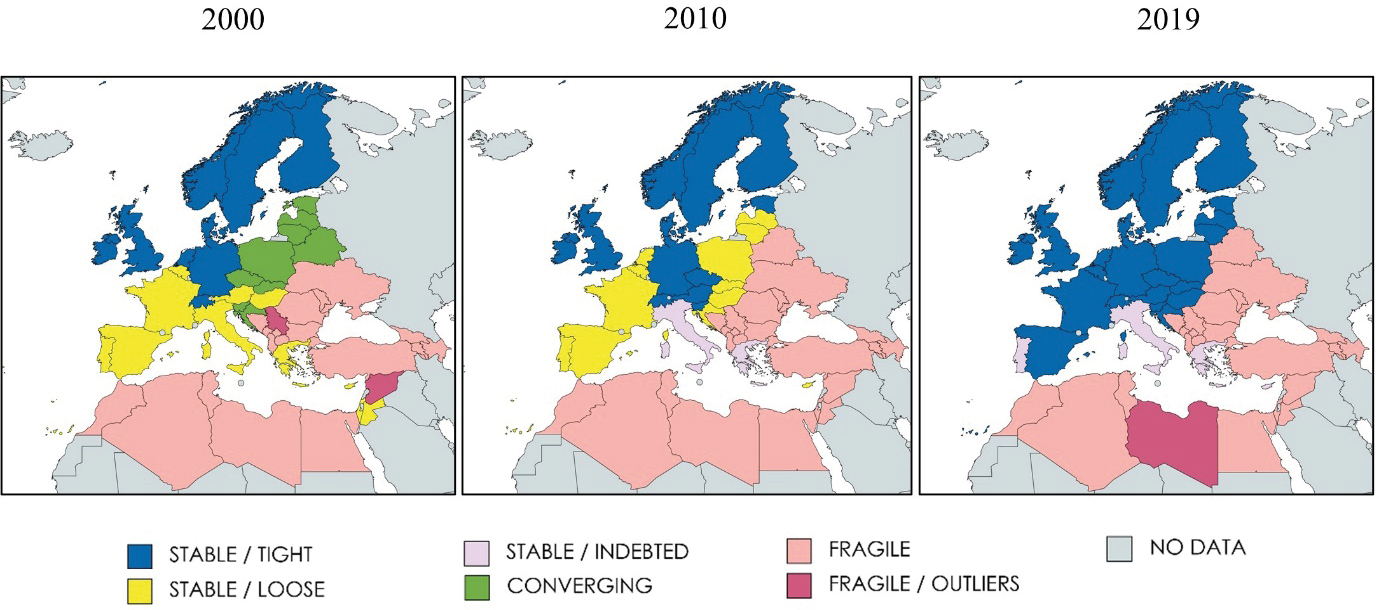
Changes in cluster composition between 2000 and 2010 reflect how the Great Recession compromised the fiscal stance of some countries belonging to the cluster “stable/loose”: debt levels in Portugal, Italy, Ireland and Greece skyrocketed. This is visible in the emergence of a separate cluster “stable/indebted” including Italy, Greece and later Portugal. Ireland never joined this cluster because the initial steep rise in debt levels was quickly reversed by means of tax breaks for multinational corporations. By 2019, all other countries had seemingly converged into the cluster “stable/tight”. This result is consistent with the spread of austerity across the EU in the aftermath of the Eurozone Debt Crisis, which some have understood as a “Northern European-inspired fiscal stability agenda [that] promotes a one-size-fits-all solution [to the crisis] that does not take into account the need for differential adjustment programs in the south of Europe” (Regan 2017, 984).
The effects of enlargement are also visible in the evolution of clusters. In all three reference years, the dividing lines between clusters mirror the external borders of the EU. In 2000, most of those countries soon to become “new” member states formed a separate cluster “converging” on account of their having a similar fiscal stance compared to “old” member states, but lower scores in rule of law and political stability. By 2010, they had already converged in the cluster “stable”, evidence of effective democratization and stabilization. Cluster “fragile” consists almost exclusively of non-member states standing out for comparatively low rule of law and high state fragility. This result is consistent with the argument that the lack of membership perspective weakens the EU’s efforts to promote democratization and stabilization. Bulgaria and Romania, two “new” member states that continue to feature comparatively low rule of law scores almost two decades after accession, are well-known exceptions (Dimitrov, Plachkova 2021).
Note that the results of the cluster analysis for 2019 are not consistent with growing evidence of democratic backsliding in Hungary and Poland. This might be related to the type of data used to measure rule of law, which is based on expert assessments that are slow to react but then suddenly change (Thomas 2010). To check this, we have rerun the analysis using data from 2020. The results reveal that depending on the clustering method used, the two countries are found to belong either to cluster “stable” or “fragile”, suggesting that backsliding was beginning to gain momentum around that time.
4.2. Organizational Proximity: Multispeed Adoption of Sustainability Standards
Two trends can be identified in the evolution of organizational proximity (Fig. 3). The first trend relates to trade liberalization. All countries in the sample have sought to increase access to the EU Single Market for their products in recent decades, resulting in an overall waiving of trade tariffs. Only a few continue to apply comparatively higher tariffs, forming a separate cluster “protectionists”. At no point in time did member states or accession candidates belong to this cluster, which is logical insofar as membership is tightly associated with a clear commitment to trade liberalization. That said, the lack of membership perspective did not preclude a certain number of neighboring countries from waiving tariffs. Armenia, Georgia, Moldova and Ukraine among ENP-South countries and Jordan and Morocco among ENP-South countries liberalized trade to such an extent as not to belong to the cluster ‘protectionists’ (the latter two initially did in 2000 and 2010 but moved to another cluster in 2019).
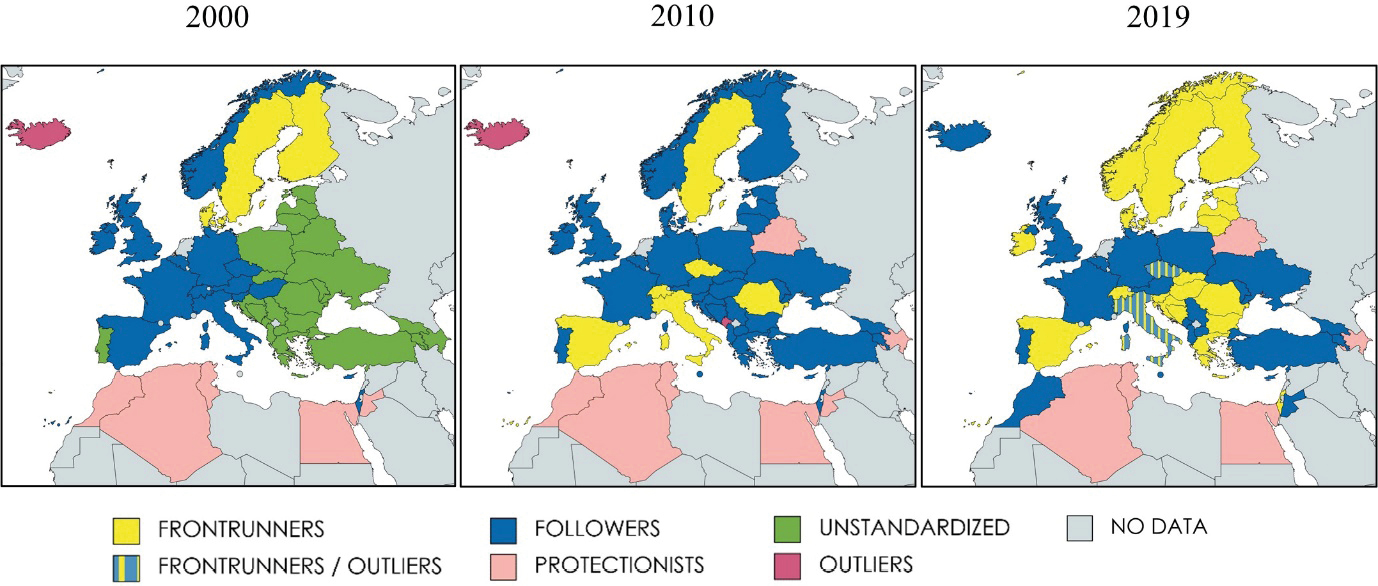
The second trend relates to sustainability standards. Three clusters can be identified based on the pace at which these were adopted: “frontrunners”, “followers” and “unstandardized”. Cluster “unstandardized” is present only in 2000, attesting how pervasive standardization has been in the last two decades (which is why the label “followers” was preferred over “laggers”). The evolution of the clusters “frontrunners” and “followers” tells a rather surprising story. Nordic countries stand out as frontrunners consistently throughout the period, suggesting they have never lost their initial edge. In 2010, they are joined by a seemingly disparate group of countries: Spain, Italy, Czechia and Romania, as well as non-EU member Switzerland. In 2019, the group of frontrunners extends to the periphery: Ireland, the Nordic, the Baltic and countries in the Balkans (writ large) stand out as frontrunners in the adoption of sustainability standards.3 Interestingly, this applies almost exclusively to “new” (2004, 2007, 2013) member states except for one candidate (Bosnia and Herzegovina). The data leaves little room for doubt: Italy and Czechia are clear outliers,4 with a much high proportion of ISO 14001 certified firms than all other countries in the sample.
This finding deserves further research, insofar as it counters core-periphery understandings of the sustainability transition suggesting that “new” member states and especially non-members are trailing behind. One possible explanation is that core member states adopted and harmonized national sustainability standards before the global ISO 14001 became the reference, but such an explanation is inconsistent with the EU’s long track record bolstering global standards in general and ISO standards in particular (Mattli 2001). What is more, it comes short of explaining the results for the Nordic countries. Another possible explanation is that firms in Southern and Central European countries and especially the Balkans see in the adoption of sustainability standards a strategy to facilitate their access into the EU Single Market and attract investments from wealthier EU member states. This explanation is consistent with the fact that many “new” member states and current accession candidates and ENP countries established themselves as attractive nearshoring destinations for Western European manufacturers, in sectors such as automotive (Pavlínek 2020) and clothing and textiles (Pickles, Smith 2011). Sustainability and management certification might as well have played a role in the consolidation of European regional production networks, but then why the same does not apply to Euro-Mediterranean regional production networks? Morocco and Tunisia lag behind in terms of sustainability certification despite having established themselves as attractive nearshoring destinations. Two elements might explain this divide between ENP-East and ENP-South countries. On the one hand, certification is a costly endeavor so differences in certification might mirror differences in wealth between the two. On the other hand, ENP-South countries suffered from greater political instability and economic insecurity over the years (Smith 2015).
4.3. Discussion
The results of the cluster analysis show that reconceptualizing heterogeneity as dynamic proximity allows for the variegated and evolving character of European integration to be unraveled: variegated geographies of proximity appear indeed on the map depending on the dimension (institutional and organizational) and the year (2000, 2010 and 2019) considered. It is worth noting that geographical proximity, not explicitly mapped and analyzed, appears to influence institutional and organizational proximity: geographically proximate countries have a higher probability to end up in the same cluster. This is not to say that geographical proximity determines the other dimensions: cluster composition and evolution cannot be understood with it alone.
A key motivation for reconceptualizing heterogeneity as dynamic proximity was to move away from a monolithic understanding of European integration reifying EU membership as a structuring principle. To what extent the dividing lines between clusters can be traced back to bordering processes defined by membership? The latter does have a decisive influence on cluster composition in the institutional proximity dimension. Convergence towards a tight fiscal stance and a strong rule of law took place to a significant extent only in members of the EU and remarkably also the EFTA, the second a finding that supports the hypothesis that permanent differentiation might deliver similar outcomes than full integration (Leruth et al. 2019). In 2019, the clusters retrace EU and EFTA borders almost spotlessly, with only two exceptions: Bulgaria and Romania, which joined the EU more than 15 years ago. These are, however, notable exceptions that underscore the importance of adopting an open-ended approach to the issue of membership, rather than assuming it has a decisive role beforehand. Multi-speed models of differentiated integration imply a normative expectation that Bulgaria and Romania have not yet converged toward a tight fiscal stance and a strong rule of law, but inevitably will. The analysis conducted here leaves the question open as to whether they have not yet converged or are following a different path.
EU membership also plays a role in influencing the evolution of organizational proximity, as made evident by the fact that only “new” EU member states in Central and South-Eastern Europe stand out as frontrunners in sustainability certification (with the exceptions of Poland which is not a frontrunner and Bosnia and Herzegovina which is not a member state). This result points to the important role that the EU plays in bolstering the adoption of global standards, enforcing trademarks and reducing trade tariffs, which should not however be overestimated. The variegated geographies of organizational proximity that emerged from the analysis can be better understood by considering firm-led dynamics of delocalization and regionalization of production. Previous research on the topic of standardization highlighted the primary role that firms and particularly trans-national corporations play in spreading standards such as the ISO 9000 (Neumayer, Perkins 2005) or the ISO 14001 (Perkins, Neumayer 2010). In fact, compliance with standards is largely considered to a be an unavoidable stepping stone for firms willing to participate in globalized production networks (Nadvi 2008). The variegated geographies of standardization that appeared on the map might thus reflect different degrees of inclusion in regionalized production networks.
5. Conclusion
This article proposed a novel approach to mapping European integration focused on the political and economic heterogeneity that underpins differentiated integration pathways in an “ever looser” rather than “ever closer” EU. We argued that such a novel approach is needed because of two reasons. First, because considering differentiation not an epiphenomenal, but rather a structural and permanent feature of the EU implies paying greater attention to the heterogeneity that drives demand for it. Second, because the current conceptualization of heterogeneity as state preferences and capacities is rather unsatisfactory seen from a geographer’s perspective, because of the absolute as opposed to relative and dynamic spatial framework it presupposes. By reconceptualizing (political and economic) heterogeneity as variegated geographies of (institutional and organizational) proximity and by operationalizing these by means of cluster analysis, we opened up the possibility to identify groups of countries sharing similarities (and thus likely to demand similar integration pathways) in an exploratory manner, instead of assuming them a priori based on EU membership. Admittedly, the clusters are identified in an exploratory manner, but the indicators used in the cluster analysis are selected “arbitrarily”. This is a limitation to take into consideration when interpreting the maps, insofar as substantially different geometries of proximity would most likely appear on the map should different indicators be used to analyze the same dimension. This versatility is also an asset though: other researchers might find it interesting to represent cartographically their own analyses of heterogeneity, factoring the indicators they use in the dynamic proximity framework we propose.
What is the added value of the maps of European integration we produced (Fig. 2 and 3) compared to conventional maps focused on EU membership as a structuring principle (Fig. 1)? Our maps are “messier”, more difficult to grasp at a glance and therefore less suitable as alternative representations of European integration. They are, however, powerful tools to generate research questions about heterogeneity and therefore to orientate further geographical research on differentiated integration, not only because of their multi-dimensional and dynamic nature, but also because boundaries are drawn in an exploratory manner rather than assumed à priori. Regarding institutional proximity (or political heterogeneity), our maps highlight how Portugal, Italy and Greece in Southern Europe (because of debt levels) and Romania and Bulgaria in Eastern Europe (because of state fragility) might require and possibly have followed differentiated integration pathways that are not leading to convergence toward a Northern European-inspired tight fiscal stance. Further research could aim to elucidate this argument further by exploring how the variegated geographies of institutional proximity that emerged from the cluster analysis relate to varieties of capitalism in the EU. Regarding organizational proximity (or economic heterogeneity), our maps brought to light a surprising geography of standardization whereby those countries that are usually considered to belong to the periphery of the EU stand out as frontrunners in the adoption of sustainability standards, a finding that can be made sense of only by considering the important interplay between firm-led dynamics of European production delocalization and regionalization and state-led dynamics of European integration. How do economic dynamics of inclusion and exclusion from production networks relate to political demands for differentiated integration? This is an exciting avenue for further research that exploring alternative ways to conceptualize and operationalize heterogeneity opened for differentiated integration research.
Acknowledgments
This research would not have been possible without the methodological expertise of Giulio Barcaroli. I also thank Virginie Mamadouh, Niels Beerepoot, and two anonymous reviewers for providing useful comments to earlier versions of the manuscript. All remaining shortcomings are my own.
References
Balland, P.A., Boschma, R., Frenken, K. (2015). Proximity and Innovation: From Statics to Dynamics. Regional Studies, 49(6), 907-920. DOI: https://doi.org/10.1080/00343404.2014.883598
Bellamy, R., Kröger, S. (2017). A Demoicratic Justification of Differentiated Integration in a Heterogeneous EU. Journal of European Integration, 39(5), 625-639. DOI: https://doi.org/10.1080/07036337.2017.1332058
Bjerkem, J., Harbour, M. (2020). Europe as a Global Standard-Setter: The Strategic Importance of European Standardisation. Brussels, European Policy Centre. https://www.epc.eu/publication/The-strategic-importance-of-Europe-37f244/
Blauberger, M., Van Hüllen, V. (2020). Conditionality of EU Funds: An Instrument to Enforce EU Fundamental Values? Journal of European Integration, 43(1), 1-16. DOI: https://doi.org/10.1080/07036337.2019.1708337
Boschma, R. (2005). Proximity and Innovation: A Critical Assessment. Regional Studies, 39(1), 61-74. DOI: https://doi.org/10.1080/0034340052000320887
Całus, K., Kobeszko, L. (2022, December 16). Austria vetoes Romania and Bulgaria entering Schengen. Centre for Eastern Studies (OSW) https://www.osw.waw.pl/en/publikacje/analyses/2022-12-16/austria-vetoes-romania-and-bulgaria-entering-schengen.
Carrincazeaux, C., Lung, Y., Vicente, J. (2008). The Scientific Trajectory of the French School of Proximity: Interaction and Institution-based Approaches to Regional Innovation Systems. European Planning Studies, 16(5), 617-628. DOI: https://doi.org/10.1080/09654310802049117
Dimitrov, G., Plachkova, A. (2021). Bulgaria and Romania, Twin Cinderellas in the European Union: How They Contributed in a Peculiar Way to the Change in EU Policy for the Promotion of Democracy and Rule of Law. European Politics and Society, 22(2), 167-184. DOI: https://doi.org/10.1080/23745118.2020.1729946
Dosenrode, S. (2022). The Danish Defence Opt-out and the Non-Europeanisation of Danish Defence. In Fischer, K., Mouritzen, H. (Eds.). Danish Foreign Policy Review. Copenhagen, Dansk Institut for Internationale Studier, 107-137. https://vbn.aau.dk/en/publications/the-danish-defence-opt-out-and-the-non-europeanization-of-the-dan
Euronews (2022, June 1st, 2022). Denmark Votes to Join EU Common Defence Policy. https://www.euronews.com/2022/06/01/initial-results-show-danes-vote-to-join-eu-defence-policy
Gilly, J.-P., Torre, A. (Eds.) (2000). Dynamiques de Proximité. Paris, L’Harmattan.
Harvey, D. (2005). Spaces of Neoliberalization: Towards a Theory of Uneven Geographical Development. Stuttgart, Franz Steiner Verlag.
Higgins, A. (2023, October). With Opposition Gains, Poland Looks to Unwind an ‘Illiberal Democracy’. New York Times. https://www.nytimes.com/2023/10/16/world/europe/poland-vote.html
Hofelich, T. (2022). De Facto Differentiation in the European Union: Circumventing Rules, Law and Rule of Law. In Leruth, B., Gänzle, S., Trondal, J. (Eds.). The Routledge Handbook of Differentiation in the European Union. London, Routledge, 66-80. DOI: https://doi.org/10.4324/9780429054136
Holzinger, K., Schimmelfennig, F. (2012). Differentiated Integration in the European Union: Many Concepts, Sparse Theory, Few Data. Journal of European Public Policy, 19(2), 292-305. DOI: https://doi.org/10.1080/13501763.2012.641747
Jain, A. (2010). Data Clustering: 50 Years beyond K-Means. Pattern Recognition Letters, 31, 651-666. DOI: https://doi.org/10.1016/j.patrec.2009.09.011
Joliffe, I.T., Cadima, J. (2016). Principal Component Analysis: A Review and Recent Developments. Philosophical Transactions of the Royal Society A, 374, 1-16. DOI: https://doi.org/10.1098/rsta.2015.0202
Knudsen, J.S. (2013). The Growth of Private Regulation of Labor Standards in Global Supply Chains: Mission Impossible for Western Small- and Medium-Sized Firms? Journal of Business Ethics, 117, 387-398. DOI: https://doi.org/10.1007/s10551-012-1527-8
Kostova, T., Beugelsdijk, S., Scott, R., Kunst, V., Chua, C., Van Essen, M. (2020). The Construct of Institutional Distance through the lens of Different Institutional Perspectives: Review, Analysis, and Recommendations. Journal of International Business Studies, 51, 467-497. DOI: https://doi.org/10.1057/s41267-019-00294-w
Leruth, B., Gänzle, S., Trondal, J. (2019). Differentiated Integration and Disintegration in the EU after Brexit: Risks versus Opportunities. Journal of Common Market Studies, 57(6), 1383-1394. DOI: https://doi.org/10.1111/jcms.12957
Leruth, B., Lord, C. (2015). Differentiated Integration in the European Union: a Concept, a Process, a System or a Theory? Journal of European Public Policy, 22(6), 754-763. DOI: https://doi.org/10.4324/9781315671345
Marusic, S.-J. (2022, June). Western Balkans Leaders Voice Frustration over EU Summit Failure. Balkan Insight. https://balkaninsight.com/2022/06/23/western-balkans-leaders-voice-frustration-over-eu-summit-failure/
Mattli, W. (2001). The Politics and Economics of International Institutional Standards Setting: An Introduction. Journal of European Public Policy, 8(3), 328-344. DOI: https://doi.org/10.1080/13501760110056004
Nadvi, K. (2008). Global Standards, Global Governance and the Organization of Global Value Chains. Journal of Economic Geography, 8, 323-343. DOI: https://doi.org/10.1093/jeg/lbn003
Neumayer, E., Perkins, R. (2005). Uneven Geographies of Organizational Practice: Explaining the Cross-National Transfer and Diffusion of ISO 9000. Economic Geography, 81(3), 237-259. DOI: https://doi.org/10.1111/j.1944-8287.2005.tb00269.x
O’Brennan, J. (2014). “On the Slow Train to Nowhere?” The European Union, “Enlargement Fatigue” and the Western Balkans. European Foreign Affairs Review, 19(2), 221-242. DOI: https://doi.org/ 10.54648/eerr2014011
Pavlínek, P. (2020). Restructuring and Internationalization of the European Automotive Industry. Journal of Economic Geography, 20(2), 509-541. DOI: https://doi.org/10.1093/jeg/lby070
Perkins, R., Neumayer, E. (2010). Geographic Variations in the Early Diffusion of Corporate Voluntary Standards: Comparing ISO 14001 and the Global Compact. Environment and Planning A, 42, 347-365. DOI: https://doi.org/10.1068/a4249
Pickles, J., Smith, A. (2011). Delocalization and Persistence in the European Clothing Industry: The Reconfiguration of Trade and Production Networks. Regional Studies, 45(2), 167-185. DOI: https://doi.org/10.1080/00343401003601933
Regan, A. (2017). The Imbalance of Capitalisms in the Eurozone: Can the North and South of Europe Converge? Comparative European Politics, 15, 969-990. DOI: https://doi.org/10.1057/cep.2015.5
Sacher, M. (2019). Macroeconomic Conditionalities: Using the Controversial Link between EU Cohesion Policy and Economic Governance. Journal of Contemporary European Research, 15(2), 179-193. DOI: https://doi.org/10.30950/jcer.v15i2.1005
Schimmelfennig, F. (2014). EU Enlargement and Differentiated Integration: Discrimination or Equal Treatment? Journal of European Public Policy, 21(5), 681-689. DOI: https://doi.org/10.1080/13501763.2014.897744
Schimmelfennig, F., Sedelmeier, U. (2019). The Europeanization of Eastern Europe: the External Incentives Model Revisited. Journal of European Public Policy, 27(6), 814-833. DOI: https://doi.org/10.1080/13501763.2019.1617333
Schimmelfennig, F., Winzen, T. (2017). Eastern Enlargement and Differentiated Integration: Towards Normalization. Journal of European Public Policy, 24(2), 239-258. DOI: https://doi.org/10.1080/13501763.2016.1264083
Schimmelfennig, F., Winzen, T. (2020). Ever Looser Union? Differentiated European Integration. Oxford, Oxford University Press.
Scott, J.W. (2021). Visegrád Four Political Regionalism as a Critical Reflection of Europeanization: Deciphering the “Illiberal Turn”. Eurasian Geography and Economics, 63(6), 704-725. DOI: https://doi.org/10.1080/15387216.2021.1972023
Smith, A. (2015). Economic (In)security and Global Value Chains: The Dynamics of Industrial and Trade Integration in the Euro-Mediterranean Macro-Region. Cambridge Journal of Regions, Economy and Society, 8(3), 439-458. DOI: https://doi.org/10.1093/cjres/rsv010
Thomas, M.A. (2010). What do the Worldwide Governance Indicators Measure? The European Journal of Development Research, 22, 31-54. DOI: https://doi.org/10.1057/ejdr.2009.32
Torre, A. (2010). Jalons pour une analyse dynamique des proximités. Revue d’Économie Régionale & Urbaine, 3, 409-437. DOI: https://doi.org/10.3917/reru.103.0409
Torre, A., Gallaud, D. (Eds.). (2022). Handbook of Proximity Relations. Cheltenham, Edward Elgar.
Usherwood, S., Startin, N. (2013). Euroscepticism as a Persistent Phenomenon. Journal of Common Market Studies, 51(1), 1-16. DOI: https://doi.org/10.1111/j.1468-5965.2012.02297.x
Vigneau, L., Humphreys, M., Moon, J. (2015). How Do Firms Comply with International Sustainability Standards? Processes and Consequences of Adopting the Global Reporting Initiative. Journal of Business Ethics, 131, 469-486. DOI: https://doi.org/10.1007/s10551-014-2278-5
1 At the time of writing, it remained unclear whether the outcome of the parliamentary elections held in Poland on 15 October 2023, namely opposition parties winning enough seats to form a majority, would result, as expected, into a change of course in relations with the EU (see Higgins, 2023).
2 2019 was preferred over 2020 to prevent the impact of Covid-19 lockdowns from biasing the results.
3 ISO 9001 management standards have been adopted much more homogeneously than ISO 14001 sustainability standards, which is why the focus here is solely on the latter.
4 Iceland and Montenegro are also outliers but in terms of trademark applications, not sustainability certification. Montenegro does stand out for an impressive twelvefold increase in sustainability certification from 27 to 332 certificates per million inhabitants in just three years between 2017 and 2020.